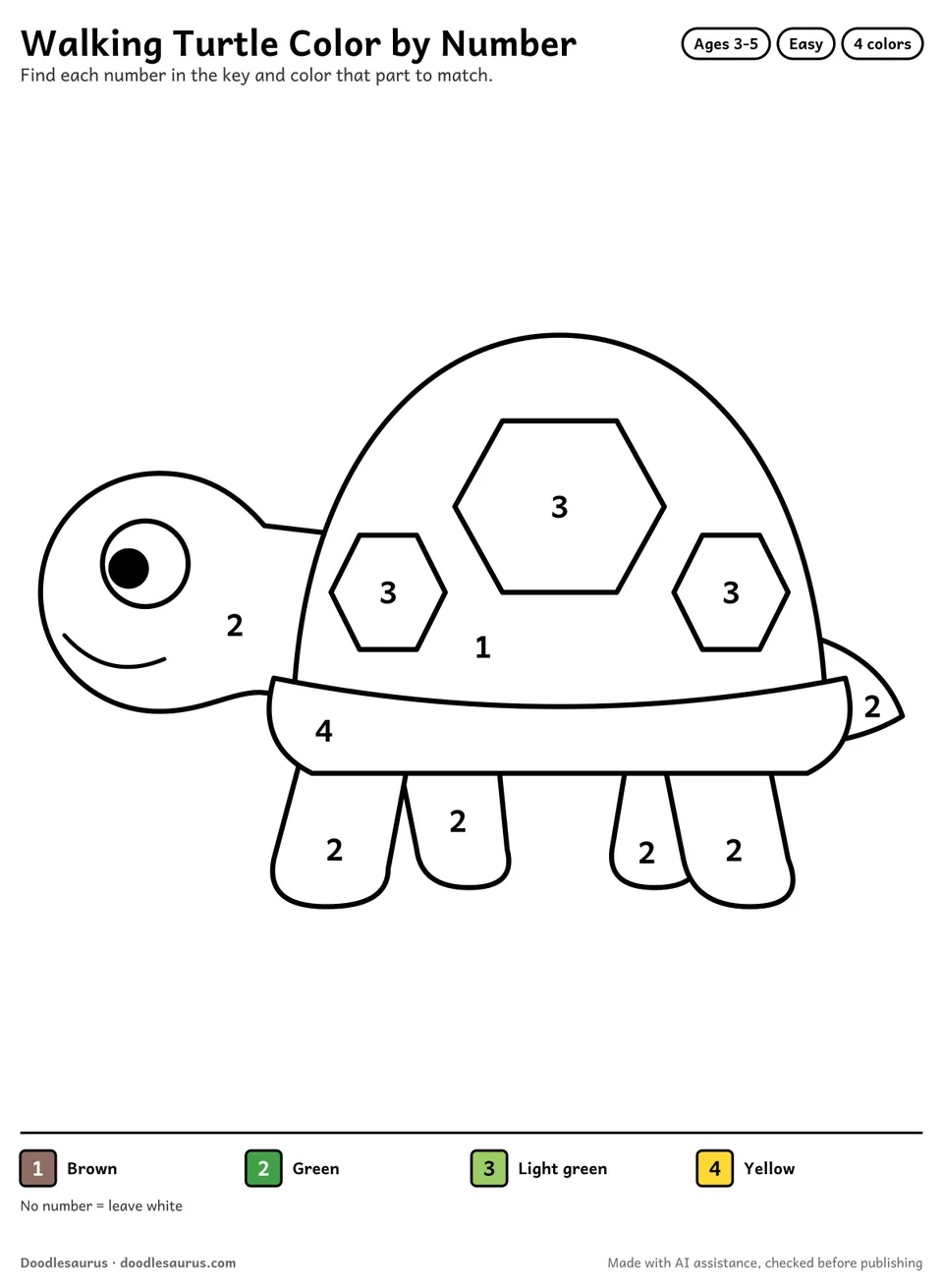
A young child can tell this turtle’s two greens apart by where they go as well as by shade. Green, number 2, covers the round head, all four short legs and the pointed tail, while light green, number 3, is only for the three hexagon plates on the shell. Keep the two crayons apart.
Shell and rim
Brown, number 1, fills the tall dome shell around the plates. It is the biggest space on the page, and going slowly around the hexagons keeps their edges clean. Yellow, number 4, colors the wide rim that runs along the bottom of the shell. Eleven parts carry a number in all. The big eye has none, so it stays white.
A four-color turtle
The turtle walks in profile and needs just four colors, which an easy sheet already fits, so it comes as one sheet for ages 3 to 5. Turning off fit to page and printing the A4 or Letter file at 100 percent keeps the numbers in the smaller parts easy to read. Page two of the PDF is a colored answer key.
Skills practiced & tips
Read the key aloud first and lay the matching crayons out in number order.
Fill all parts with the same number before moving on to the next one.
Color the large shell around the plates carefully so the hexagons stay clean.
Set the green and light green crayons apart so they do not get mixed up.
Leave the eye white; it carries no number.
Turtle fun facts
Turtles have no teeth; they bite with a hard, sharp-edged beak.
The plates on a turtle's shell are called scutes, and they are made of keratin, the same material as human fingernails.
Many turtles bask in the sun on logs or rocks to warm up their bodies.
Classroom ideas
Preschool (ages 3 to 5): match the numbers 1 to 4 with brown, green, light green and yellow crayons and count how many parts belong to each.
Kindergarten: read the color names in the key as a sight-word warm-up before coloring.
Grade 1: talk about why a brown shell with light green plates looks like a real turtle, then compare it with a photo.
What is the yellow strip along the bottom of the shell?
That is the wide rim, number 4. Brown, number 1, fills the dome above it, green, number 2, is the head, legs and tail, and light green, number 3, is the three plates, so the turtle uses four colors.
Would a medium turtle sheet look any different?
No. The turtle drawing has just four colors, and an easy sheet already fits all of them, so a medium sheet would only repeat it. The turtle comes as one easy sheet for ages 3 to 5.
Is the sheet too simple for older children?
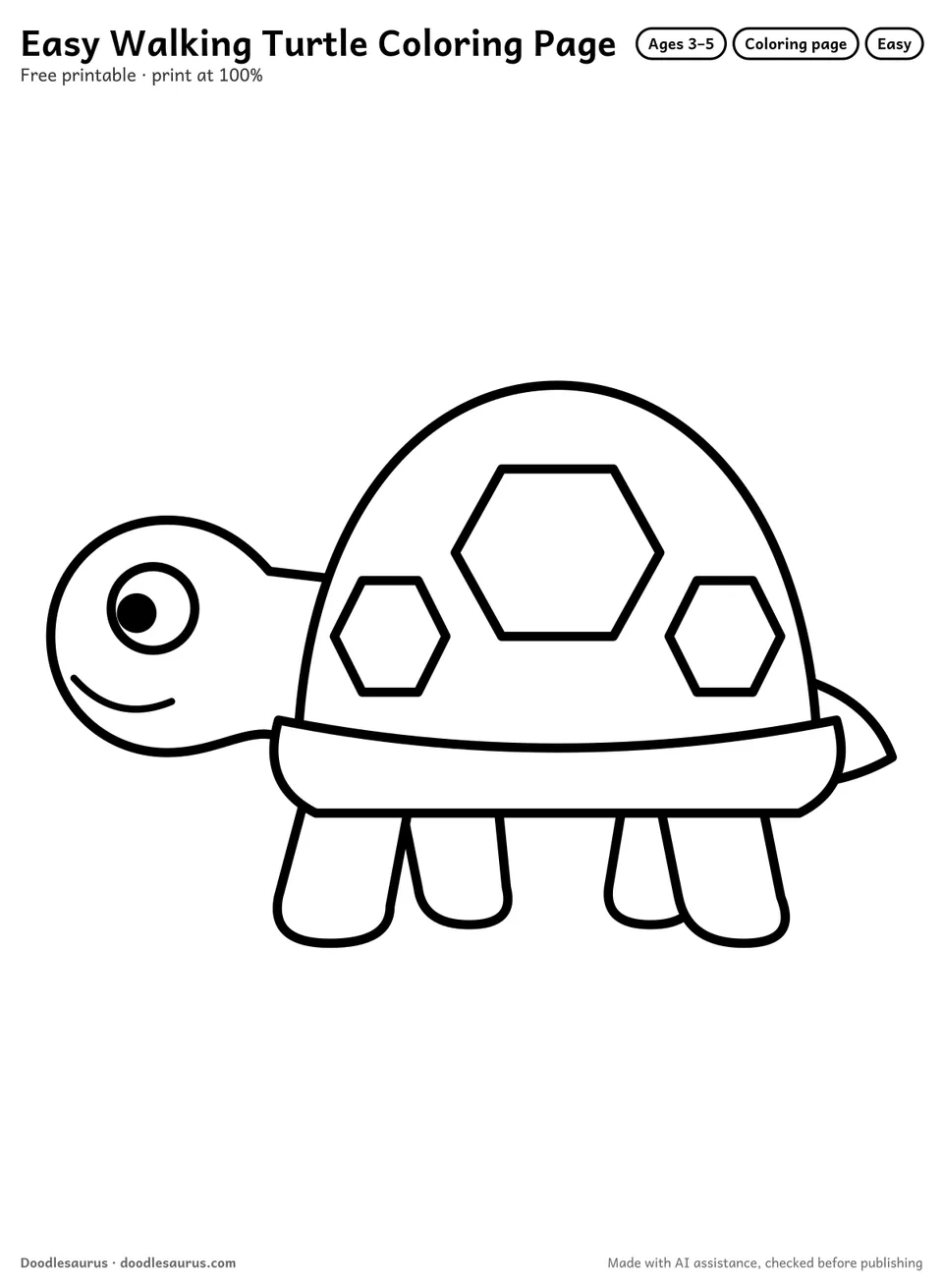
Older children can still enjoy it, and telling green from light green is a nice small challenge. For a longer project, the walking turtle coloring page leaves every color choice to them.
Which parts are green and which are light green?
Green, number 2, is the head, the four legs and the tail. Light green, number 3, is only the three hexagon plates on the shell.
Is the answer key part of the PDF or a separate file?
Both. It is the second page of the PDF, in both A4 and US Letter, and shows the turtle fully colored with the numbers still visible. You can also download it as a separate file.
About this printable
Made with AI assistance (vector drawing authored by a language model) and checked by automated tests and an AI reviewer.
Checked by automated tests and an AI reviewer on 22 Oct 2026.