
Frog Tracing Worksheets with a Lily Pad
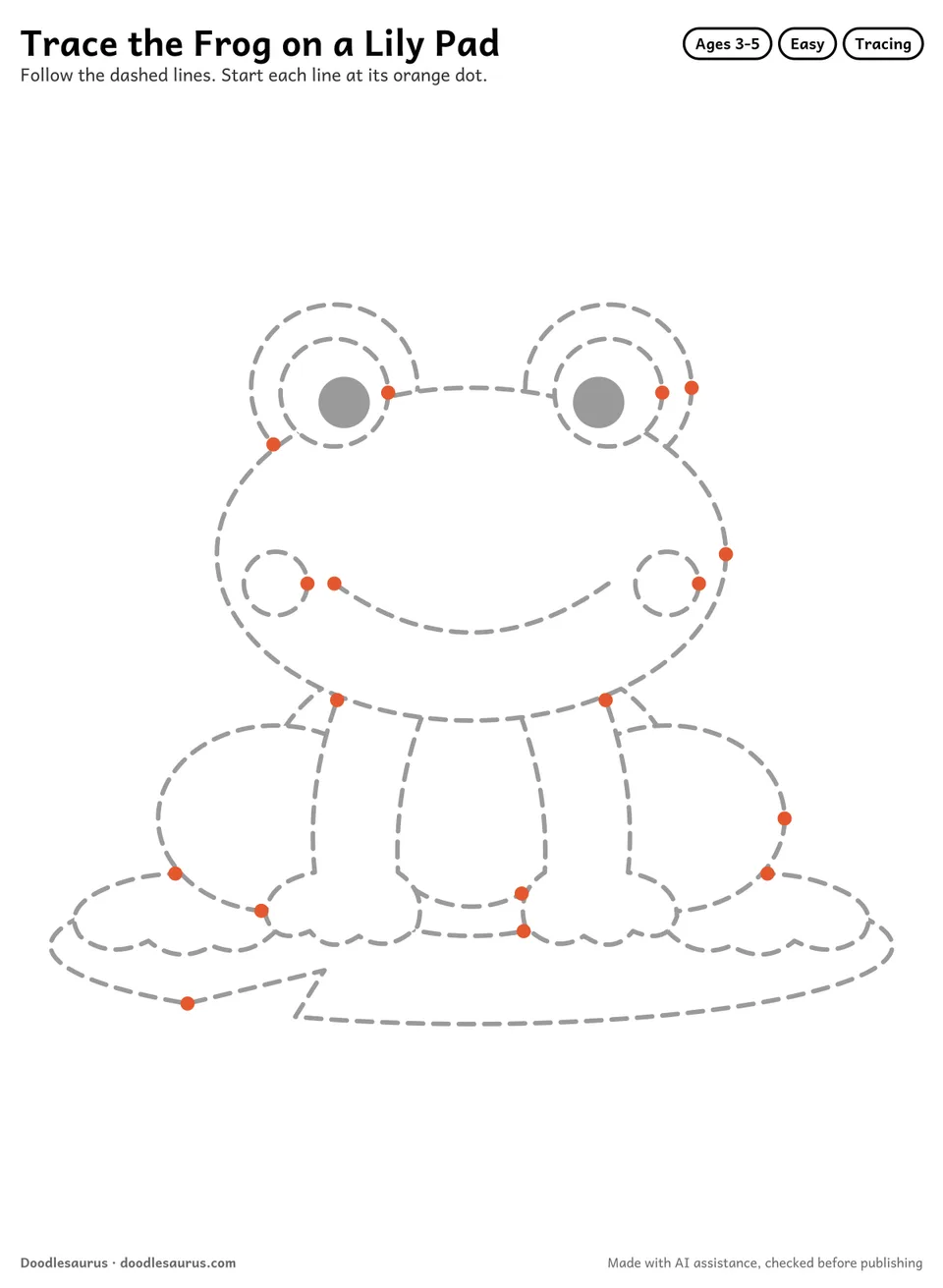
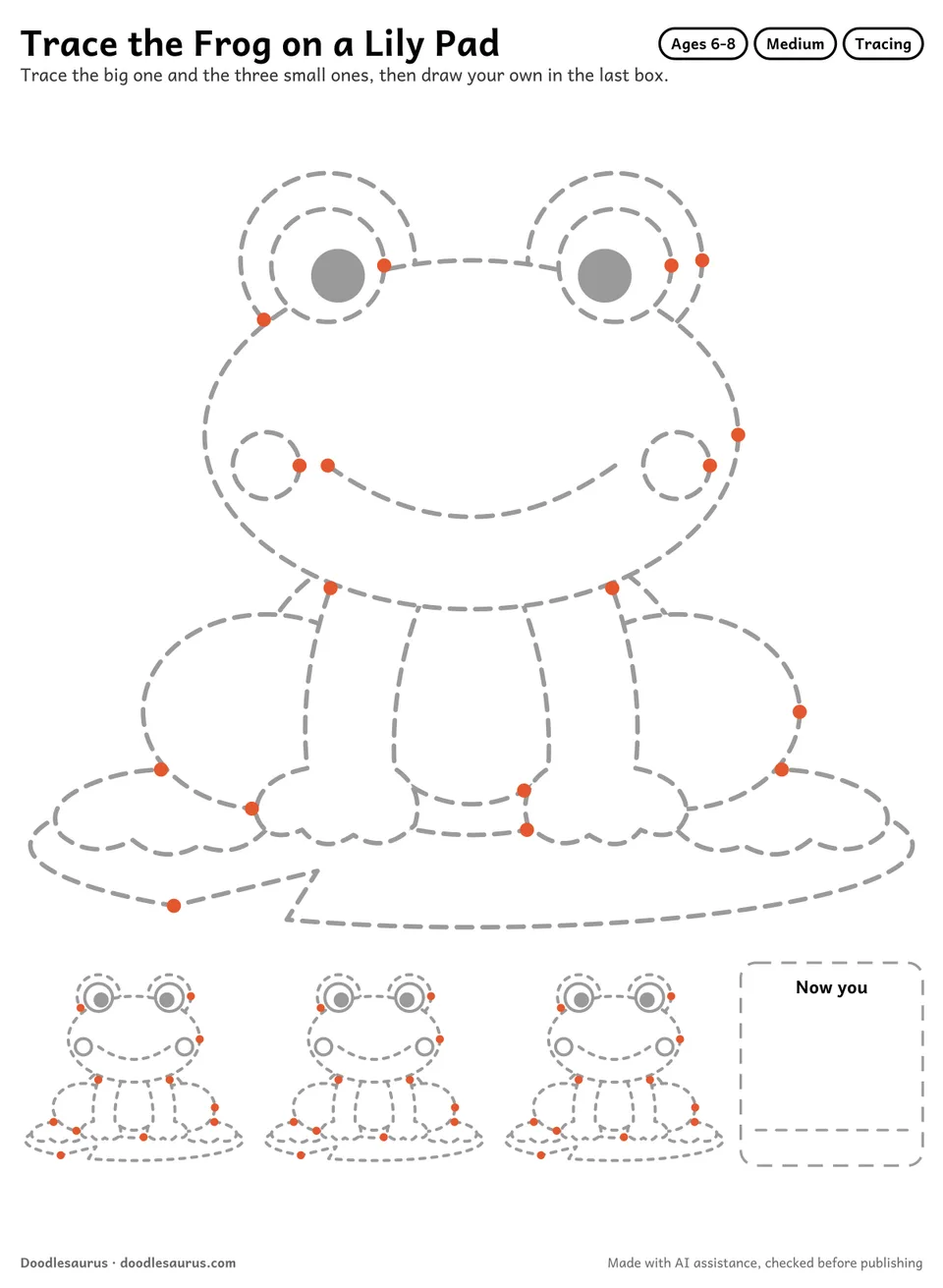
Frog tracing worksheets with a frog on a lily pad: 17 start dots on the big frog for ages 3 to 5, and 11 on each of three small frogs for 6 to 8.
Choose a level
Frog on a Lily Pad Tracing Worksheet
Double circles for the eyes sit high on this frog’s head, and as short, closed loops they are a gentle place to start. On the big frog each stroke begins at a small orange dot. The two pupils are filled in gray with no dot, so the face is easy to spot before the first line is traced.
Easy: one large frog
One frog fills most of the easy sheet, made for ages 3 to 5. It mixes closed shapes with open lines: two small cheek circles, a long smile, the wide oval of the head, two fairly straight front legs and the curved back thighs. The feet and the edge of the lily pad are wavy. They are a chance to practice small bumps once the big curves feel easy.
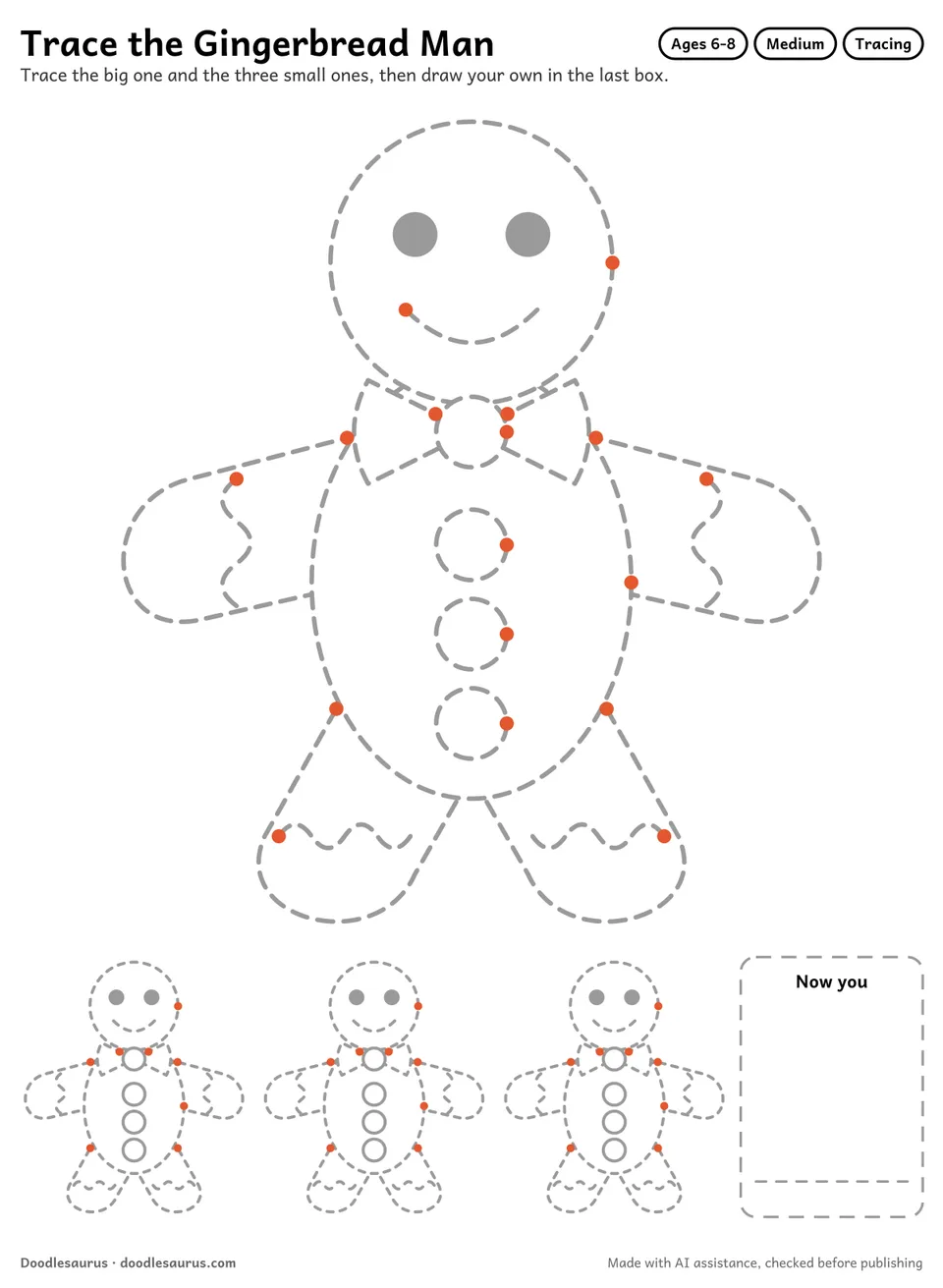
Medium: three small frogs and a Now you box
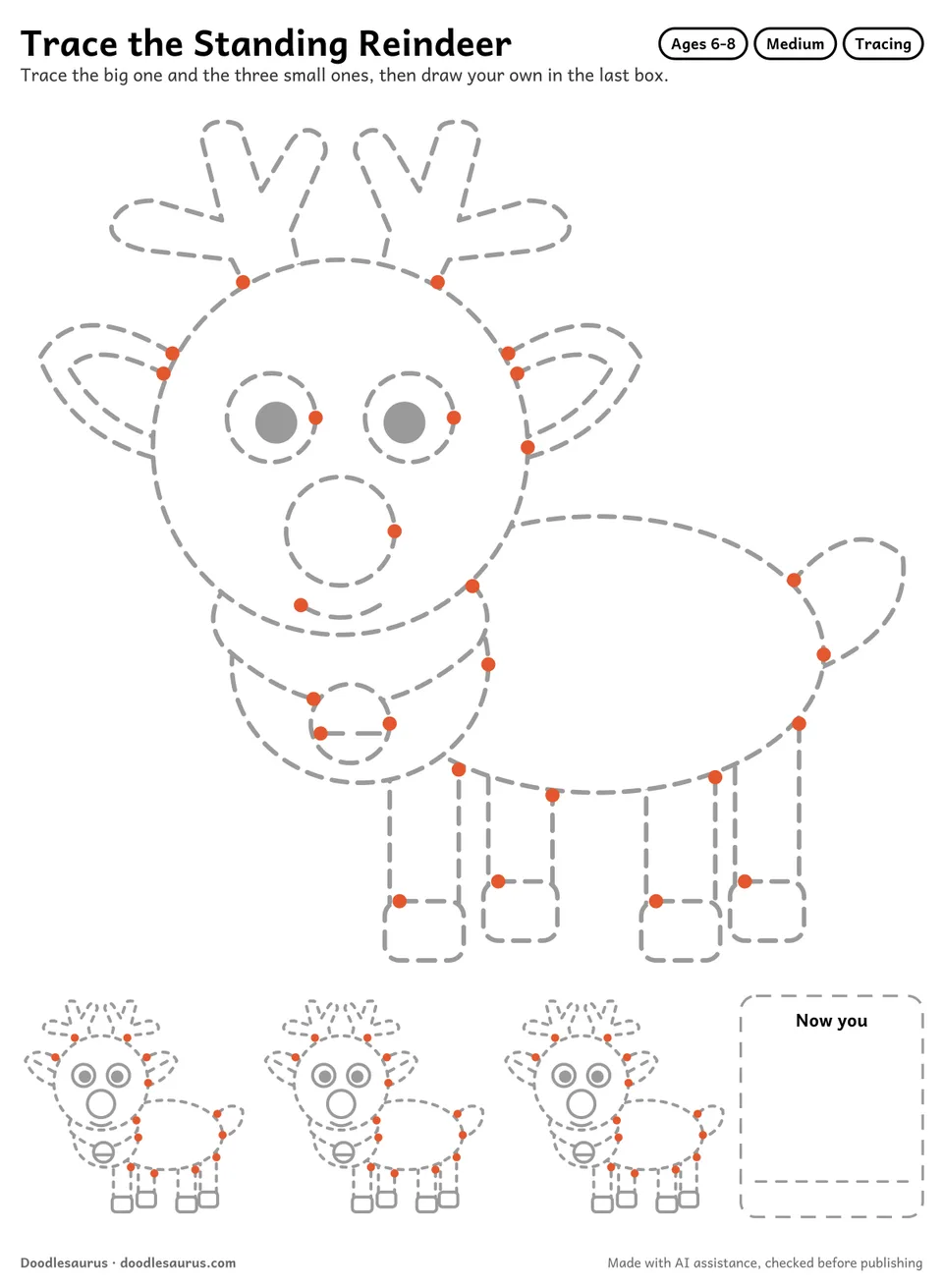
Below the same large frog, the medium sheet for ages 6 to 8 has three small copies where every curve is tighter and the pencil has to stop and turn more often. Each small frog has 11 orange dots. Those small dashes get very short and hard to follow when a printer shrinks the page, so keep the A4 or US Letter file at 100 percent with fit to page off. The last corner holds a tall Now you box for a freehand frog.
Skills practiced & tips
- Start with the eye circles; short, closed loops are a gentle warm-up.
- Remind your child to lift the pencil and move to the next orange dot rather than jumping across the page.
- Use a thick crayon for the large frog and a sharp pencil for the three little ones.
- Save the bumpy toe lines and the lily pad edge for last, since they change direction often.
- Let your child color the frog once every line has been traced.
Frog fun facts
- Frogs are amphibians, which means most of them spend part of their life in water and part on land.
- Lily pads float because their leaves hold pockets of air inside.
- Some tree frogs have sticky toe pads that let them cling to leaves and even glass.
Classroom ideas
- Preschool (ages 3 to 5): slip the easy sheet into a plastic sleeve and trace it again and again with a dry-erase pen.
- Kindergarten: trace the big frog on Monday and the three small frogs on Tuesday, then draw a frog in the Now you box.
- Grade 1: after the Now you drawing, students write a label or a short sentence about where their frog lives.
More frog activities
More tracing
Frequently asked questions
What is a child asked to do after tracing the frog four times?
Draw it freehand in the tall Now you box in the last corner of the medium sheet for ages 6 to 8. The four tracings are the large frog and the three small frogs below it, while the easy sheet for ages 3 to 5 is a single large dashed frog filling most of the page.
Why does the big frog have 17 dots and each small frog only 11?
The three small frogs mark only the larger shapes. Their cheeks, smile, belly and both inner eye rings have no dot, and the cheeks and inner eye rings are thin solid lines there. On the big frog every dashed stroke has one, 17 in all, and a glance at it shows where the smile and the belly begin.
Which lines on the frog are bumpy?
The toe lines on the webbed feet and the edge of the lily pad. They change direction often, so they are best left for last.
About this printable
- Made with AI assistance (vector drawing authored by a language model) and checked by automated tests and an AI reviewer.
- Checked by automated tests and an AI reviewer on 22 Oct 2026.
- Free for personal and single-classroom use. See the license. Read the license · How these are made · Report a problem.
- Vector PDF, 1 page, 186×254 mm art box — prints edge-safe on A4 and US Letter.
New printables, twice a month
Our newsletter starts soon, with new sheets twice a month and a free 10-page starter pack for every new reader.