Owl Tracing Worksheets with Ear Tufts and a Branch
These owl tracing worksheets put a big-eyed owl on a branch. Ages 3 to 5 trace one large owl; ages 6 to 8 add three small ones. A4 or US Letter.
Choose a level
Owl on a Branch Tracing Worksheet
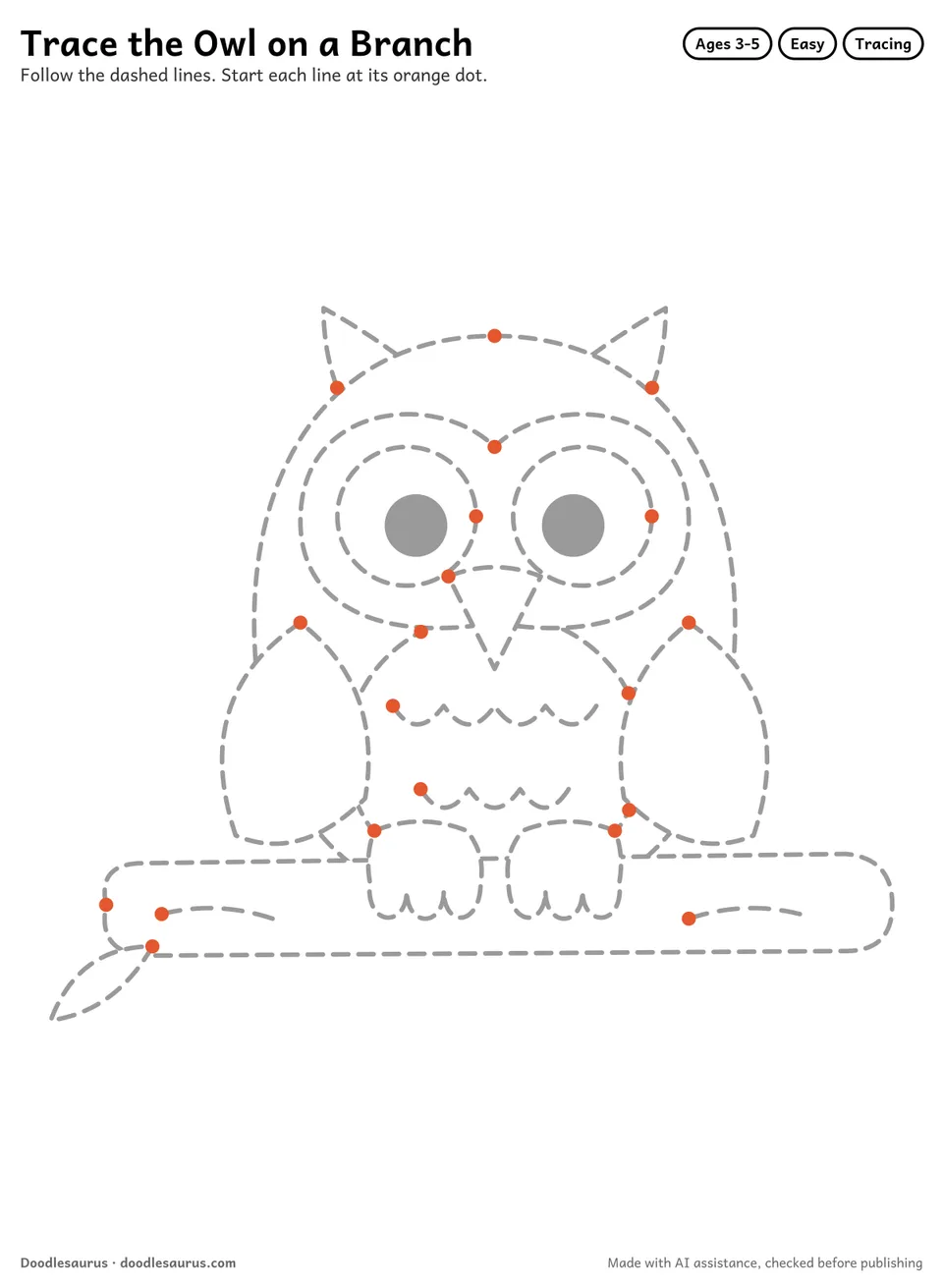
Two full circles for eyes, set inside a face mask, are what children notice first on this owl. The pupils are already filled in gray. The owl perches on a long rounded branch with a leaf at one end, and every line has an orange dot at its start, so there is no guessing where to begin.
Easy: a single large owl
Short pointed ear tufts, wide curves for the head and wings and those two round eyes take up most of the easy sheet for ages 3 to 5. Lower down are two wavy rows of chest feathers and two small feet with three toes each. A thick crayon suits this big owl.
Medium: three small owls and a free box
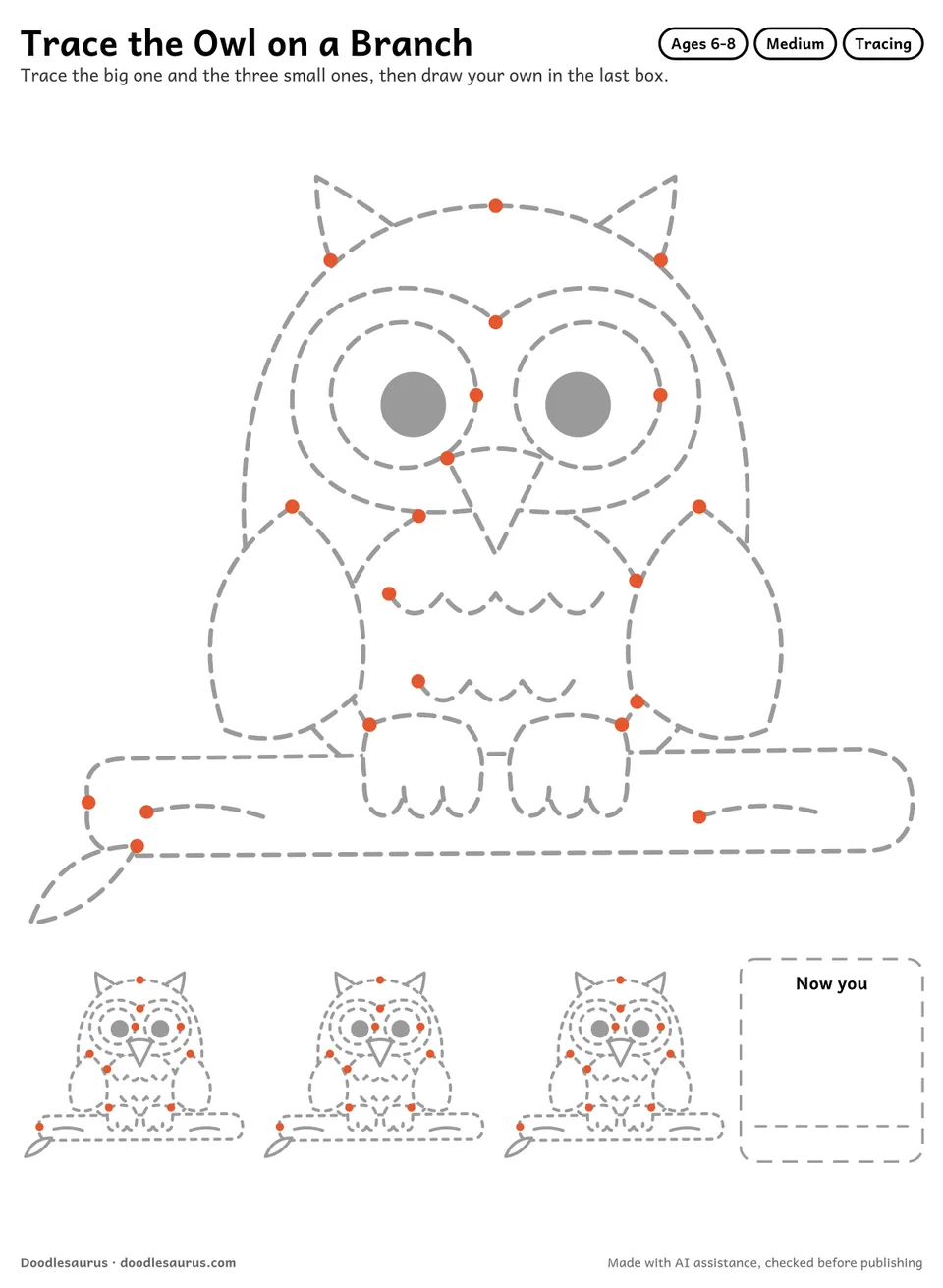
The medium sheet for ages 6 to 8 puts three small owls under the same large one. Around their eyes and toes the pencil has to turn tightly. Their ear tufts, beak, bark lines and leaf are thin solid lines with no dot. On a page shrunk to fit, the eye and toe dashes get very short and hard to follow, while the A4 or Letter PDF at 100 percent keeps them clear. The last space, labeled Now you, is left blank for an owl drawn with no dashes at all.
Skills practiced & tips
- Point to an orange dot and trace the first line together with your finger.
- Give a thick crayon for the large owl and a sharp pencil for the three small ones.
- Do the big outer shapes first, then the eye circles, and save the wavy feathers for last.
- Turn the paper a little if it helps your child follow a curve.
- Notice and praise slow, careful lines more than finishing quickly.
Owl fun facts
- In many owls one ear opening sits higher than the other, which helps them pinpoint where a sound comes from.
- Owls have three eyelids: one to blink, one for sleep and a thin one that cleans the eye.
- The barn owl is found on every continent except Antarctica.
Classroom ideas
- Preschool (ages 3 to 5): slip the easy page into a plastic sleeve and trace it again and again with a dry-erase marker.
- Kindergarten: split the medium page across two sessions, the big owl first and the small owls with the Now you box next.
- Grade 1: once the tracing is done, have children write a label or a short sentence about owls beside the drawing.
More owl activities
More tracing
Frequently asked questions
Where does the pencil turn tightest on the small owls?
Around the eyes and toes of the small owls, where the dashes get very short. The easy sheet for ages 3 to 5 has a single large dashed owl, with its two round eyes and small feet at full size.
Why does every line start with an orange dot?
The dot shows where to put the pencil down. Beginning in the same place each time helps a child move along the dashes in one steady direction.
What should my child trace first?
The big outer shapes of the head and wings, then the eye circles. The two wavy rows of chest feathers are best saved for last.
About this printable
- Made with AI assistance (vector drawing authored by a language model) and checked by automated tests and an AI reviewer.
- Checked by automated tests and an AI reviewer on 22 Oct 2026.
- Free for personal and single-classroom use. See the license. Read the license · How these are made · Report a problem.
- Vector PDF, 1 page, 186×254 mm art box — prints edge-safe on A4 and US Letter.
New printables, twice a month
Our newsletter starts soon, with new sheets twice a month and a free 10-page starter pack for every new reader.