Owl Dot to Dot in Three Levels, 30 to 60 Dots
Owl dot to dot in three levels (30, 42 or 60 dots) of one owl on a branch, its face, wings and chest feathers already in gray. Answer page with each.
Choose a level
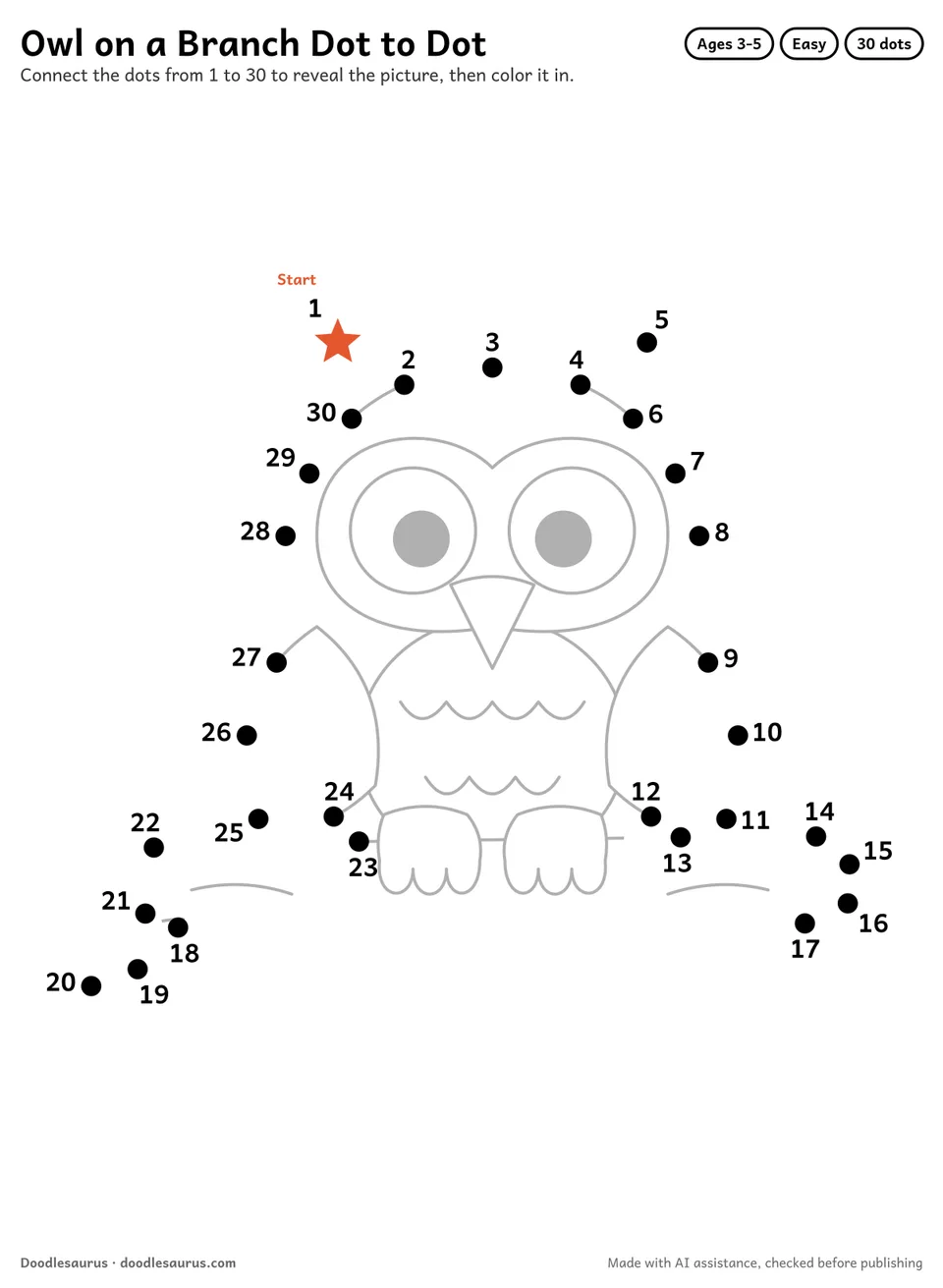
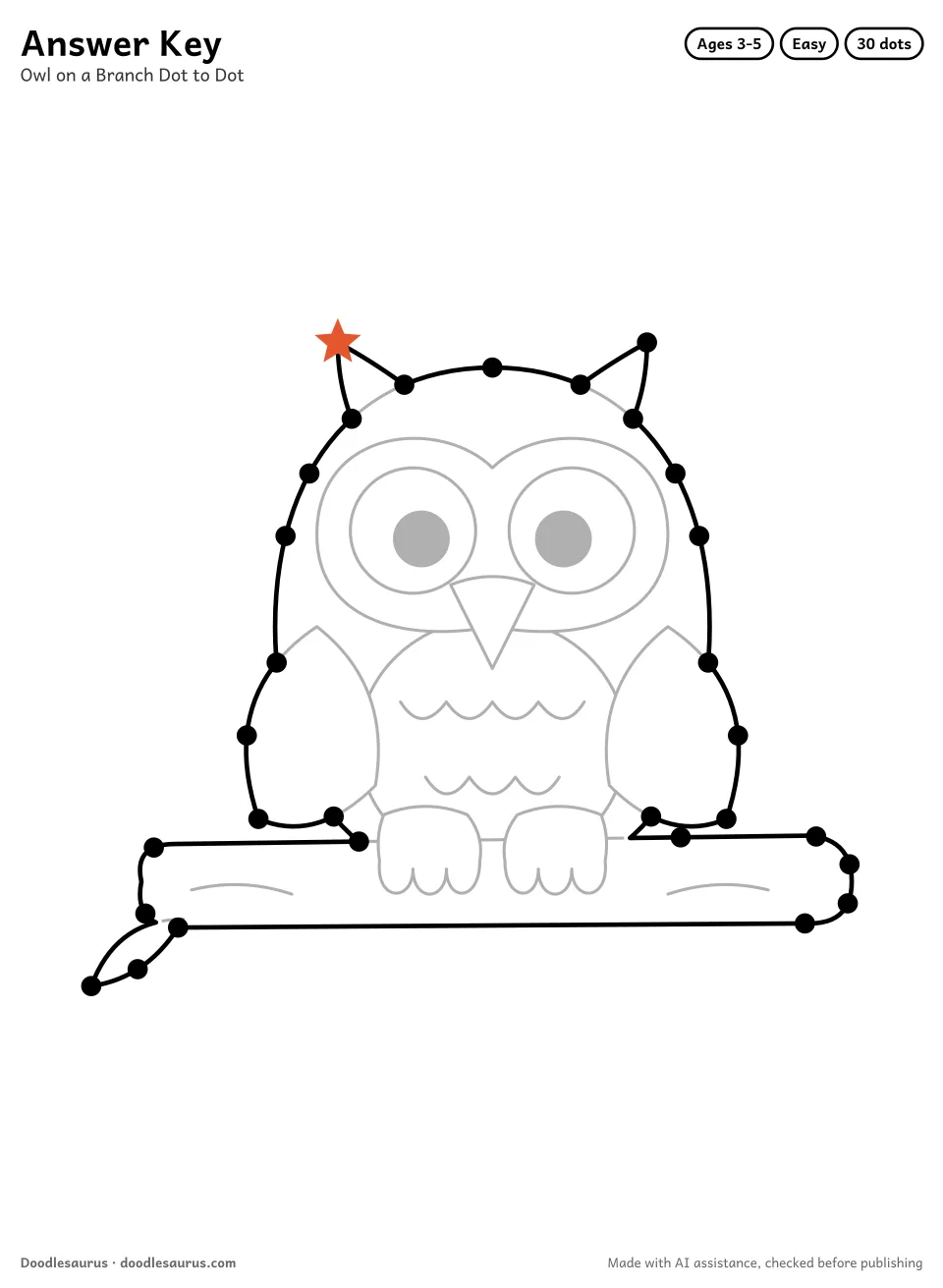
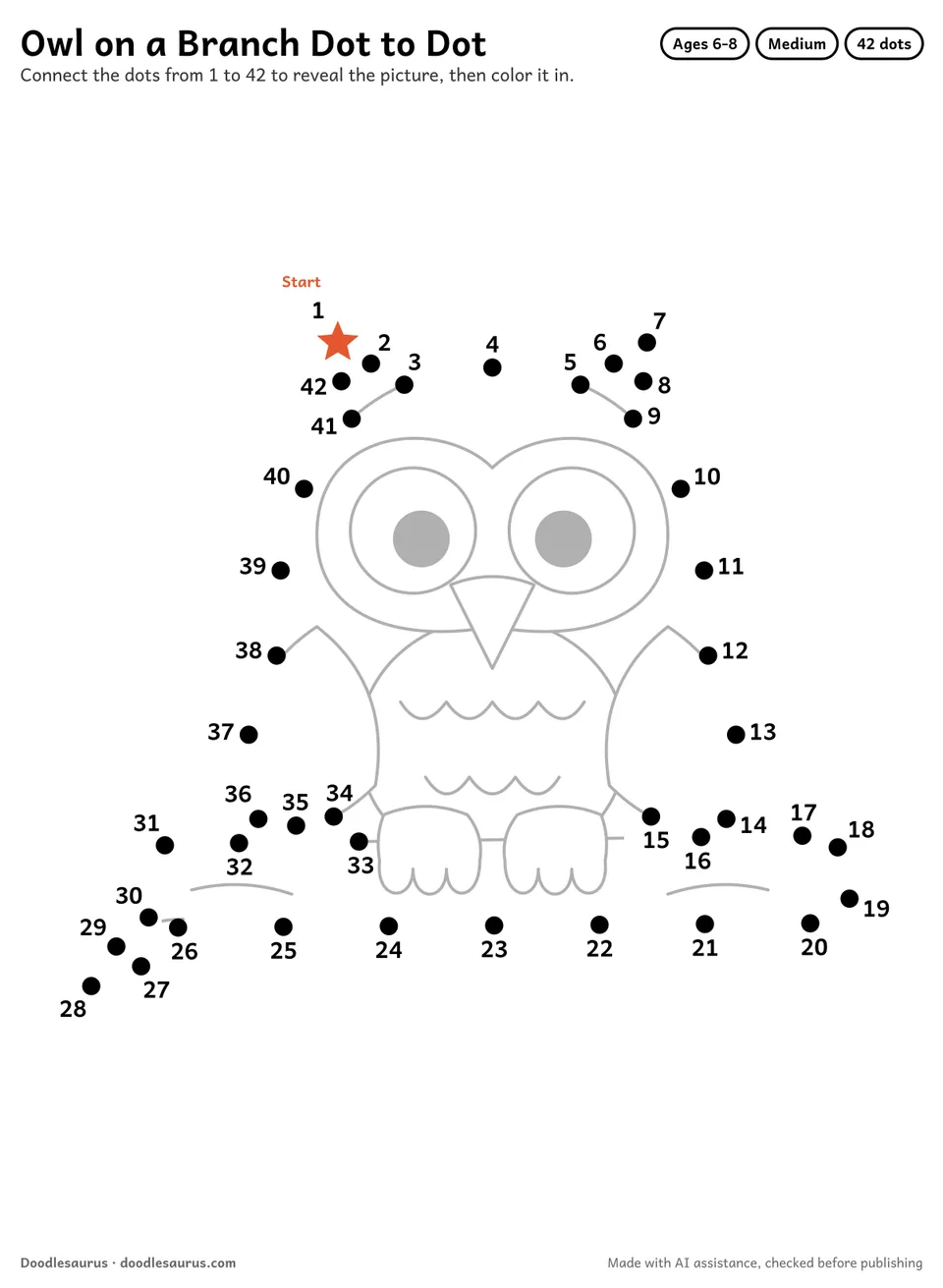
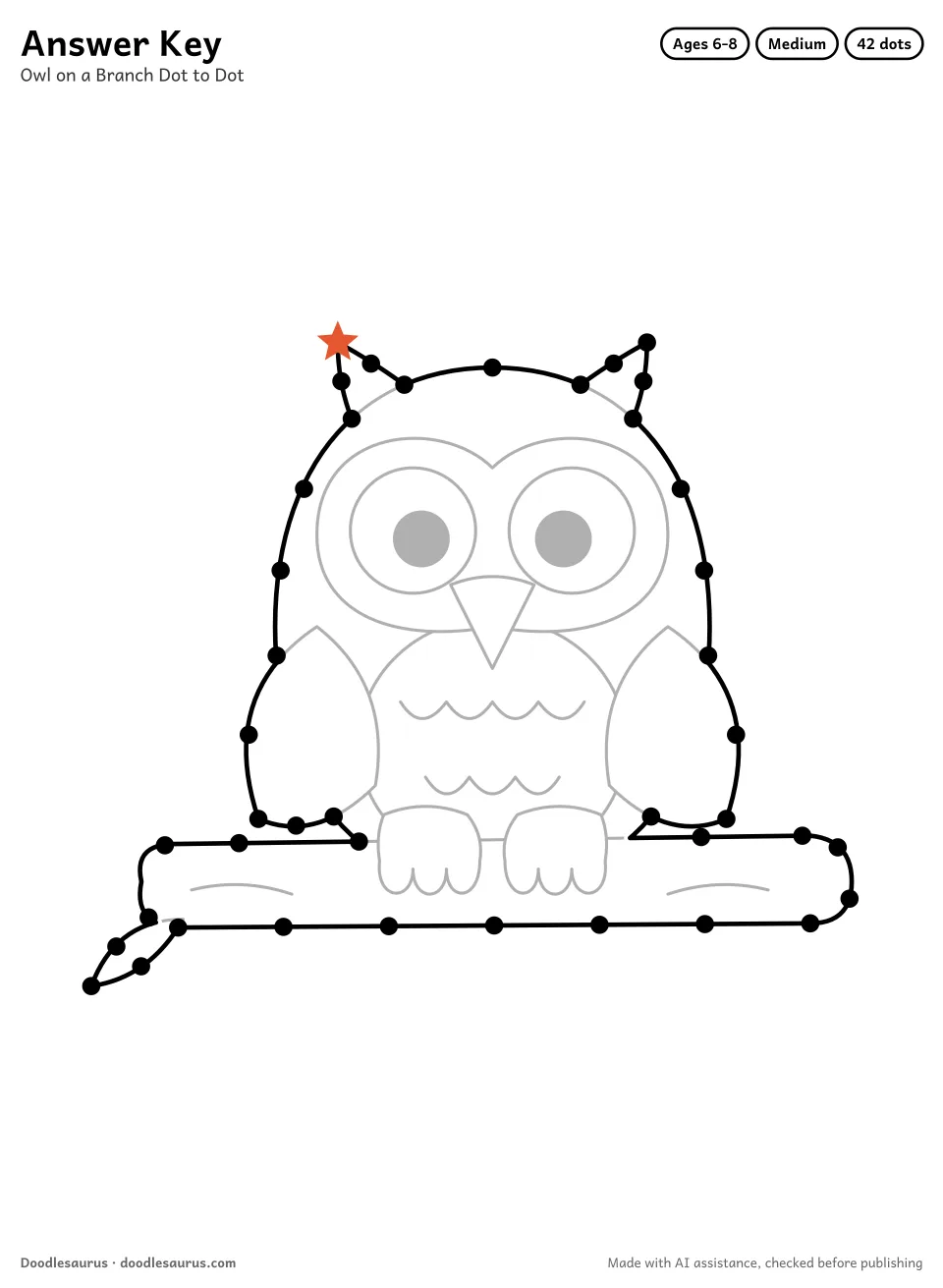
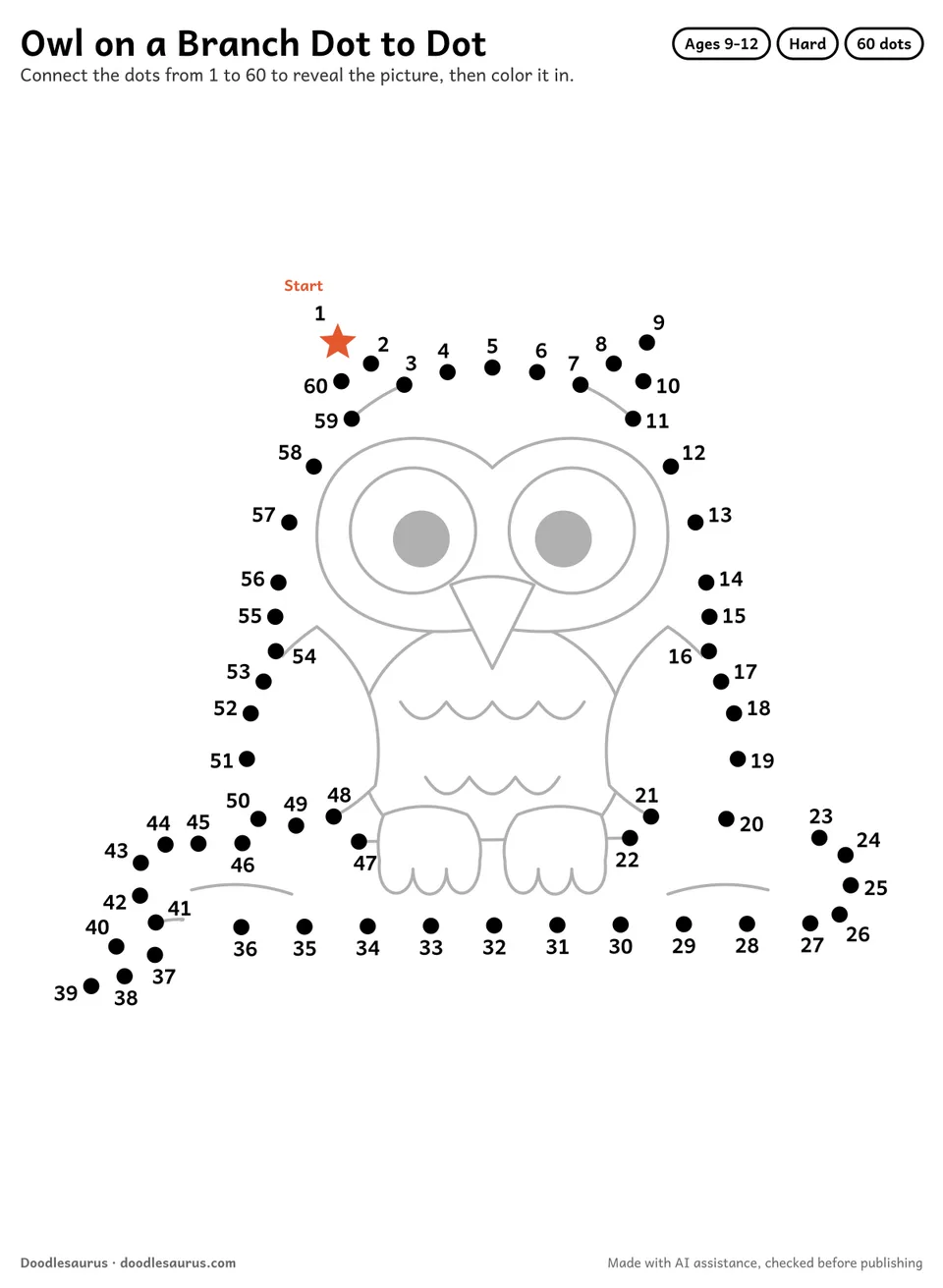
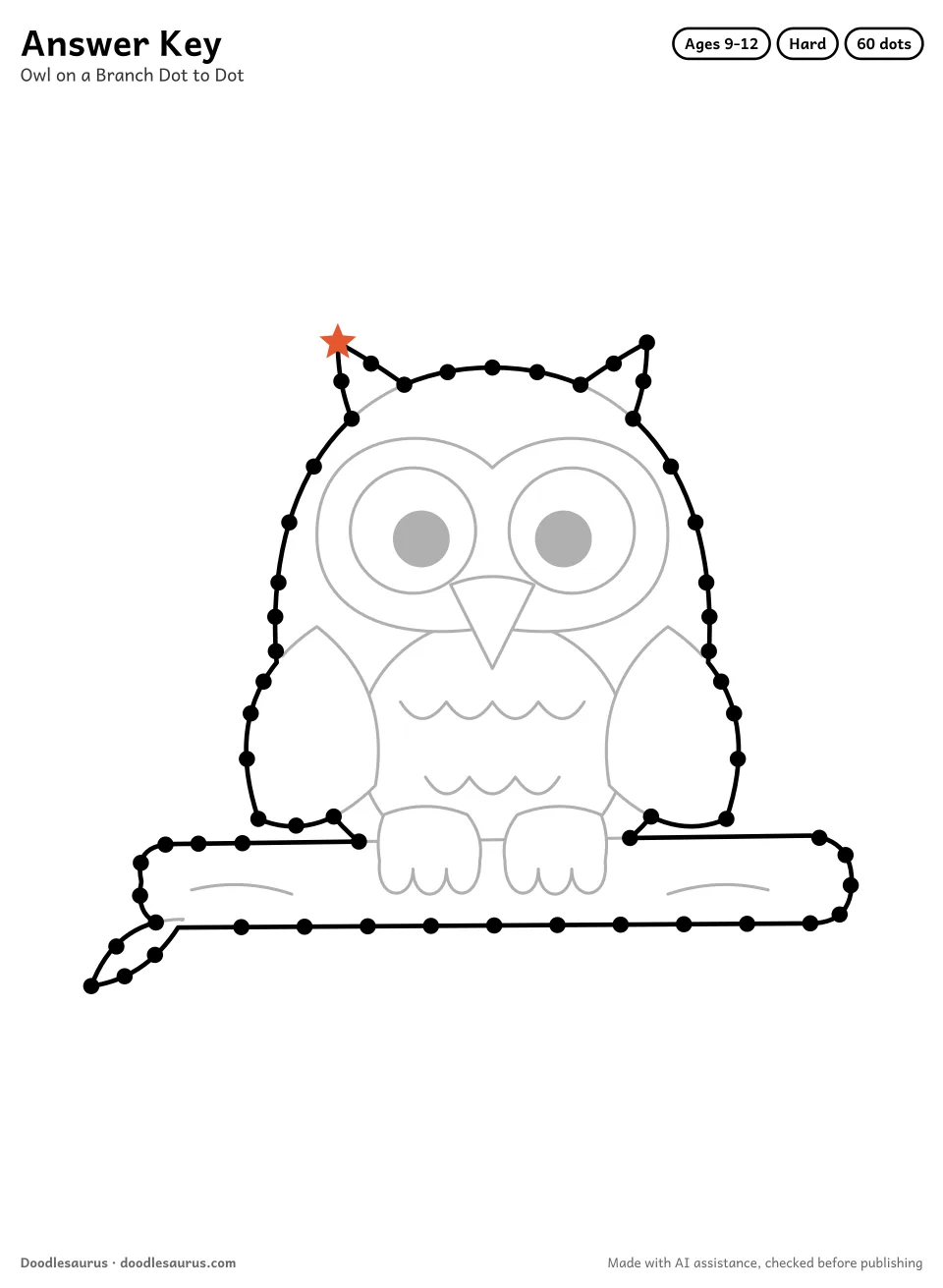
A small leaf hangs under the left end of the owl’s branch, and it is the one place where the numbers get crowded. The rest is calm: the owl sits upright with two short ear tufts, and a long flat branch runs under its feet.
30, 42 and 60 dots
Thirty dots make the easy owl, aimed at ages 3 to 5. The medium owl for ages 6 to 8 uses 42, and the detailed owl for ages 9 to 12 uses 60. It is the same bird on all three, perched in the same spot.
From ear tuft to ear tuft
The first dot is an orange star at the tip of the left ear tuft. Numbers cross the top of the head, climb to the point of the right tuft and run down the owl’s right side. Near the bottom they round the right end of the branch, travel along its underside, twist around the leaf and come back up past the left foot to close the shape beside dot 1.
The face mask, two ringed eyes, a pointed beak, both wings, two wavy rows of chest feathers, the toes and two grain lines on the branch are printed in gray on every page, so a young child sees an owl long before the last line. The detailed page keeps those lines and adds more, smaller dots. To check the work, each level has its own answer page. Scaling the page down pulls the leaf dots even closer, so use the Letter PDF on US Letter paper or the A4 PDF on A4, at 100 percent.
Skills practiced & tips
- Show your child the orange Start star at the tip of the left ear tuft before anything else.
- Read the next number out loud and find it together before drawing each line.
- Slow down around the leaf, where the dots sit close together.
- Use a ruler for the long straight line along the bottom of the branch.
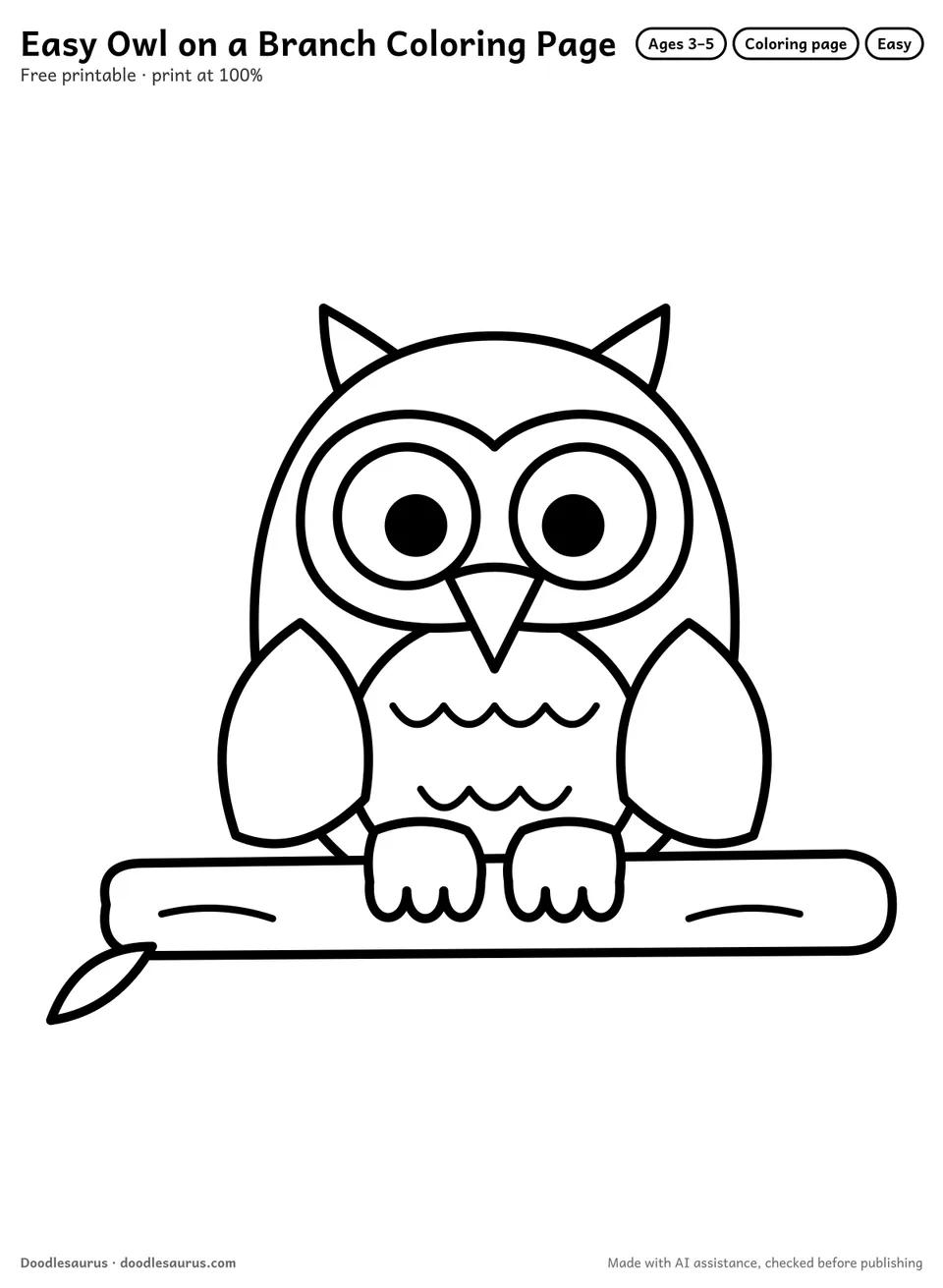
- Once the outline is joined, go over it in a dark marker and color the owl.
Owl fun facts
- An owl's face is shaped like a shallow dish that funnels sound toward its ears.
- Many owls swallow small prey whole and later cough up a pellet of fur and bones.
- Owls are mostly active at night, though a few kinds, such as the snowy owl, also hunt in daylight.
Classroom ideas
- Preschool (ages 3 to 5): do the 30-dot owl as a group, counting each number aloud as children draw.
- Grade 1: give the 42-dot page as a morning task and ask children to circle every even number first.
- Grades 4 and 5: offer the 60-dot owl to fast finishers and let them check it against the answer page.
More owl activities
More dot to dot
Frequently asked questions
Does the owl keep its branch at every level?
Yes. The easy owl has 30 dots, the medium owl 42 and the detailed owl 60, and all three outline the same owl on its branch. A child moving up a level already knows the picture.
What are the gray shapes inside the dots?
They are guide lines. All three pages show the face disc, two ringed eyes, the beak, folded wings, two rows of chest feathers, the toes and two grain marks on the branch in light gray. The 60-dot page adds more, smaller dots.
Can I check my child's work?
Yes. Every level has its own answer page with the finished owl drawn in full, which also doubles as a simple page to color.
Where are the tricky dots?
Around the leaf under the left end of the branch, where the dots sit close together. The long flat line along the bottom of the branch is the easy part, and a ruler helps there.
About this printable
- Made with AI assistance (vector drawing authored by a language model) and checked by automated tests and an AI reviewer.
- Checked by automated tests and an AI reviewer on 22 Oct 2026.
- Free for personal and single-classroom use. See the license. Read the license · How these are made · Report a problem.
- Vector PDF, 2 pages, 186×254 mm art box — prints edge-safe on A4 and US Letter.
New printables, twice a month
Our newsletter starts soon, with new sheets twice a month and a free 10-page starter pack for every new reader.