
Maple Leaf Dot to Dot with Five Pointed Tips
Leaf dot to dot printables of a five-tipped maple leaf, joined in straight lines with 36, 47 or 67 dots. Free, and every level has an answer page.
Choose a level
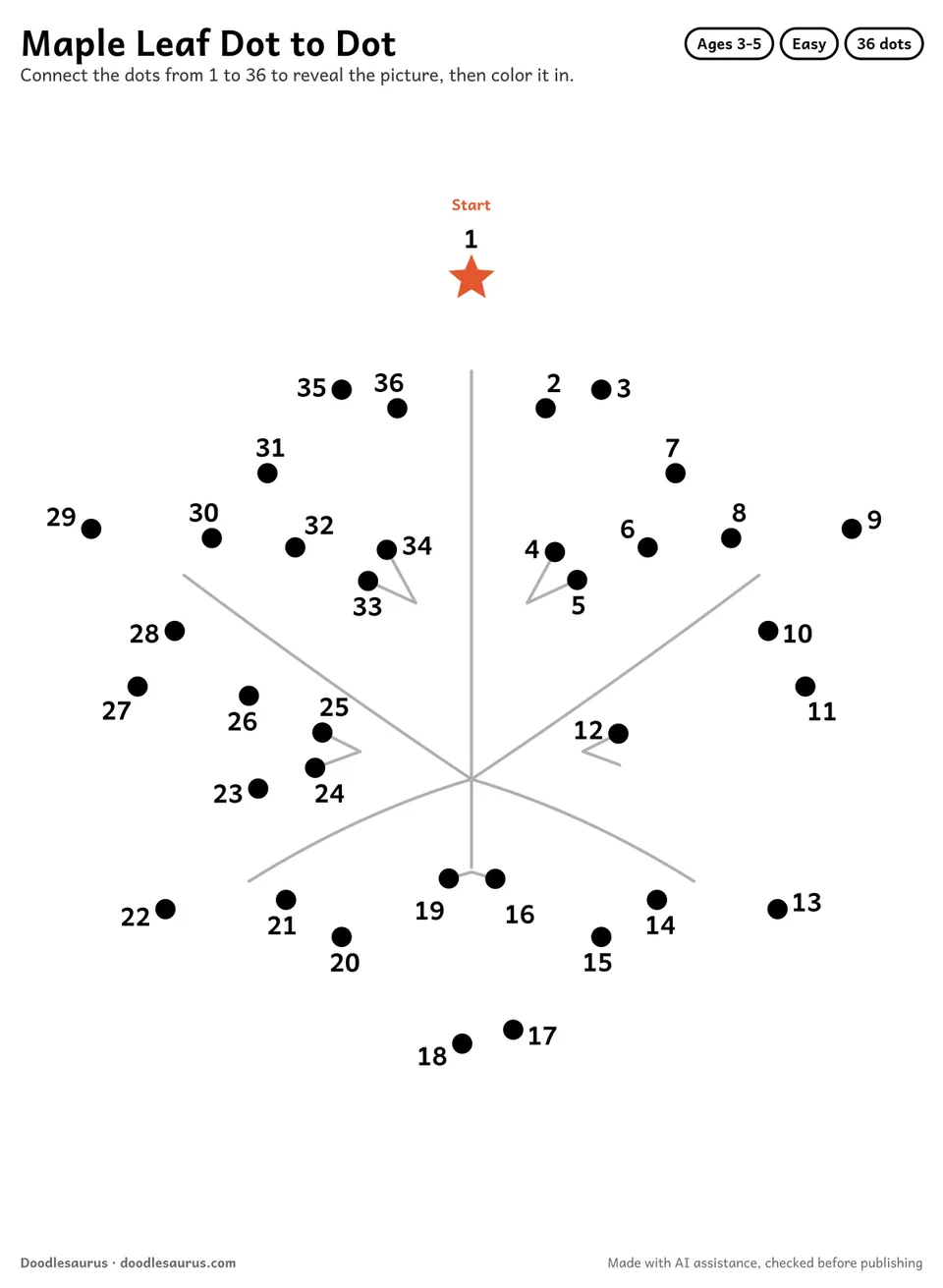
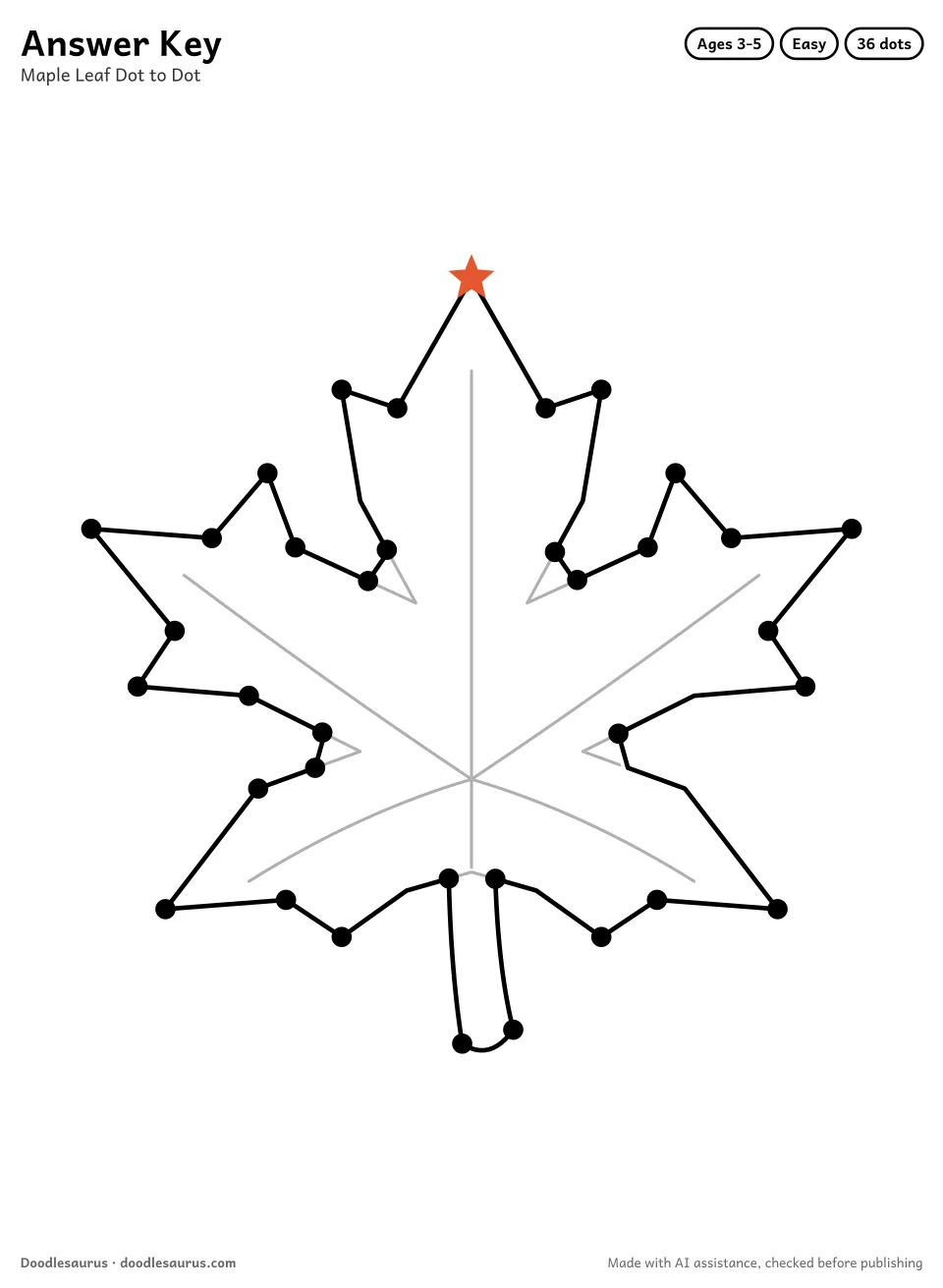
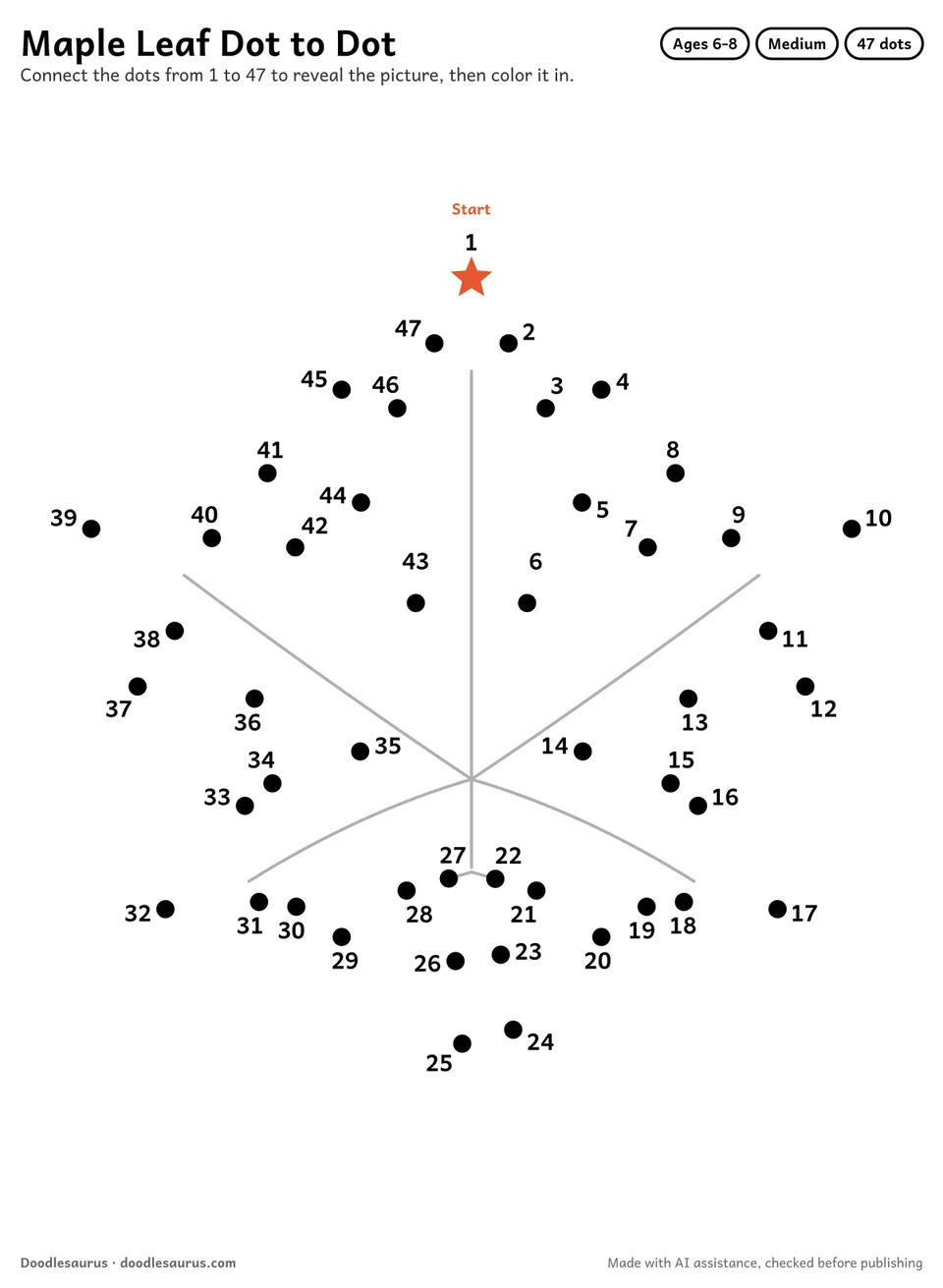
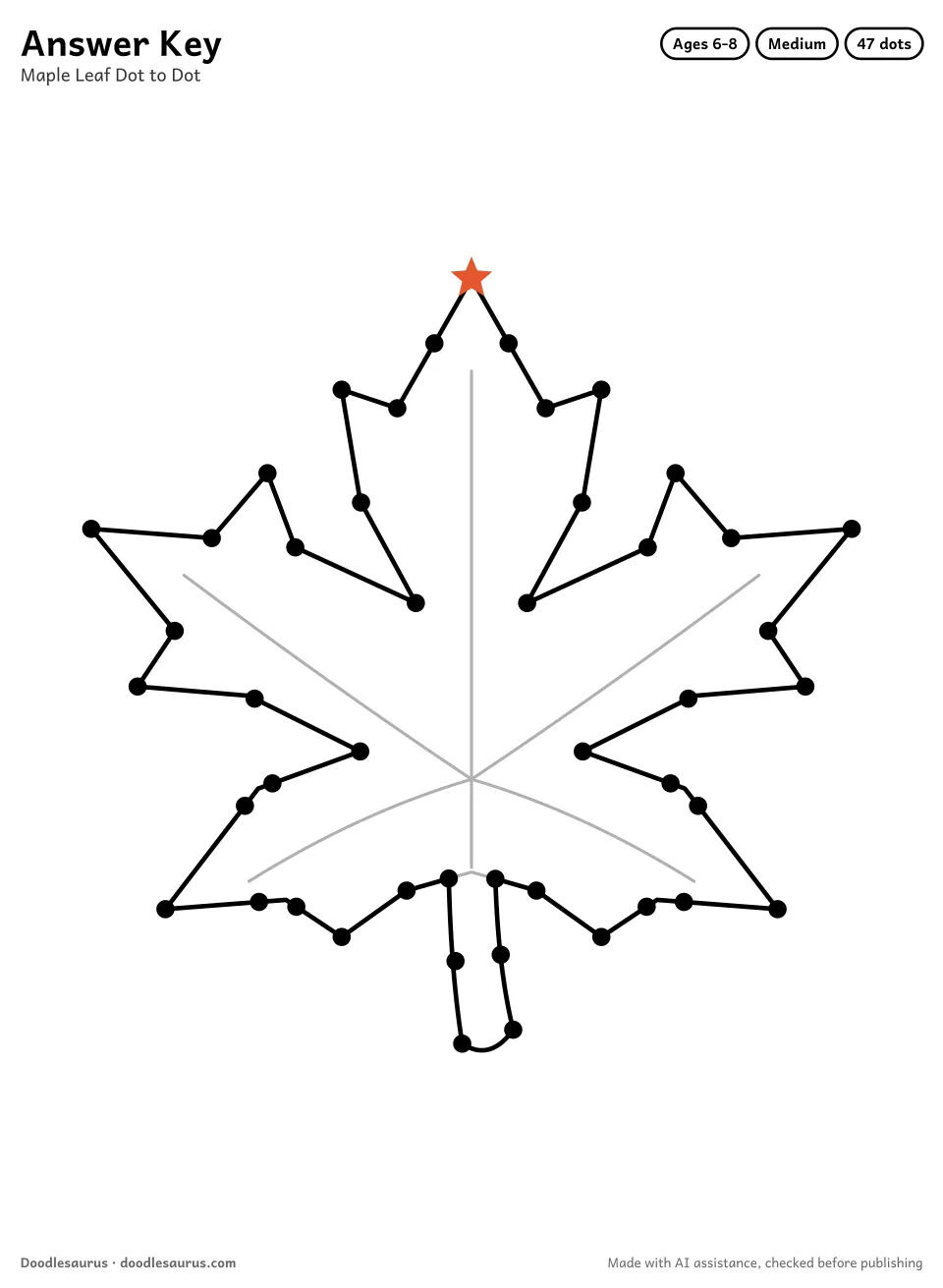
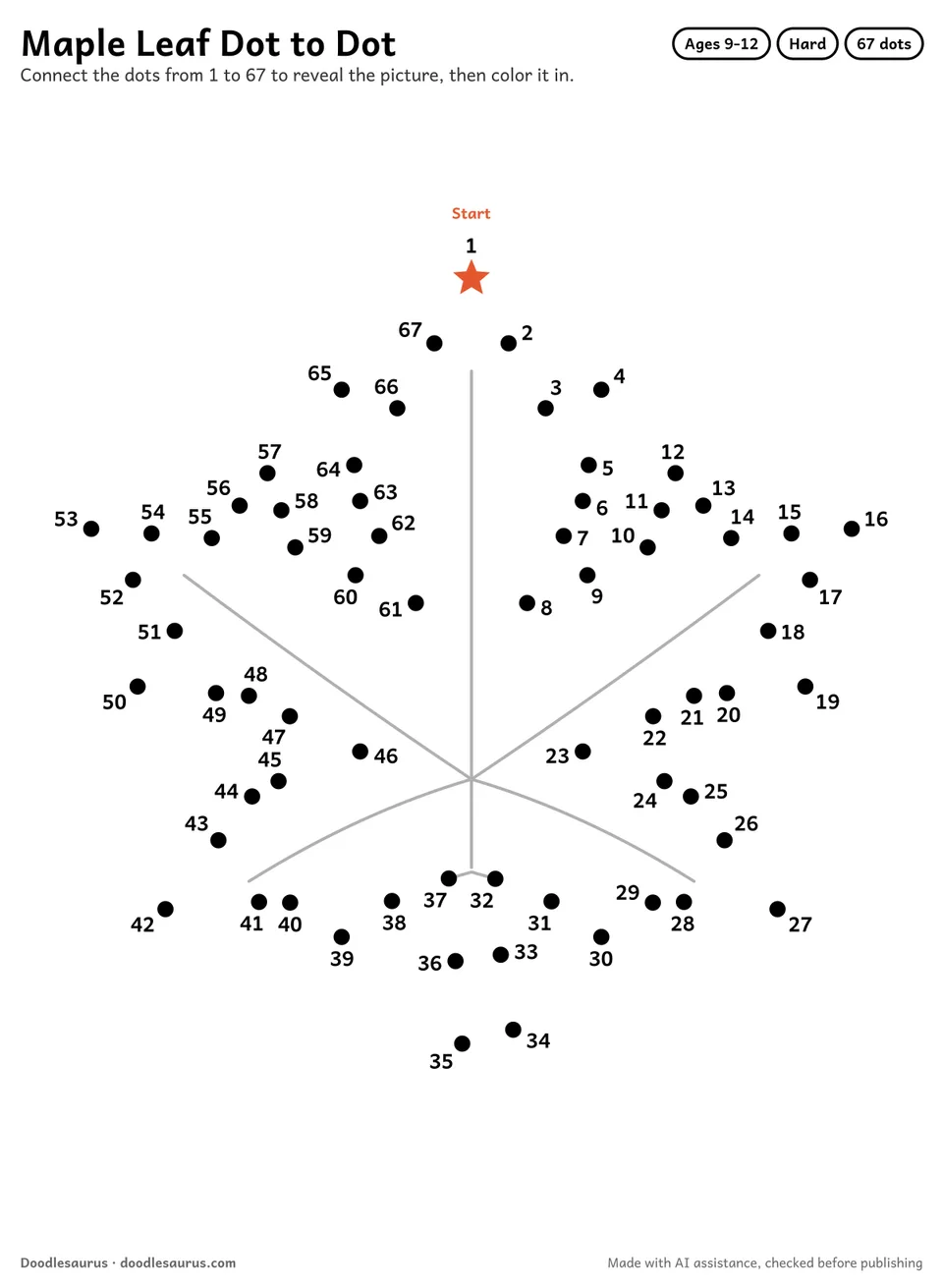
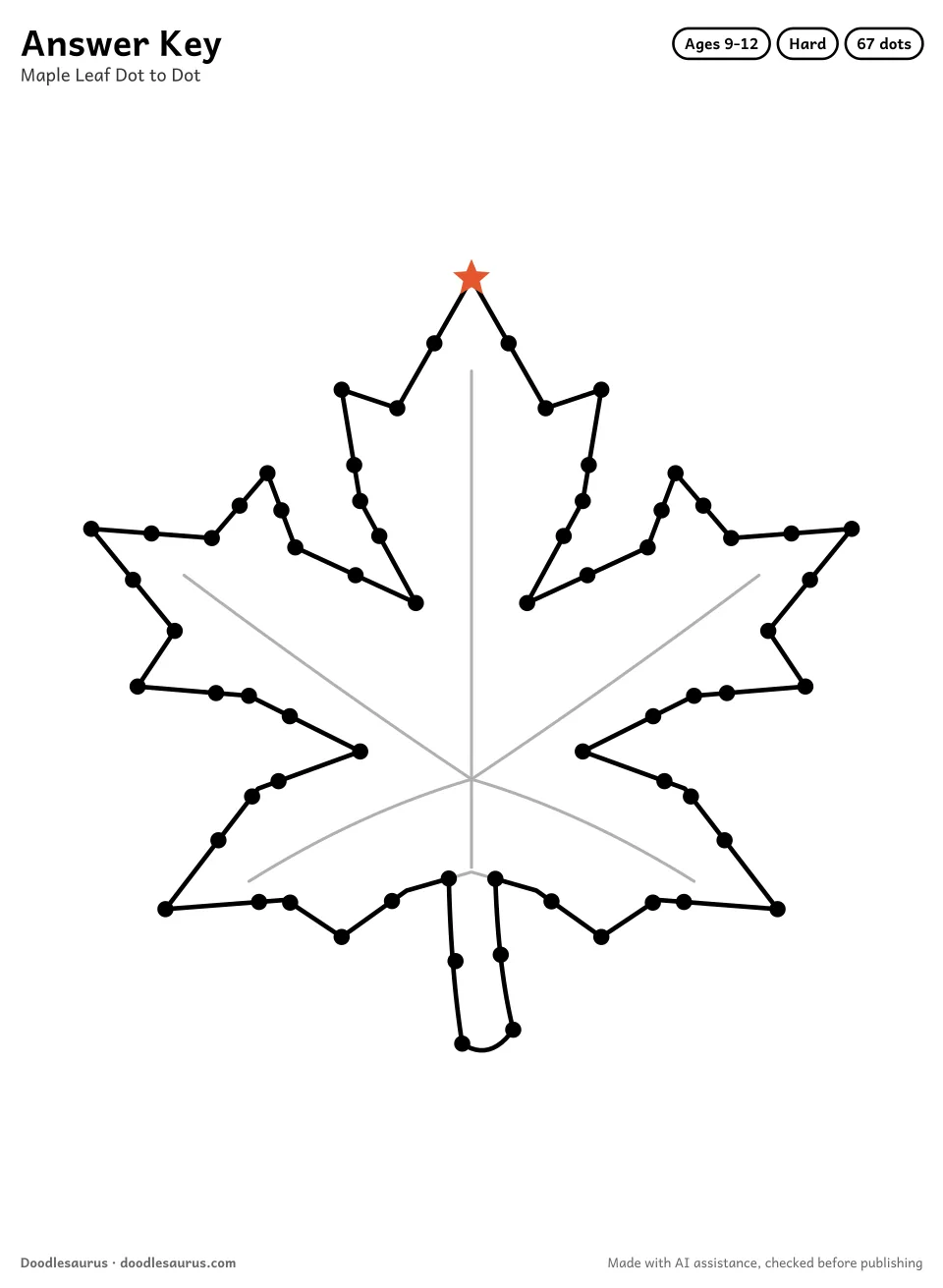
Every join on this maple leaf is a straight line. The leaf has five tips with sharp notches between them, and a short stem whose rounded end is the only curve on the page. Children who like neat edges get a lot out of it, since there is nothing to guess about how a line should bend.
36, 47 or 67 dots
Thirty-six dots is a lot for an easy page. Each tip and notch needs its own dot to hold the shape. To stop there, the easy line for ages 3 to 5 cuts across the narrow ends of the four deepest notches, and those ends print in gray. The medium leaf for ages 6 to 8 has 47 dots. With 67 dots, the hard leaf for ages 9 to 12 follows every notch right to its end.
Clockwise from the top tip
An orange Start star marks the top tip on all three levels. The numbers go clockwise down the right side, out to the wide side tip and the lower tip, and reach the stem at the bottom, where the dots bunch up. Then they climb the left side to the top again. The edge turns sharply at every point and notch. Find the next number before drawing each line. Five veins are already printed in light gray, so the leaf is easy to guess well before it is closed.
Each level has its own answer page with the joined outline. Some numbers on the 67-dot page sit close together. They get hard to read if the page is scaled down, so the A4 file belongs on A4 paper and the Letter file on US Letter, both at 100 percent.
Skills practiced & tips
- The leaf edge is made of straight lines, so a ruler or a slow, steady hand works well; only the stem has gentle curves.
- Count the dots aloud and pause at each sharp point.
- Look ahead to the next number, since the edge doubles back at every notch.
- Near the stem at the bottom the dots sit close together, so check the numbers twice.
- After joining the dots, color the leaf in autumn red, orange or yellow.
Leaf fun facts
- In a maple leaf the main veins spread out from one point like fingers from a palm, a pattern called palmate.
- The bright reds of autumn maples come from pigments the leaves make as the days grow cooler and shorter.
Classroom ideas
- Pre-K (ages 3 to 5): join the 36-dot leaf together, then talk about where you might find a leaf like it.
- Grade 1: on the 47-dot leaf, students read each number aloud before drawing the line to it.
- Grades 3 to 5: offer the 67-dot page, ask pupils to use a ruler for every line, then check against the answer page.
More leaf activities
More dot to dot
Frequently asked questions
What sets the 67-dot leaf apart from the easier ones?
It follows every notch right to its end, which takes 67 dots. The medium leaf has 47 dots for ages 6 to 8, and the easy leaf has 36 for ages 3 to 5.
Why does the easy leaf have as many as 36 dots?
A maple leaf has many sharp points and notches, and each tip needs its own dot to keep the shape. To keep the count at 36, the easy line cuts across the narrow ends of the four deep notches between the big lobes, and those notch ends print in gray.
Do the five veins need joining?
No. They are printed in light gray on every page, so the leaf is easy to guess before the outline is closed.
Can my child use a ruler?
Yes, on any level. Every join along the edge is a straight line from point to point, so only the stem with its rounded end needs a free hand.
About this printable
- Made with AI assistance (vector drawing authored by a language model) and checked by automated tests and an AI reviewer.
- Checked by automated tests and an AI reviewer on 22 Oct 2026.
- Free for personal and single-classroom use. See the license. Read the license · How these are made · Report a problem.
- Vector PDF, 2 pages, 186×254 mm art box — prints edge-safe on A4 and US Letter.
New printables, twice a month
Our newsletter starts soon, with new sheets twice a month and a free 10-page starter pack for every new reader.