
Fish Maze Printables in Three Levels
A fish maze for ages 3 to 12, set inside a fish with fins and a triangle tail: 46 cells on the easy sheet, 122 on the medium and 280 on the hard one.
Choose a level
A fish to swim through
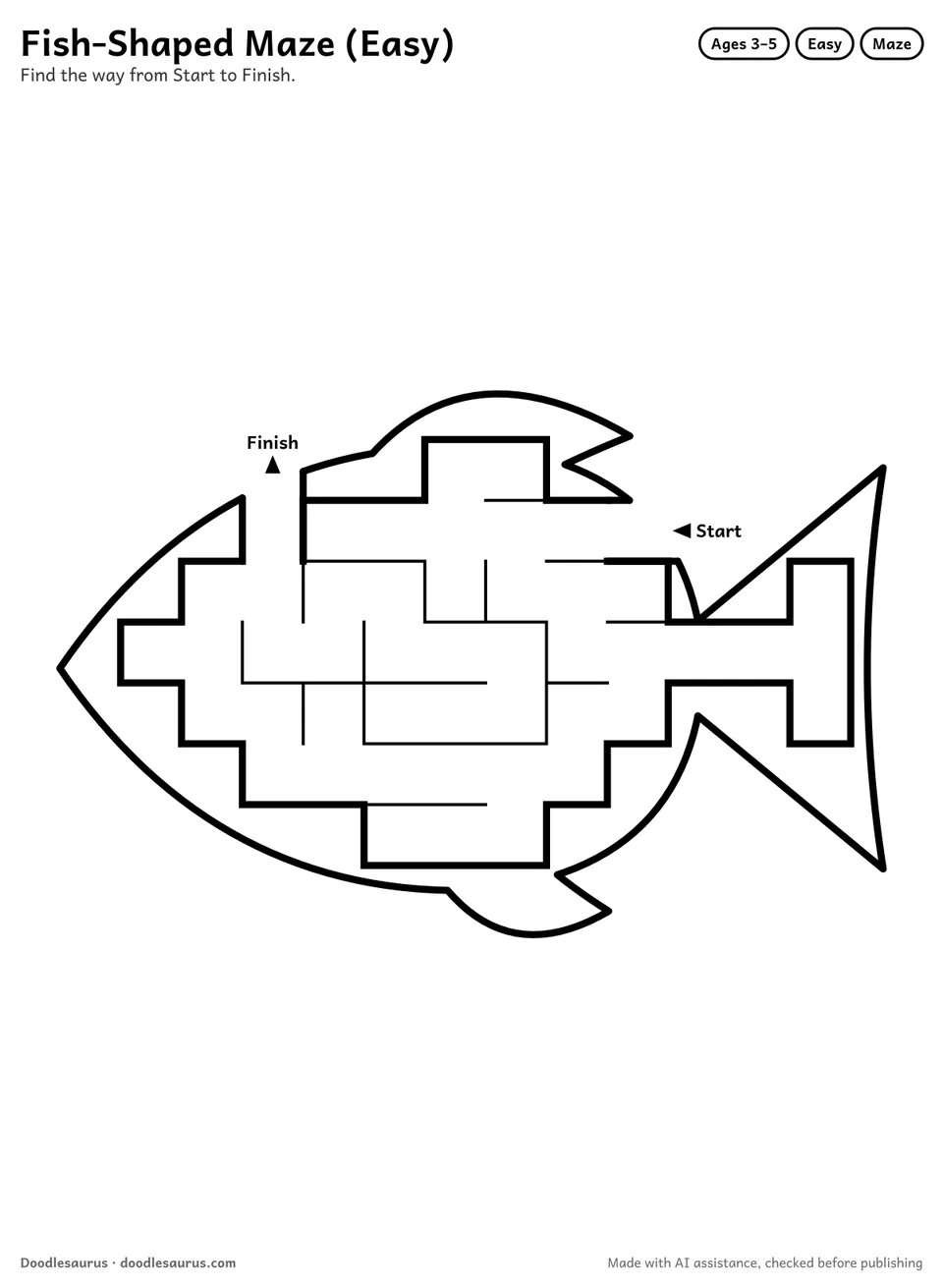
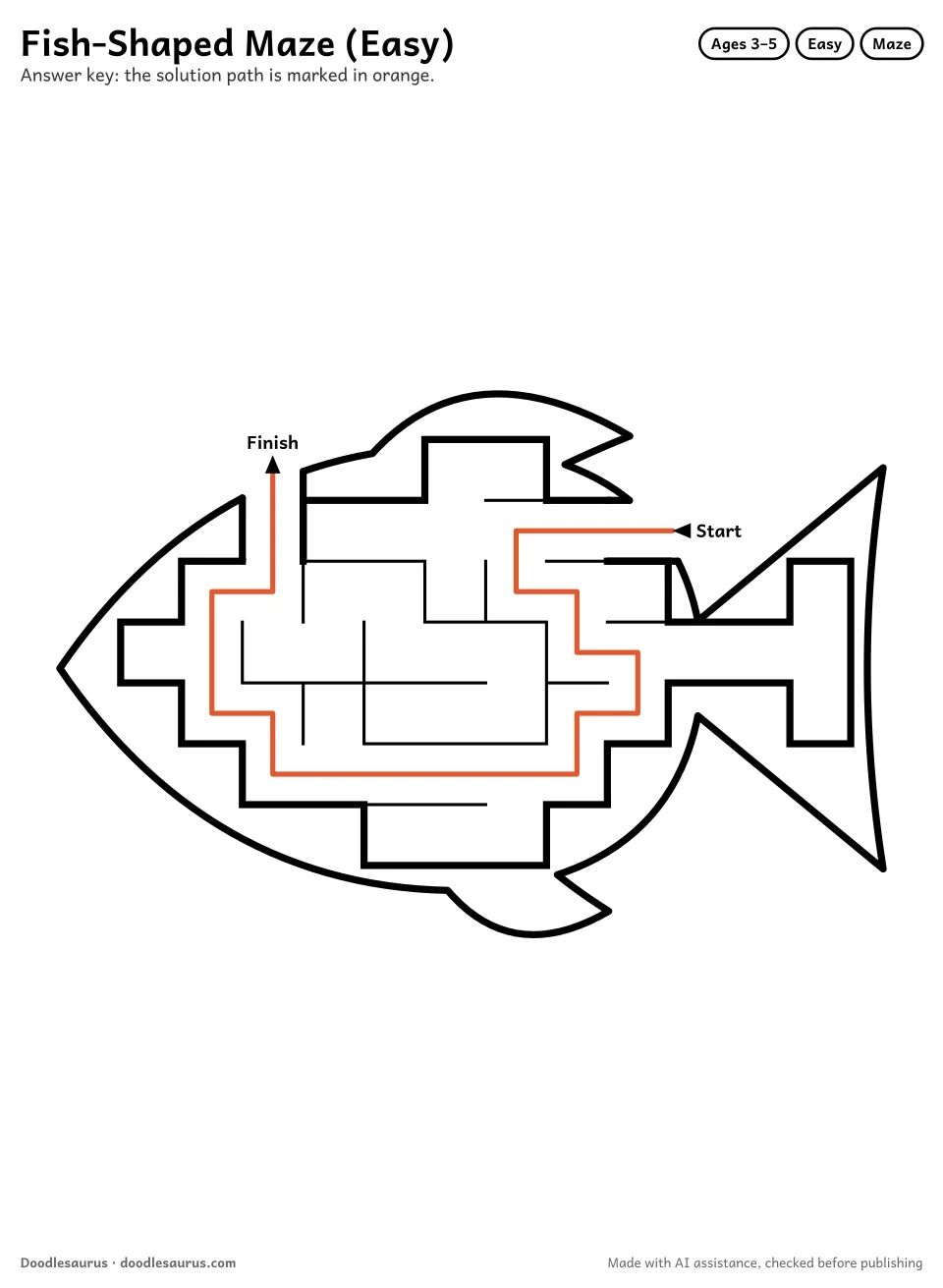
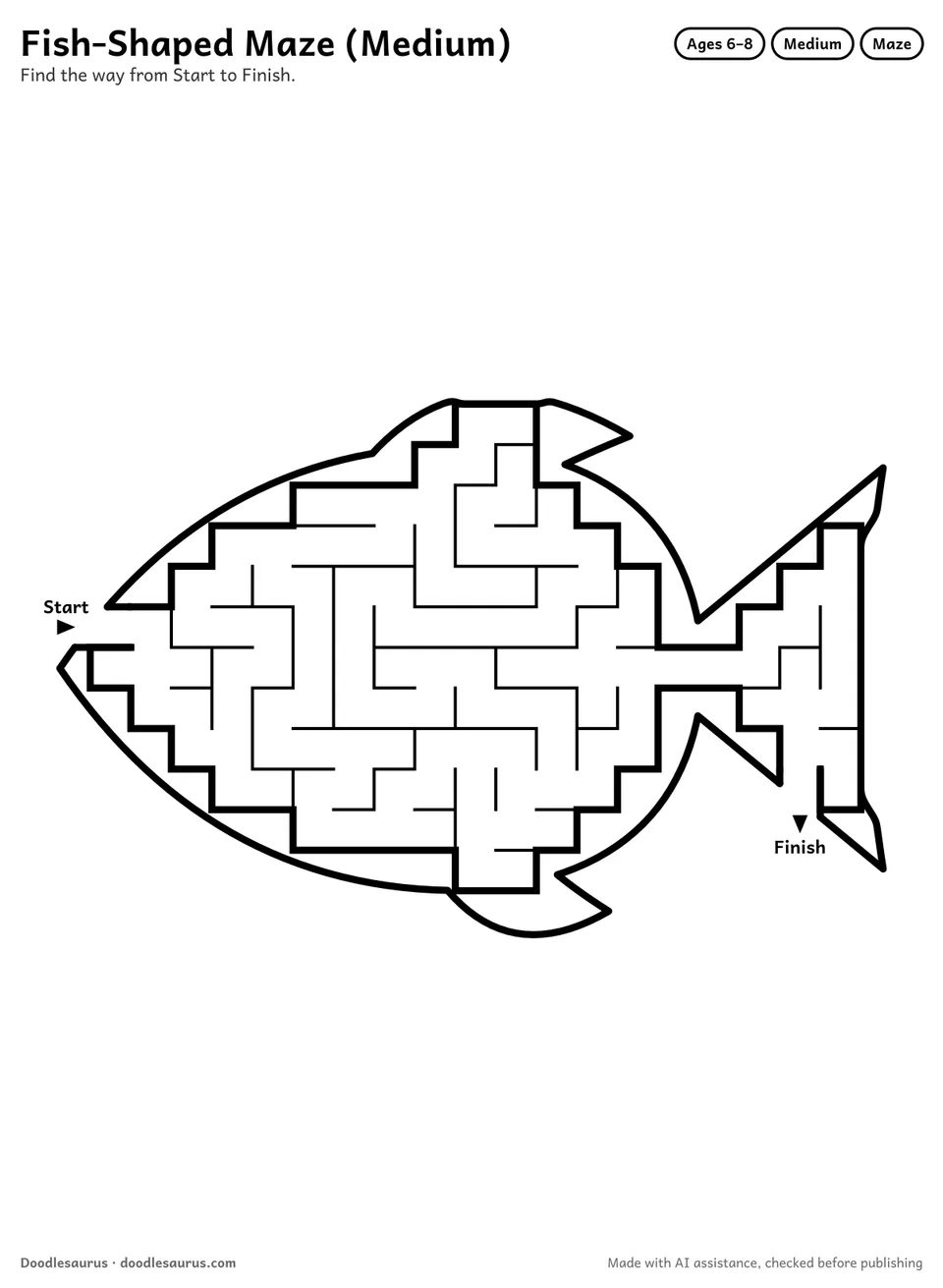
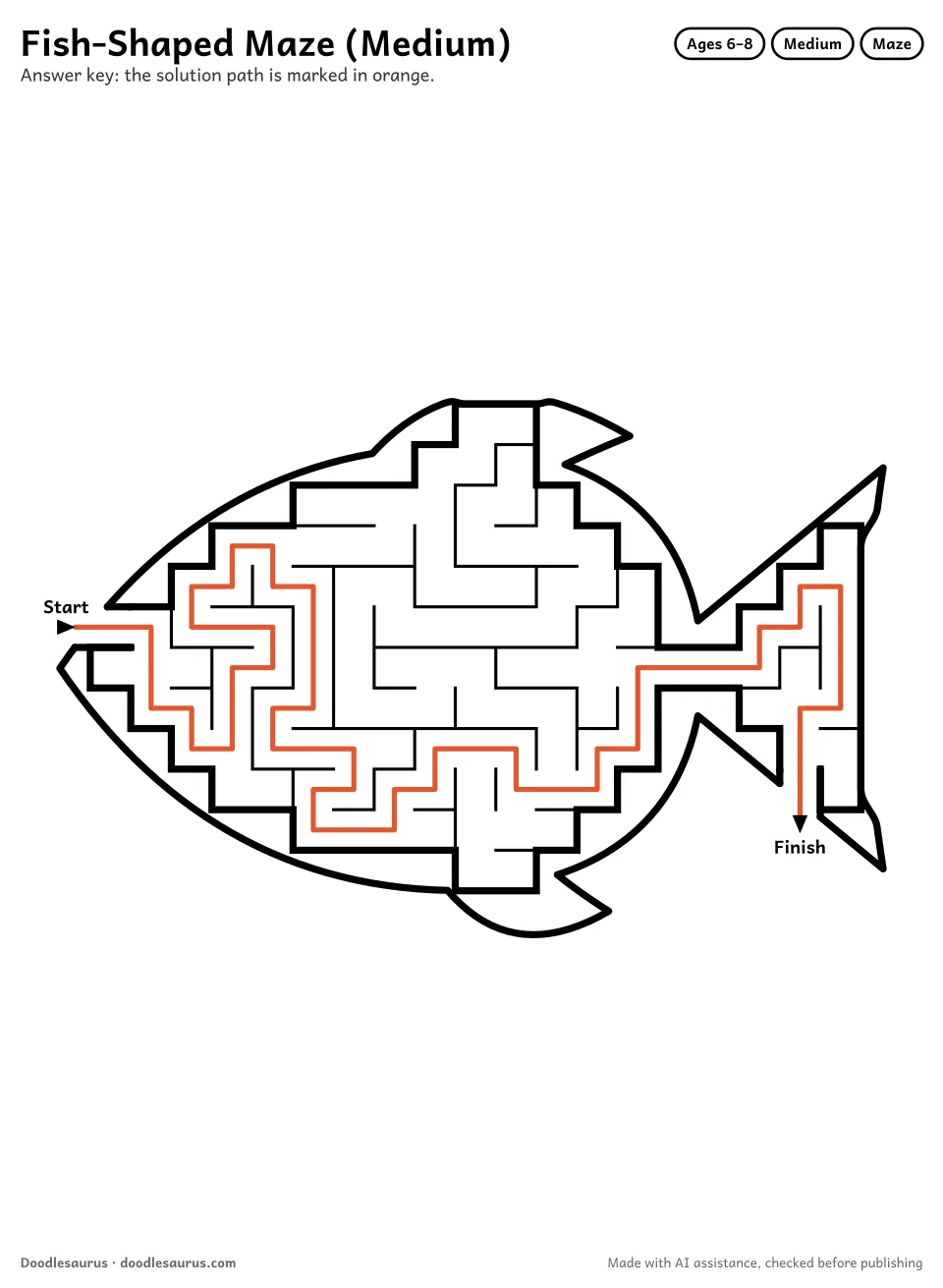
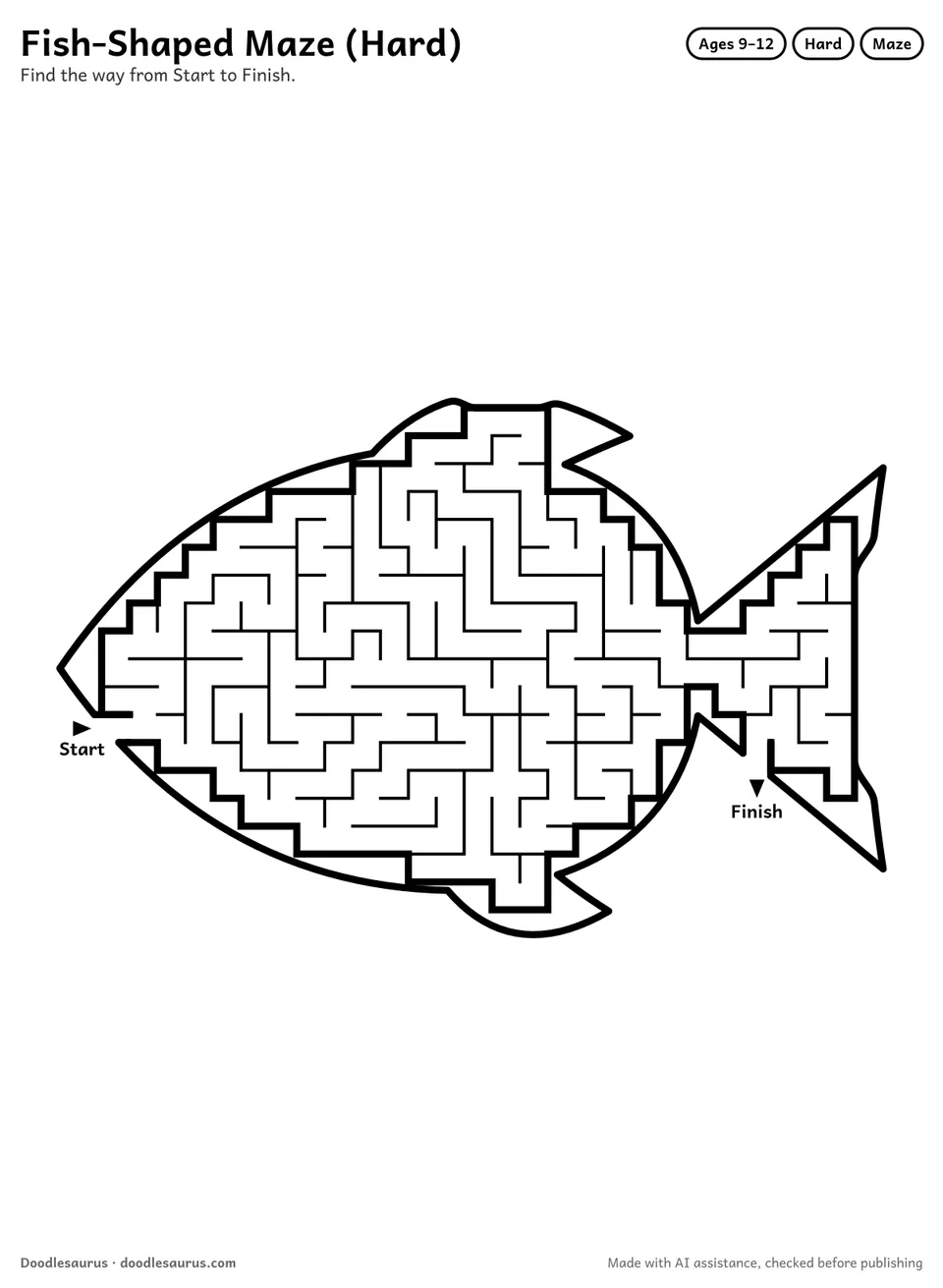
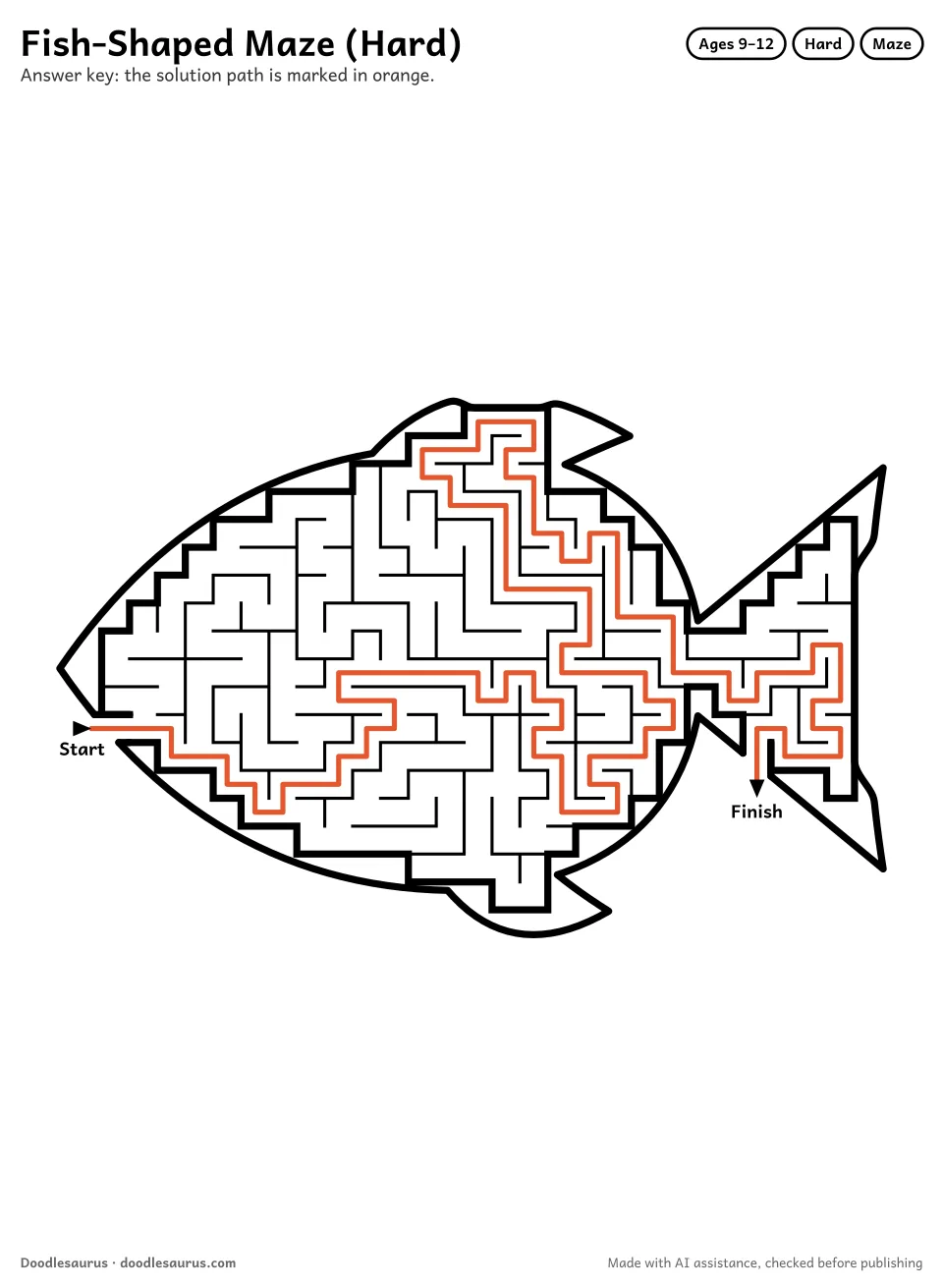
The fish on this fish maze swims to the left. It has a fin on its back, a smaller fin underneath and a broad triangle tail that the corridors run into, and the walls follow the inside of the body’s curve in little steps. Each arrow sits at the end of a short channel through a gap. The solution is traced in orange on page two of each PDF.
Picking a level
A fish is long and flat. That makes these mazes wider than they are tall, and a good deal smaller than the cat mazes. On the easy sheet, 46 cells of 12 mm make a gentle first maze for ages 3 to 5. The 19-cell route runs from just behind the back fin down and along the belly, then up to the top of the body in front of the back fin.
The medium fish has 122 cells of 8 mm for ages 6 to 8. Its route starts outside the nose, loops through the front of the body, crosses the belly, squeezes through the narrow join into the tail and leaves below the tail after 54 cells.
The hard sheet is for ages 9 to 12. It fills the fish with 280 cells of 5.5 mm. The route starts just below the nose, winds up into the back fin and down through the body, then squeezes through the same narrow join into the tail. It leaves below the tail, close to the join, after 109 cells. The fish lies across the middle of the page with white space above and below, so nothing is gained by fitting it to the page. Send the A4 or US Letter file at 100 percent.
Swimming lessons and ocean units
Parents can slip the easy fish into a bag before a swimming lesson or a visit to an aquarium. Teachers can hand out all three levels at once during an ocean unit, so each child works at a corridor width that suits their pencil grip.
Skills practiced & tips
- Point to the Start arrow and ask a young child which way the fish should swim first.
- Draw the path in blue so it looks like a stream of water through the fish.
- Keep an eraser nearby for the hard sheet, where 280 cells leave plenty of room for a wrong turn.
- After solving, add an eye, scales and a few bubbles to turn the maze into a picture.
Fish fun facts
- Most fish push themselves forward by sweeping the tail fin from side to side.
- In lab studies, goldfish have learned to find their way through simple underwater mazes and remember the route.
- Many salmon swim hundreds of miles upstream to lay eggs in the stream where they hatched.
Classroom ideas
- Preschool (ages 3 to 5): sing a sea-animal song, let children drive a finger along the easy route, then repeat it with a crayon.
- Kindergarten and Grade 1: solve the medium fish, then count the cells along the orange path on the answer key together.
- Grades 3 to 5: run the hard fish as a quiet warm-up in an ocean unit and ask students to explain their strategy in two sentences.
More fish activities
More mazes
Frequently asked questions
Is the medium fish much harder than the easy one?
It is a clear step up. Its corridors narrow from 12 mm to 8 mm, it has 122 cells instead of 46, and its answer path is 54 cells long instead of 19, with many more side paths and dead ends to avoid. The hard fish goes much further, with 280 cells of 5.5 mm and a 109-cell route.
Why is the fish maze wider than it is tall?
Because a fish is long and flat. The maze follows the body from the pointed nose to the triangle tail, so it lies across the middle of the page and holds fewer cells than the cat mazes.
Is there a correct answer to check against?
Yes. The second page repeats the fish with the solution drawn in orange. On the easy level that is the only route, while the medium and hard fish include a few loops, so a different path to Finish is fine too.
What other fish activities match this maze?
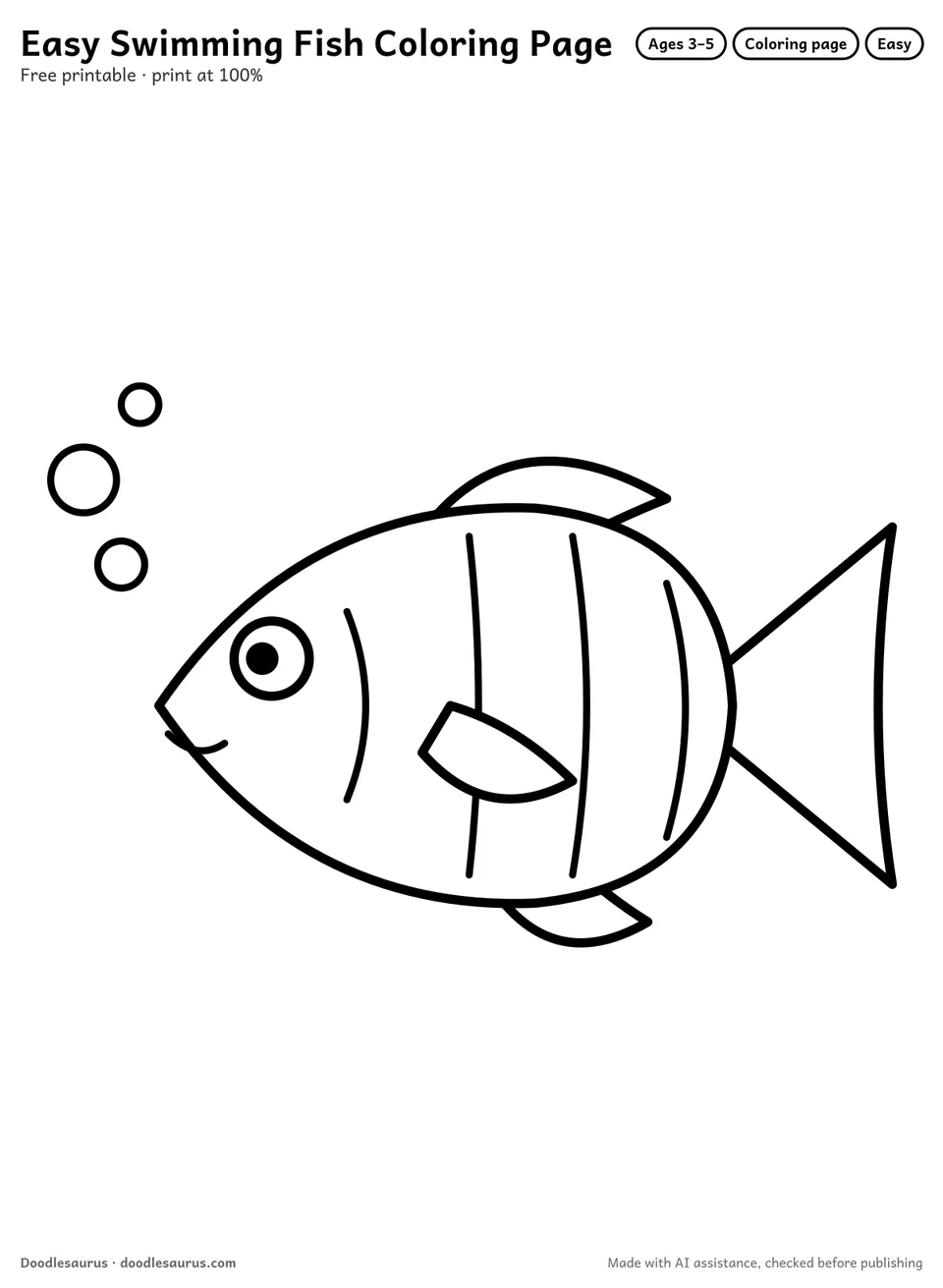
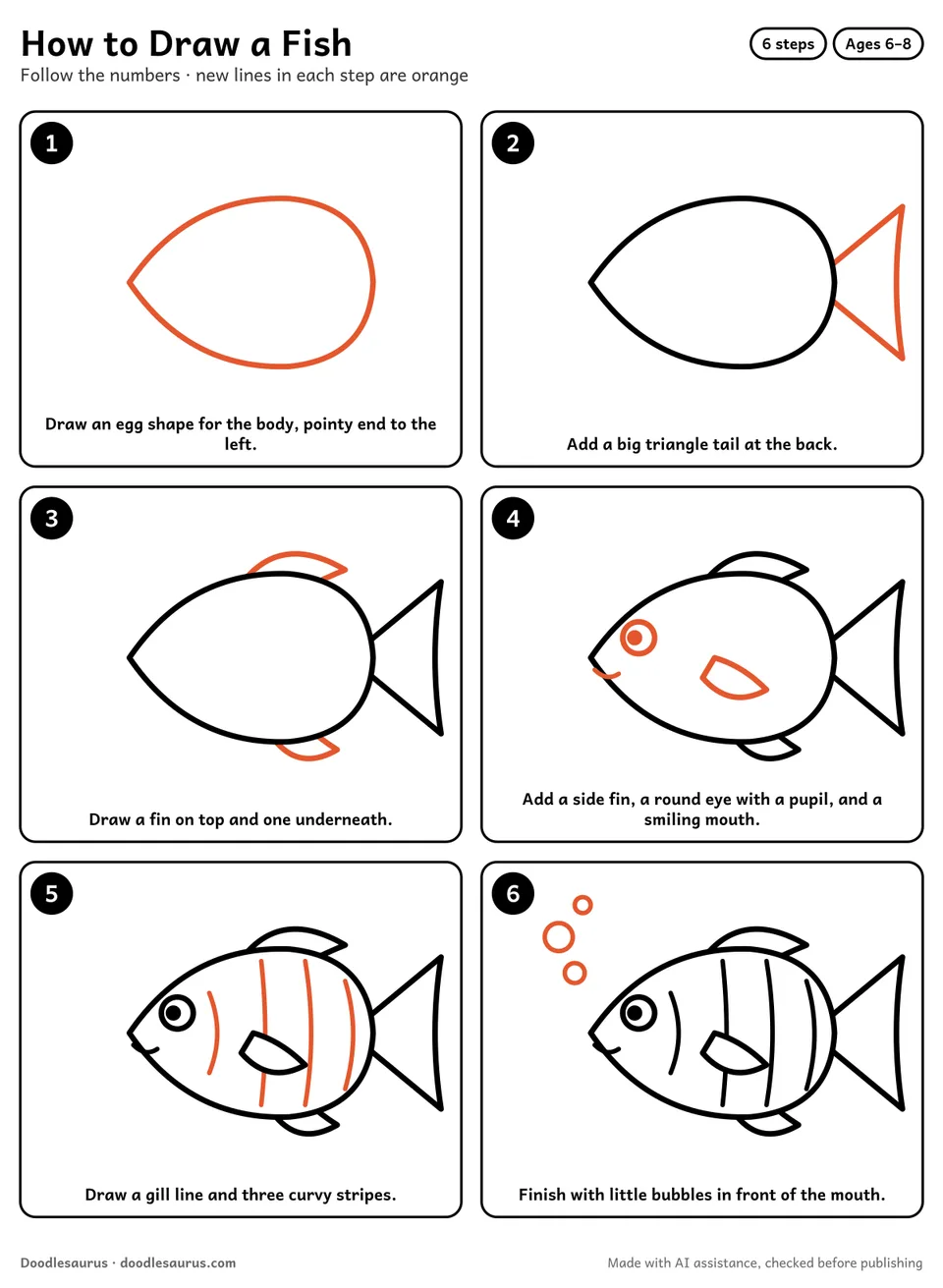
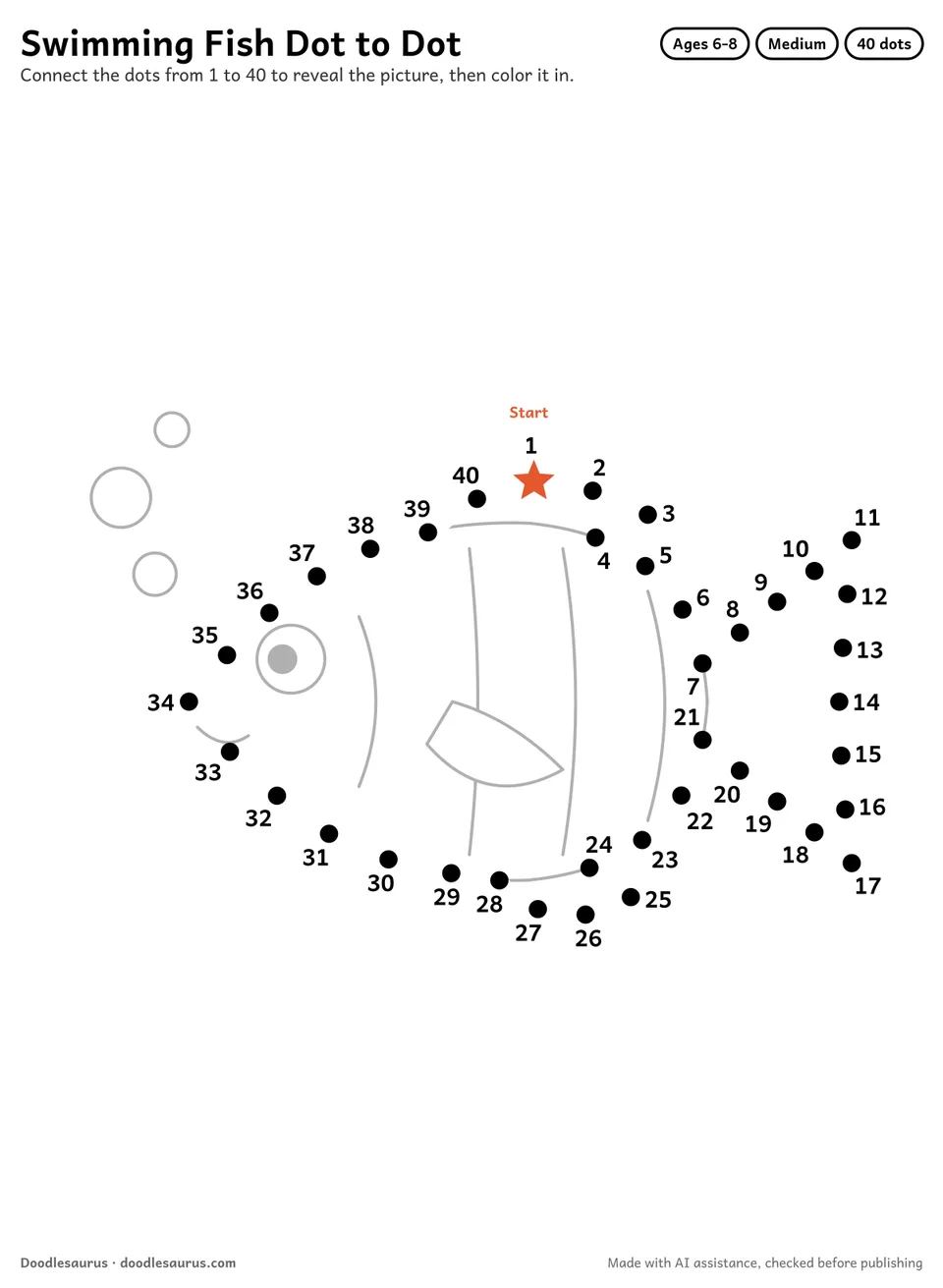
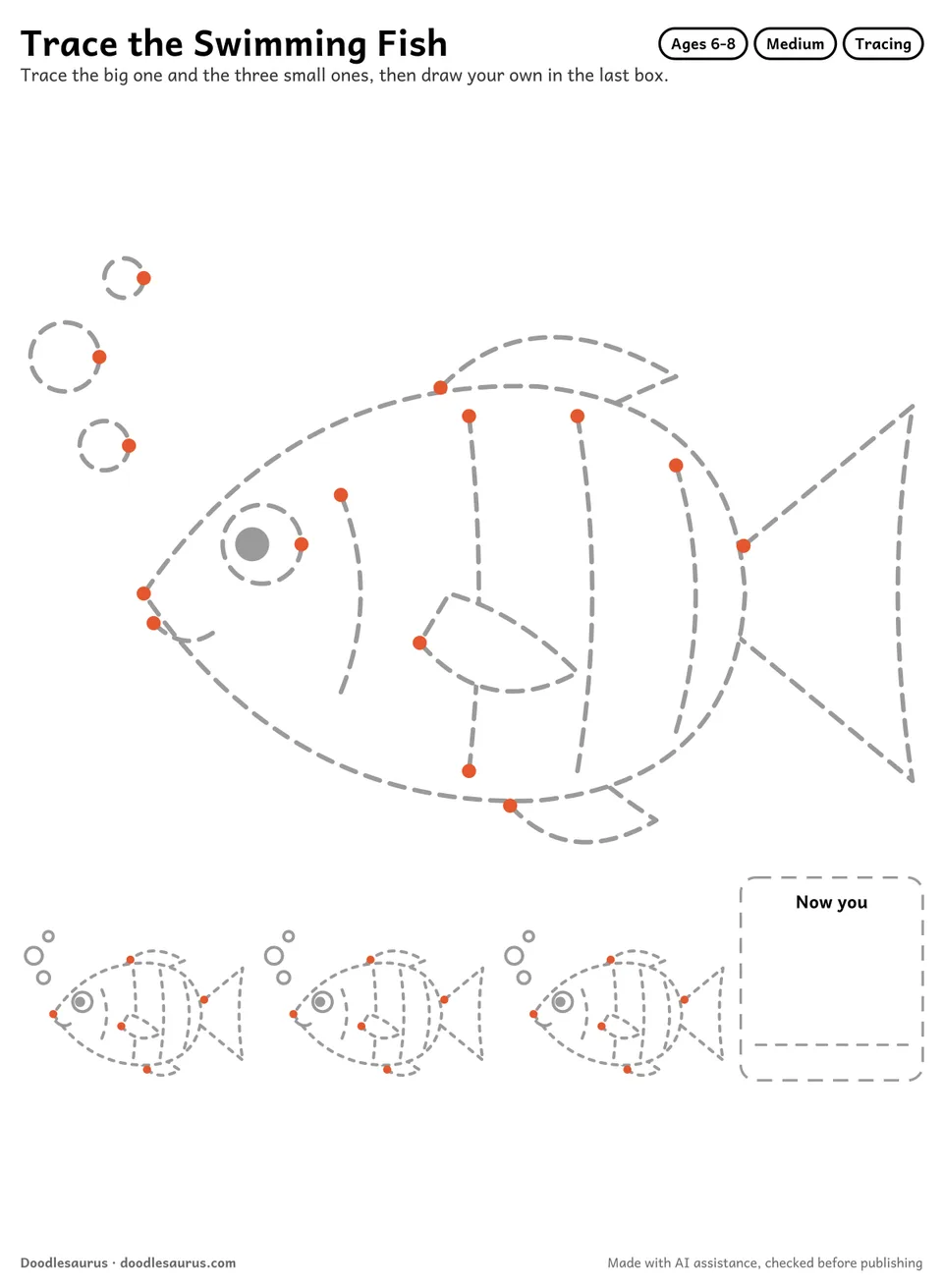
The same fish shape is used for a coloring page, a 6-step how to draw sheet, a dot to dot at 24, 40 and 57 dots, and an easy and a medium tracing worksheet.
About this printable
- Made with AI assistance (vector drawing authored by a language model) and checked by automated tests and an AI reviewer.
- Checked by automated tests and an AI reviewer on 22 Oct 2026.
- Free for personal and single-classroom use. See the license. Read the license · How these are made · Report a problem.
- Vector PDF, 2 pages, 186×254 mm art box — prints edge-safe on A4 and US Letter.
New printables, twice a month
Our newsletter starts soon, with new sheets twice a month and a free 10-page starter pack for every new reader.