
Fox Tracing Worksheets with a Bushy Tail
Fox tracing worksheets with a sitting fox and a bushy tail: one big fox for ages 3 to 5, four foxes and a Now you box for 6 to 8. A4 or US Letter.
Choose a level
Sitting Fox Tracing Worksheet
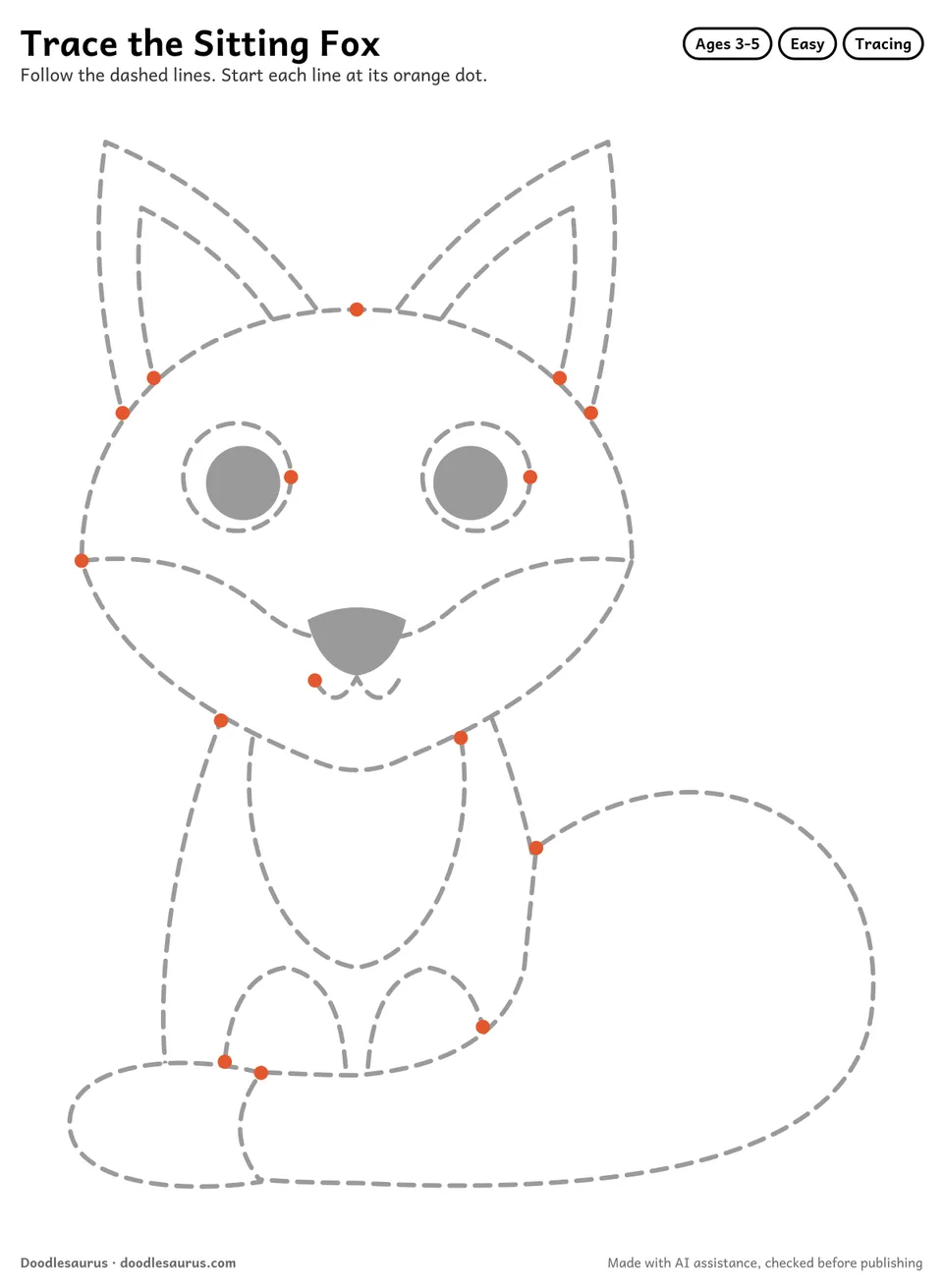
The tail does a lot of the work on this sitting fox: it is a huge, smooth line that sweeps all the way around the front. Each stroke has its own orange start dot. The pupils and the nose are already gray.
Easy: one large fox
One big fox fills the easy page, sized for ages 3 to 5. Most of its lines are long and smooth: the wide head, two tall ears with inner lines, a wavy cheek line and a slim body with an oval chest. The mouth and the eye rings add a few tighter turns, and a young child can focus on staying on the dashes and slowing down at each bend.
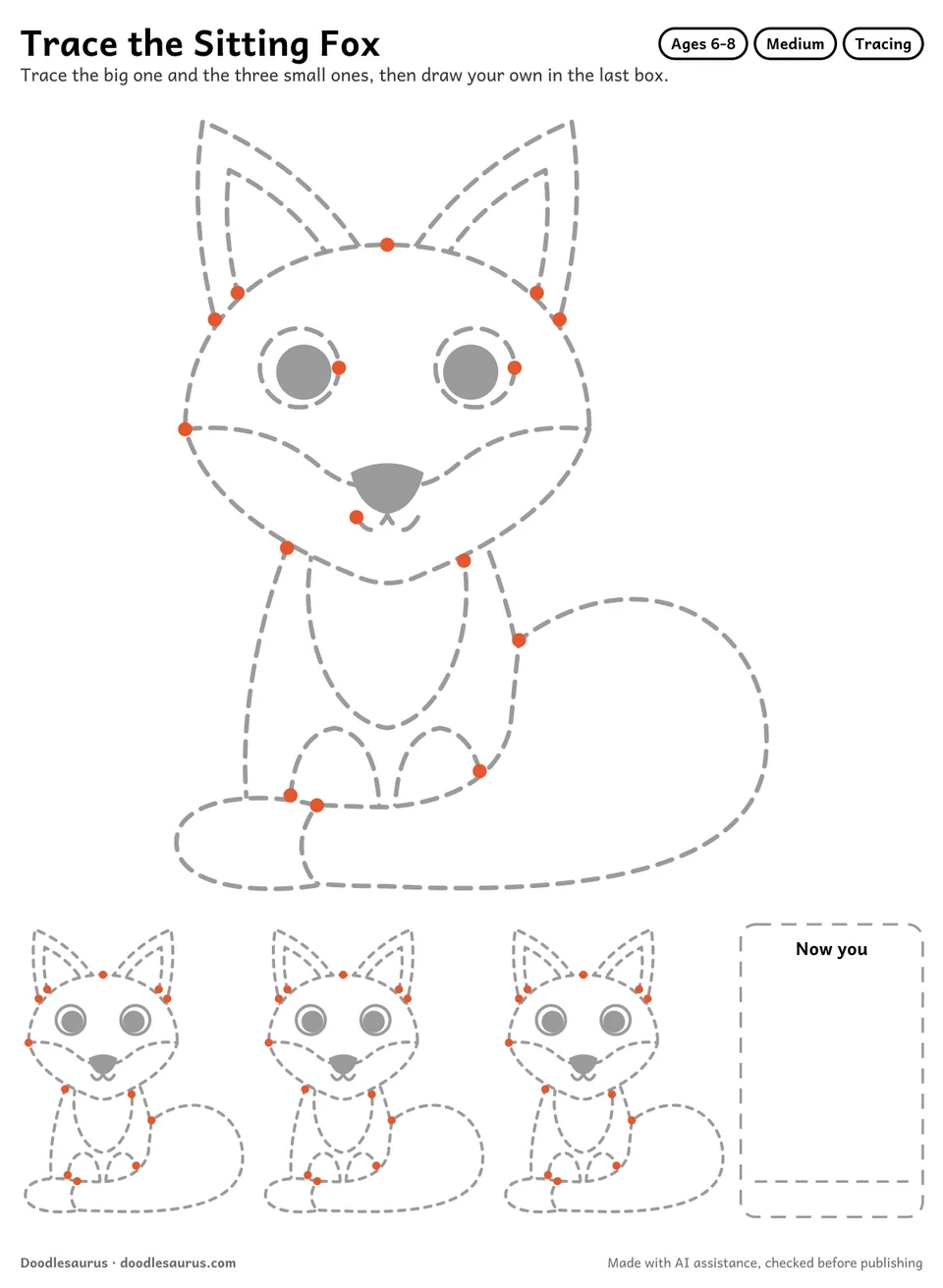
Medium: four foxes and a free box
Three smaller foxes sit in a row under a large dashed one on the medium page for ages 6 to 8, where every curve is shorter and the pencil changes direction more often. Shrunk to fit, those dashes get very short and hard to follow, so the A4 or Letter file belongs at 100 percent. On the right, a blank space labeled Now you is for a fox drawn with no guide lines.
Skills practiced & tips
- Point out the orange dot at the start of each dashed line, then trace it together with a finger.
- Begin with the long outline of the head, then do the ears, the body and the tail.
- Save the small curves, like the mouth and the eye rings, for when the hand is warmed up.
- Offer a thick crayon for the big fox and a sharp pencil for the three little ones.
- Color the fox once the tracing is done so the dashed lines become a finished picture.
Fox fun facts
- Foxes can hear very quiet sounds, which helps them find mice moving under leaves or snow.
- Fox families often live in an underground den, sometimes dug by another animal first.
- When it turns quickly or jumps, a fox uses its tail for balance.
Classroom ideas
- Preschool (ages 3 to 5): slide the easy page into a plastic sleeve so children can trace it again and again with a dry-erase marker.
- Kindergarten: split the medium sheet over two sessions, tracing the large fox first and the small foxes and Now you box the next day.
- Grade 1: after drawing a fox in the Now you box, students label the ears, tail and paws.
More fox activities
More tracing
Frequently asked questions
Does the fox's tail really wrap around the front?
Yes. On this sitting fox the bushy tail is a huge, smooth line that sweeps all the way around the front, and it is traced after the head, the ears and the body.
What goes in the blank space on the right of the medium fox page?
A fox drawn with no guide lines. The space is labeled Now you and sits at the end of the row of three small foxes, under the large dashed fox, on the medium page for ages 6 to 8.
Where should we start on the fox?
With the long outline of the head, then the ears, the body and the tail. The mouth and the eye rings are small curves, so they can wait until the hand is warmed up.
About this printable
- Made with AI assistance (vector drawing authored by a language model) and checked by automated tests and an AI reviewer.
- Checked by automated tests and an AI reviewer on 22 Oct 2026.
- Free for personal and single-classroom use. See the license. Read the license · How these are made · Report a problem.
- Vector PDF, 1 page, 186×254 mm art box — prints edge-safe on A4 and US Letter.
New printables, twice a month
Our newsletter starts soon, with new sheets twice a month and a free 10-page starter pack for every new reader.