
Duck Dot to Dot Pages with 29, 47 or 57 Dots
Duck dot to dot printables of a standing duck in 29, 47 or 57 dots, around two tail points and webbed feet. Free connect the dots with an answer page each.
Choose a level
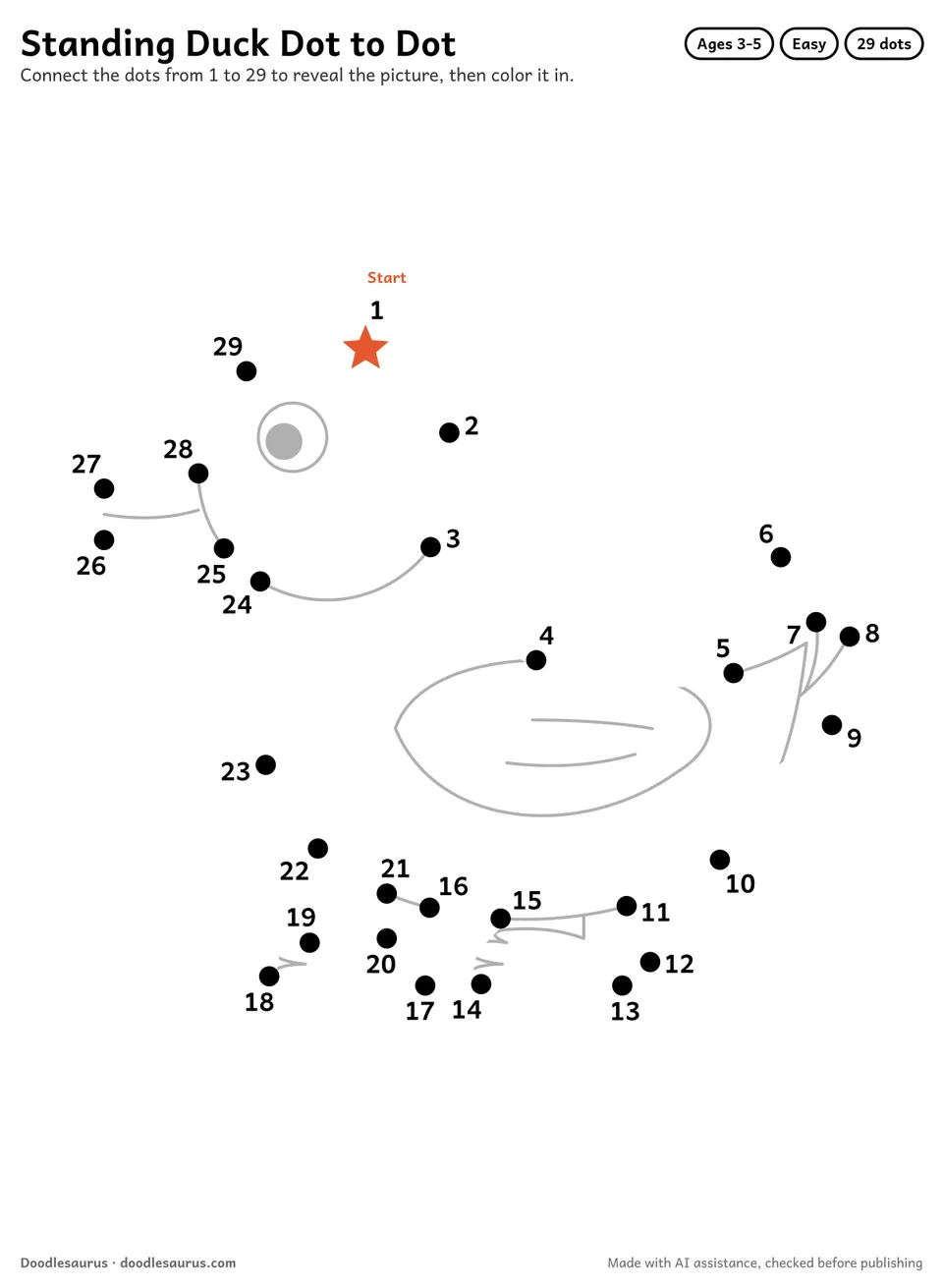
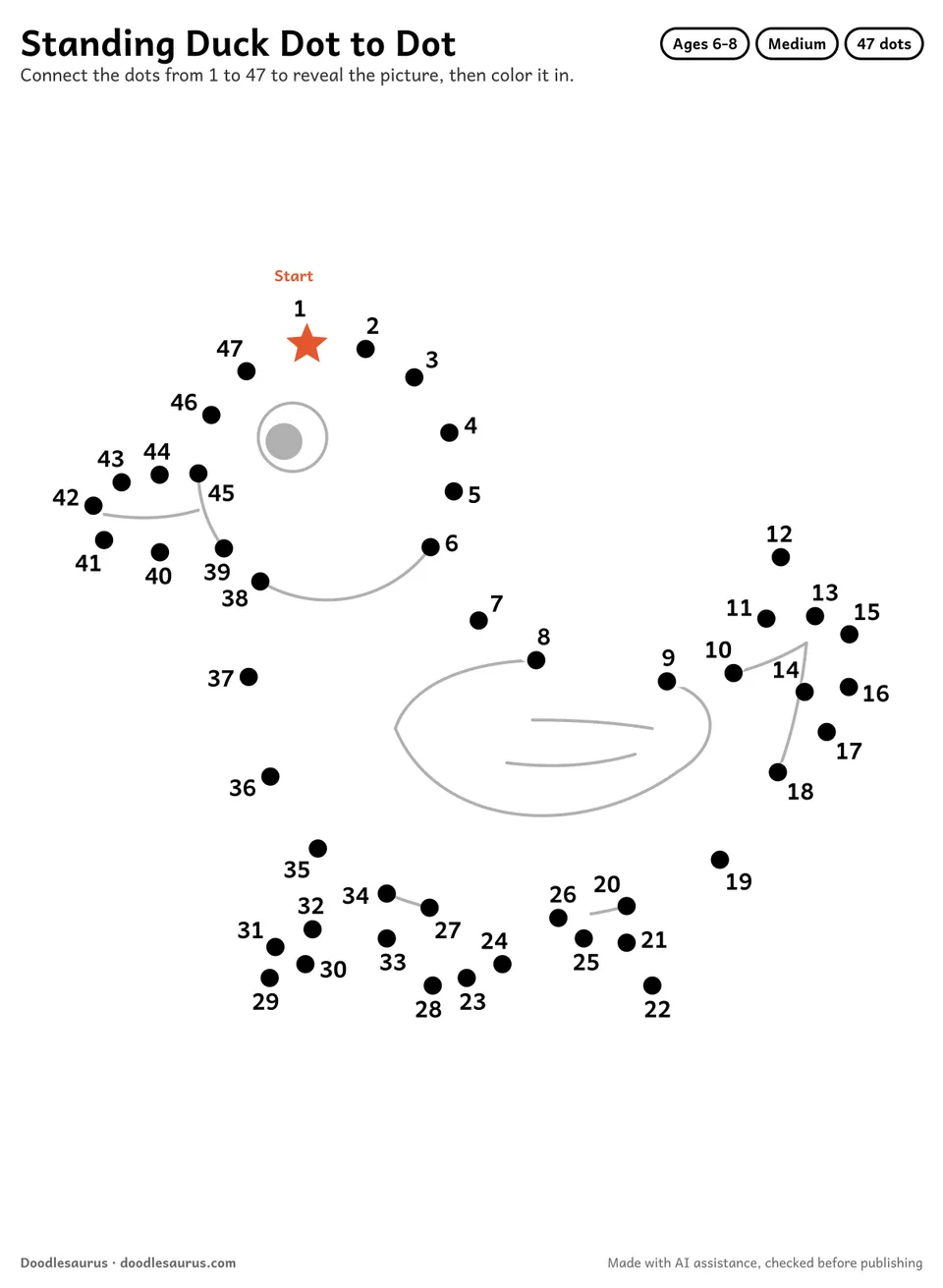
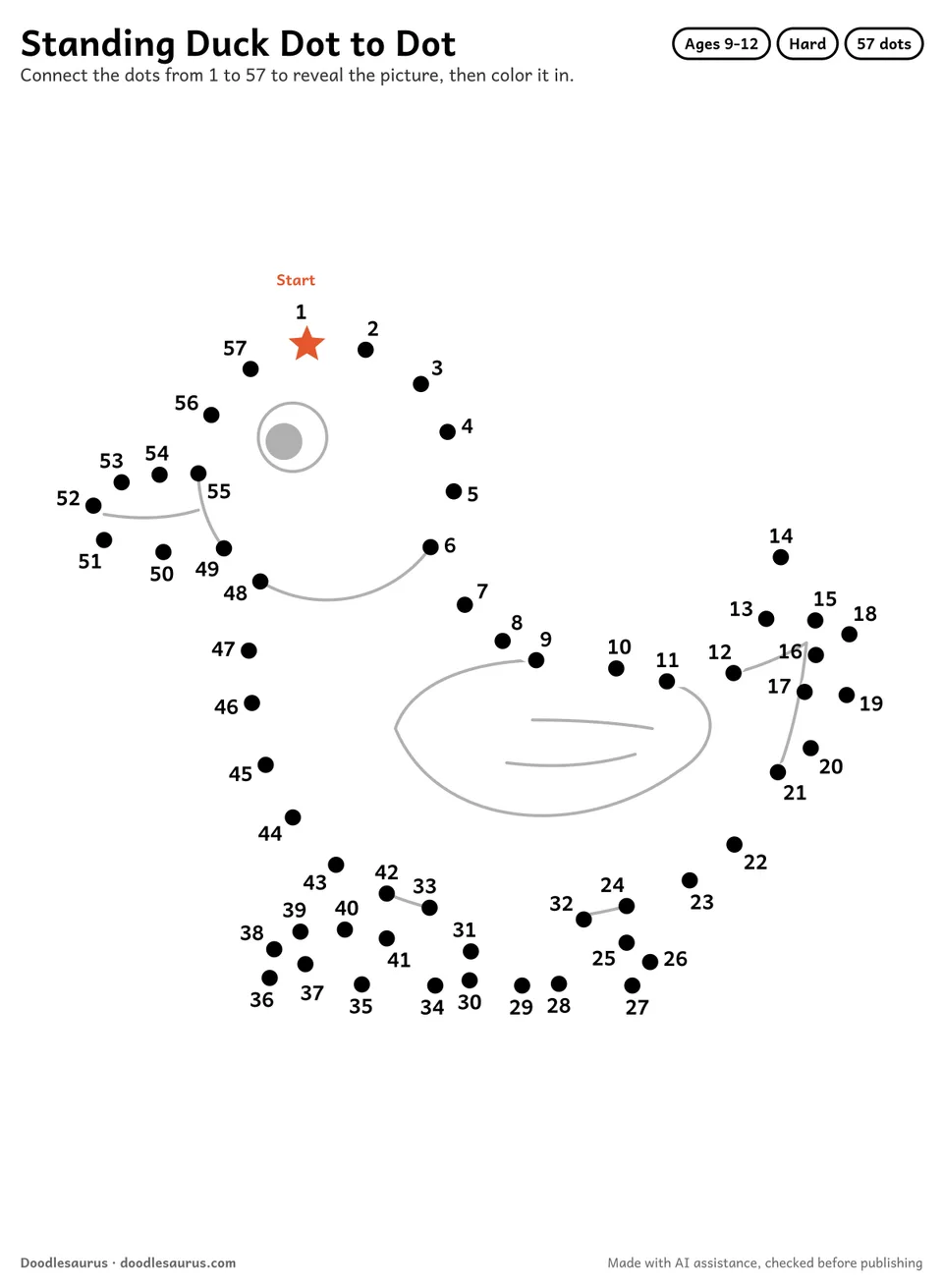
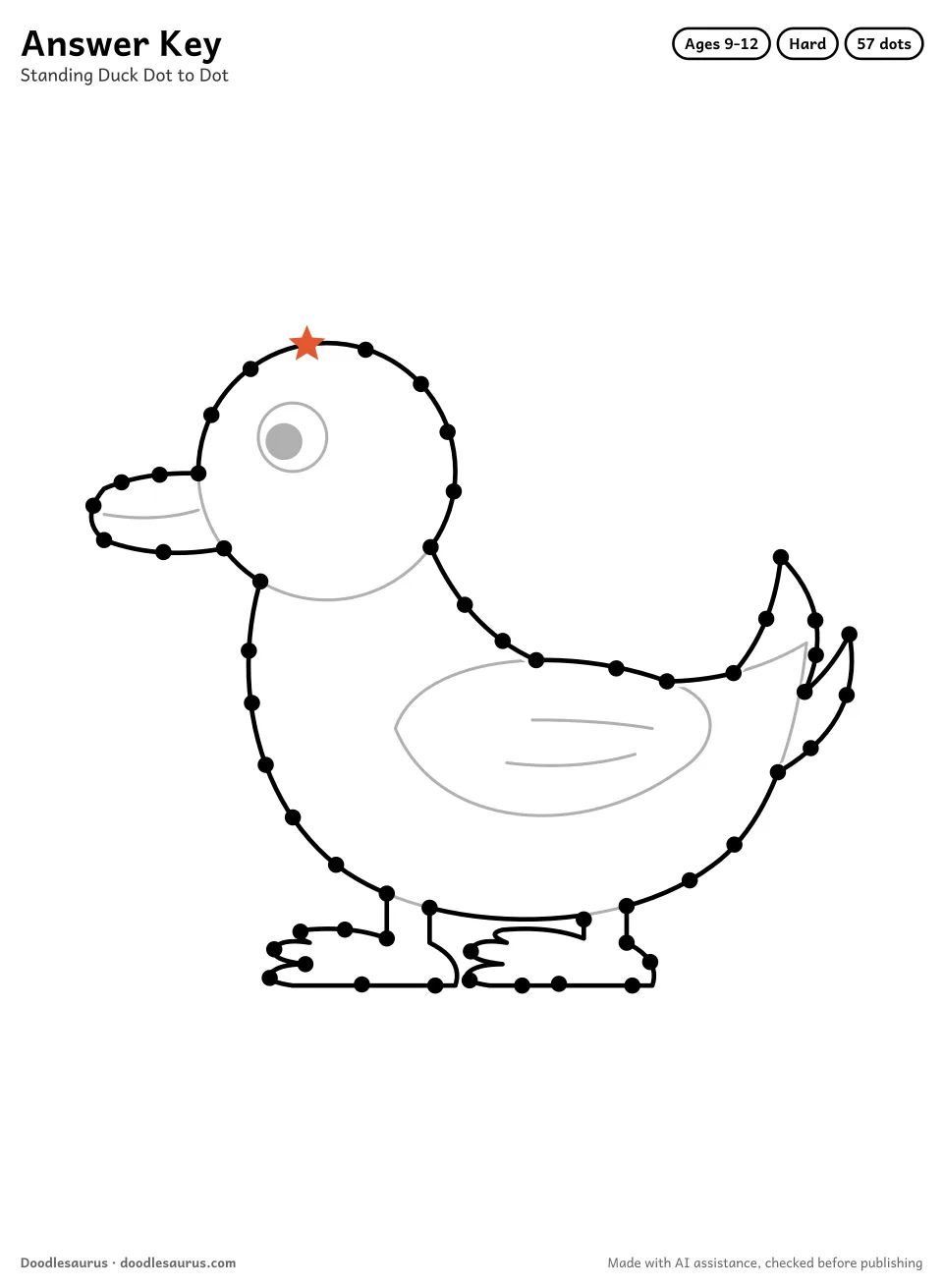
Two pointed tail feathers on the right and webbed feet along the bottom turn this duck dot to dot into more than a simple oval. They are where the levels differ most. The standing duck has 29 dots on its easy page for ages 3 to 5, 47 on the medium page for ages 6 to 8 and 57 on the detailed page for ages 9 to 12.
Down the neck and around the bill
Every sheet starts at an orange star marked Start on top of the head. The line runs down the back of the neck, along the back and up into the two tail points. Then it curves under the body to the feet, which take a busy stretch of numbers. After the feet the path climbs the chest, goes around the flat bill and closes at the head.
Tail and toes on each level
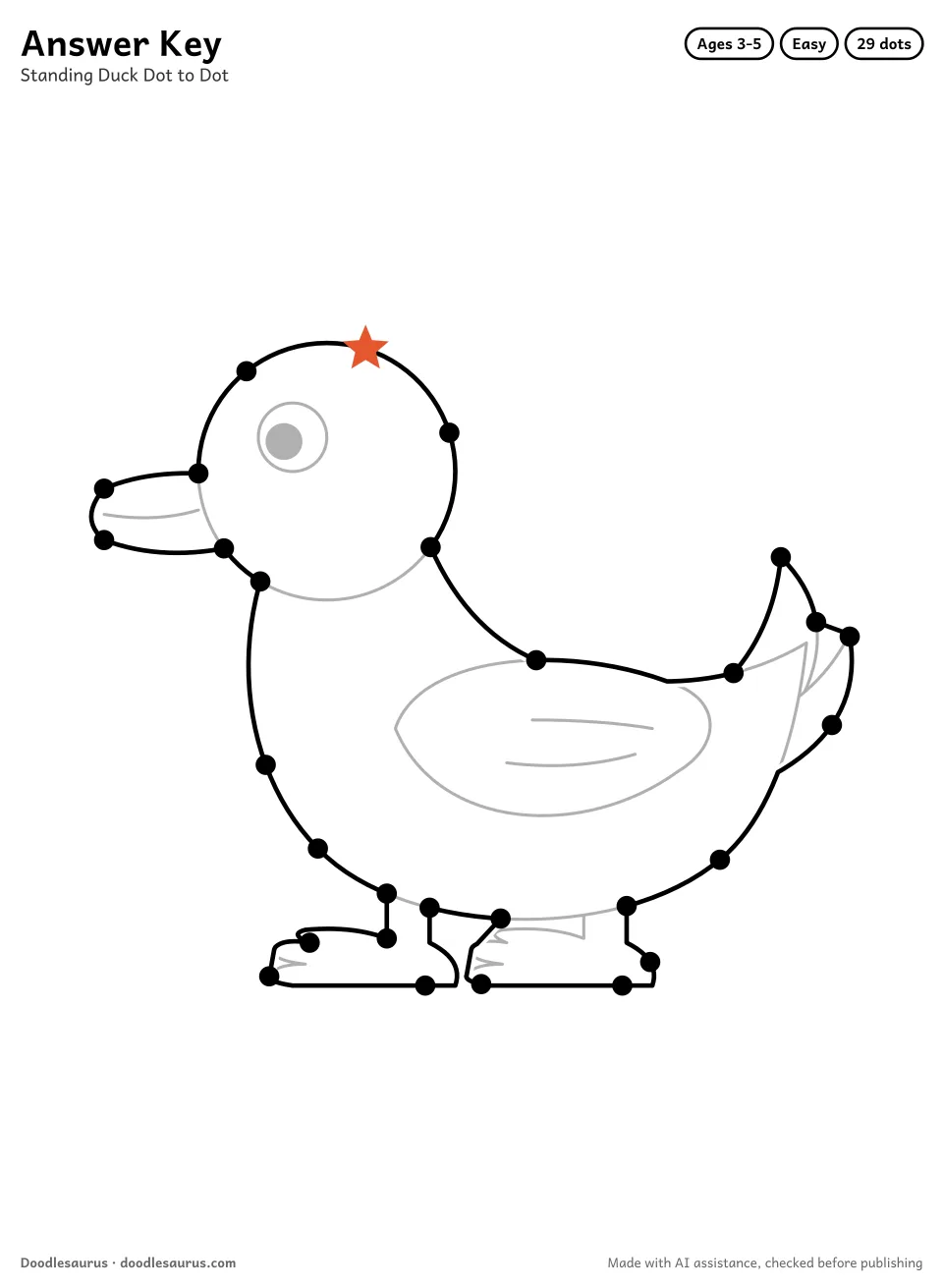
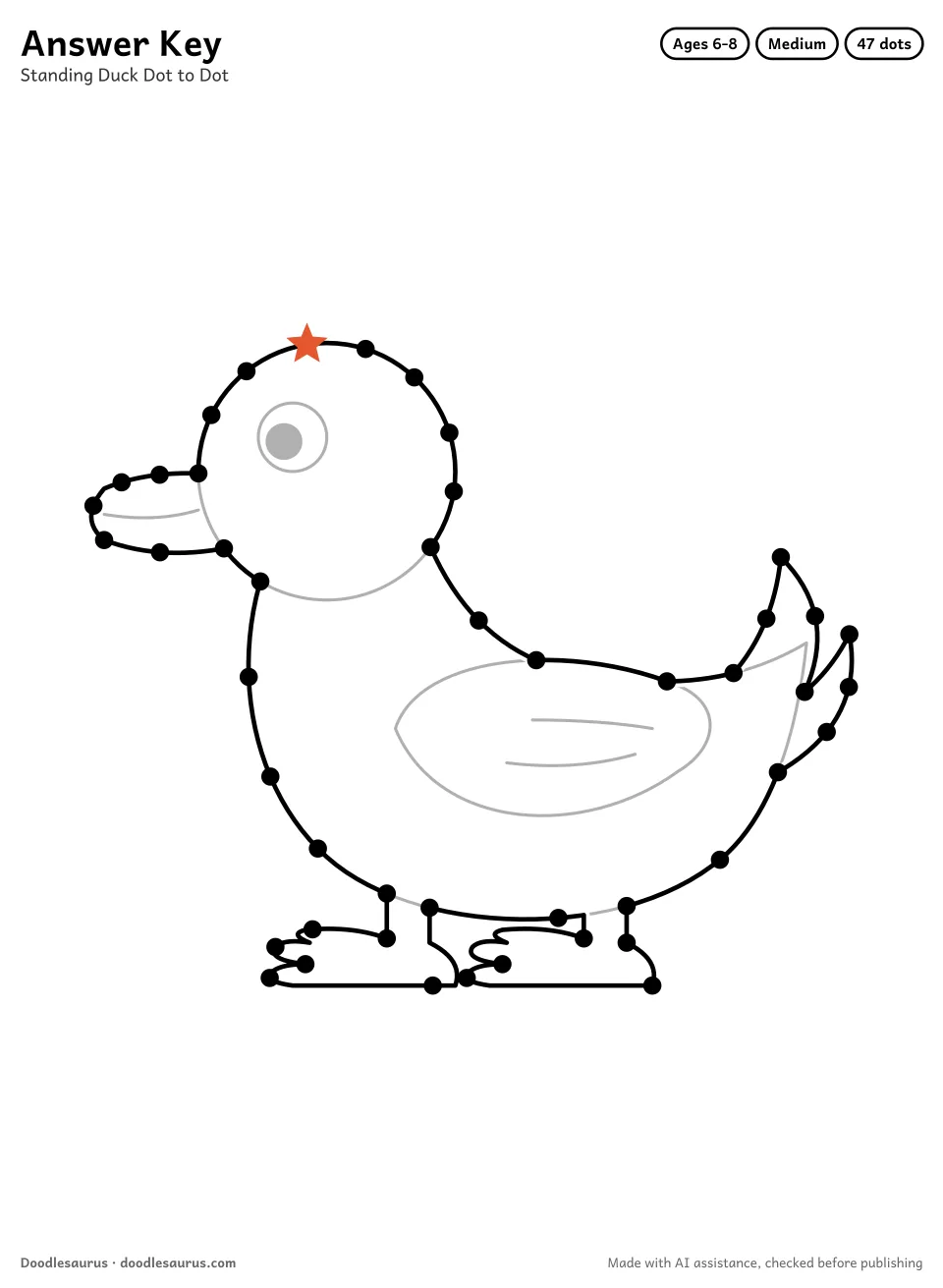
The easy line takes short cuts. It runs straight from one tail point to the other and straight past the toes, so the notch and the toes print in gray. On the medium and detailed pages the dots step in and out around each toe, and the 57-dot page adds more points around the tail and toes as well. Every page already shows a gray eye, a line across the bill, the curve of the neck, an oval wing with two feather strokes and the base of the tail, so the duck is recognizable early. The toe dots sit close. They keep their spacing only when the A4 or US Letter PDF prints at 100 percent. The finished duck is on a matching answer page for each level, for checking or as an extra picture to color.
Skills practiced & tips
- Find the orange star together and point to dot 2 before the pencil touches the paper.
- On the 29-dot page some gaps are long, so let the line bend with the round head and back instead of using a ruler.
- Slow down at the feet, where many numbers sit close together in a row.
- On the 57-dot page, read each number aloud across the feet, where dots 24 to 42 crowd together.
- Once the outline is closed, color the duck yellow or as a mallard.
Duck fun facts
- A male mallard has a shiny green head, while the female is mottled brown.
- Ducks spread oil from a gland near the tail over their feathers to keep them waterproof.
- Most ducks lose their flight feathers once a year and cannot fly for a few weeks while new ones grow.
Classroom ideas
- Preschool (ages 3 to 5): count from 1 to 29 aloud as a group while each child joins the easy duck.
- Grade 1: hand out the 47-dot page and ask students to circle every even number before they start.
- Grades 4 and 5: give early finishers the 57-dot duck and let them mark their own work with the answer page.
More duck activities
More dot to dot
Frequently asked questions
Why do so many numbers pile up at the duck's feet?
Each webbed foot has toes along the bottom, and on the medium and detailed pages the line steps in and out around every one. On the 57-dot page dots 24 to 42 crowd together across the feet.
Does the duck's wing get any dots of its own?
No. The oval wing with its two feather lines is printed in light gray on every page, along with the eye, the line across the bill, the neck curve and the base of the tail. The 57-dot page keeps them and adds more dots, and on the easy page the notch between the two tail points and the toes at the front of each foot are gray too.
Is there an answer page?
Yes, each level comes with its own answer page showing the finished duck outline, useful for checking or as an extra picture to color.
What changes between the easy and the detailed page?
The easy line runs straight across the notch between the two tail points and past the toes, which print in gray. The medium and detailed pages step in and out around each toe, and the 57-dot page adds more points around the tail and toes.
About this printable
- Made with AI assistance (vector drawing authored by a language model) and checked by automated tests and an AI reviewer.
- Checked by automated tests and an AI reviewer on 22 Oct 2026.
- Free for personal and single-classroom use. See the license. Read the license · How these are made · Report a problem.
- Vector PDF, 2 pages, 186×254 mm art box — prints edge-safe on A4 and US Letter.
New printables, twice a month
Our newsletter starts soon, with new sheets twice a month and a free 10-page starter pack for every new reader.