
Dog Maze in Three Levels with Answer Keys
No two levels of this dog maze share a Start and Finish: 85 wide cells for ages 3 to 5, 210 for ages 6 to 8 and 480 narrow ones for ages 9 to 12.
Choose a level
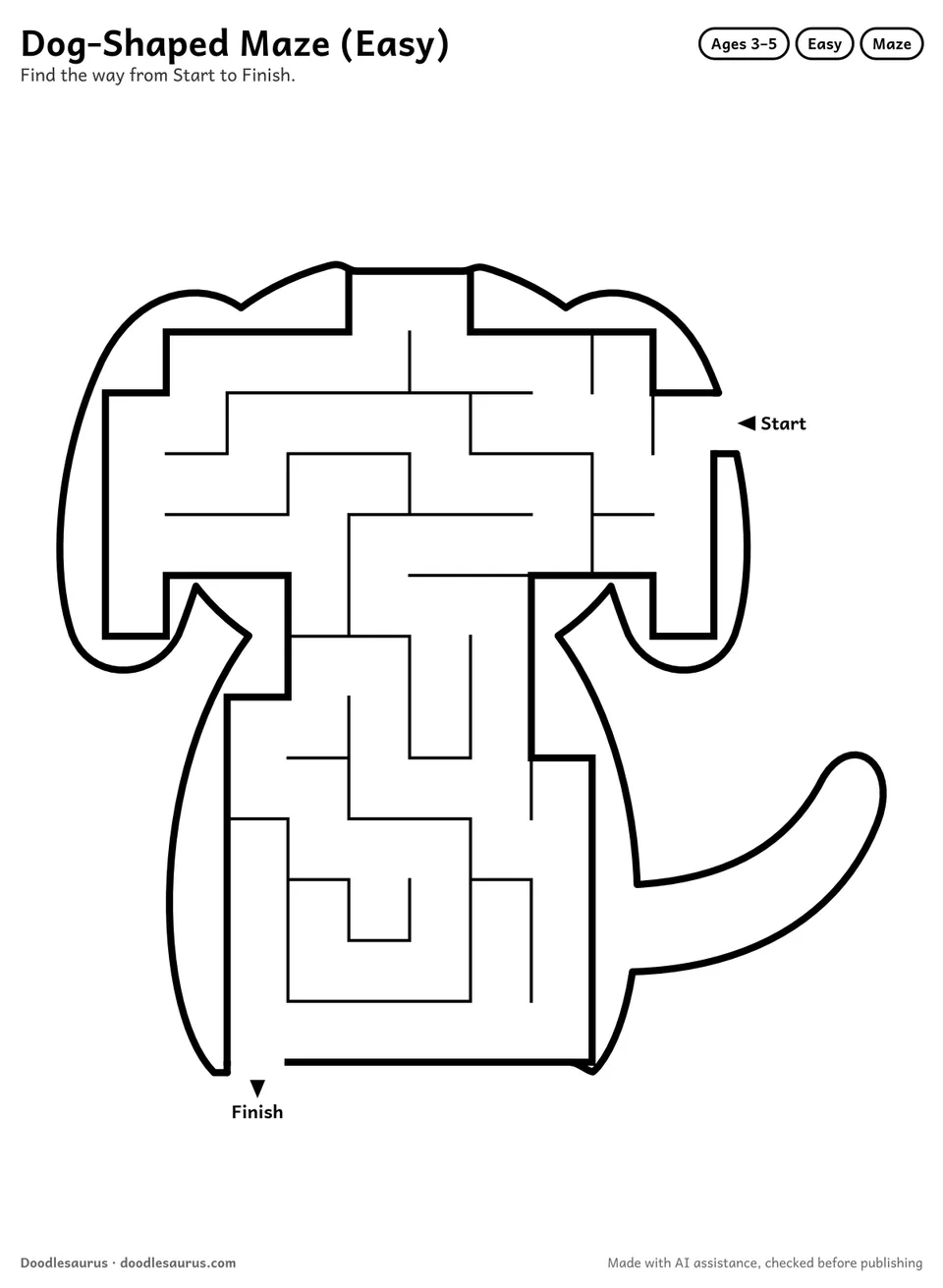
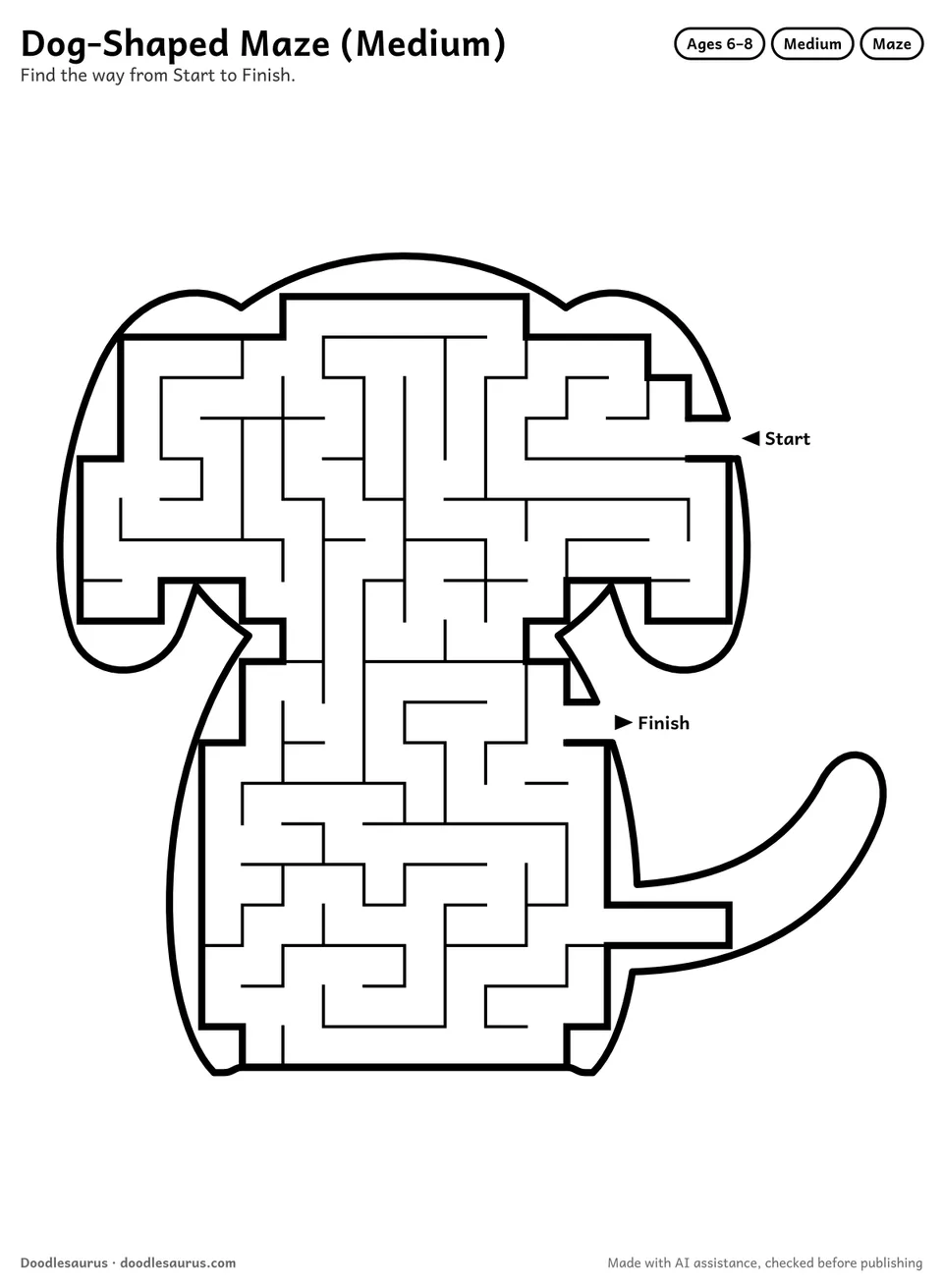
A sitting puppy
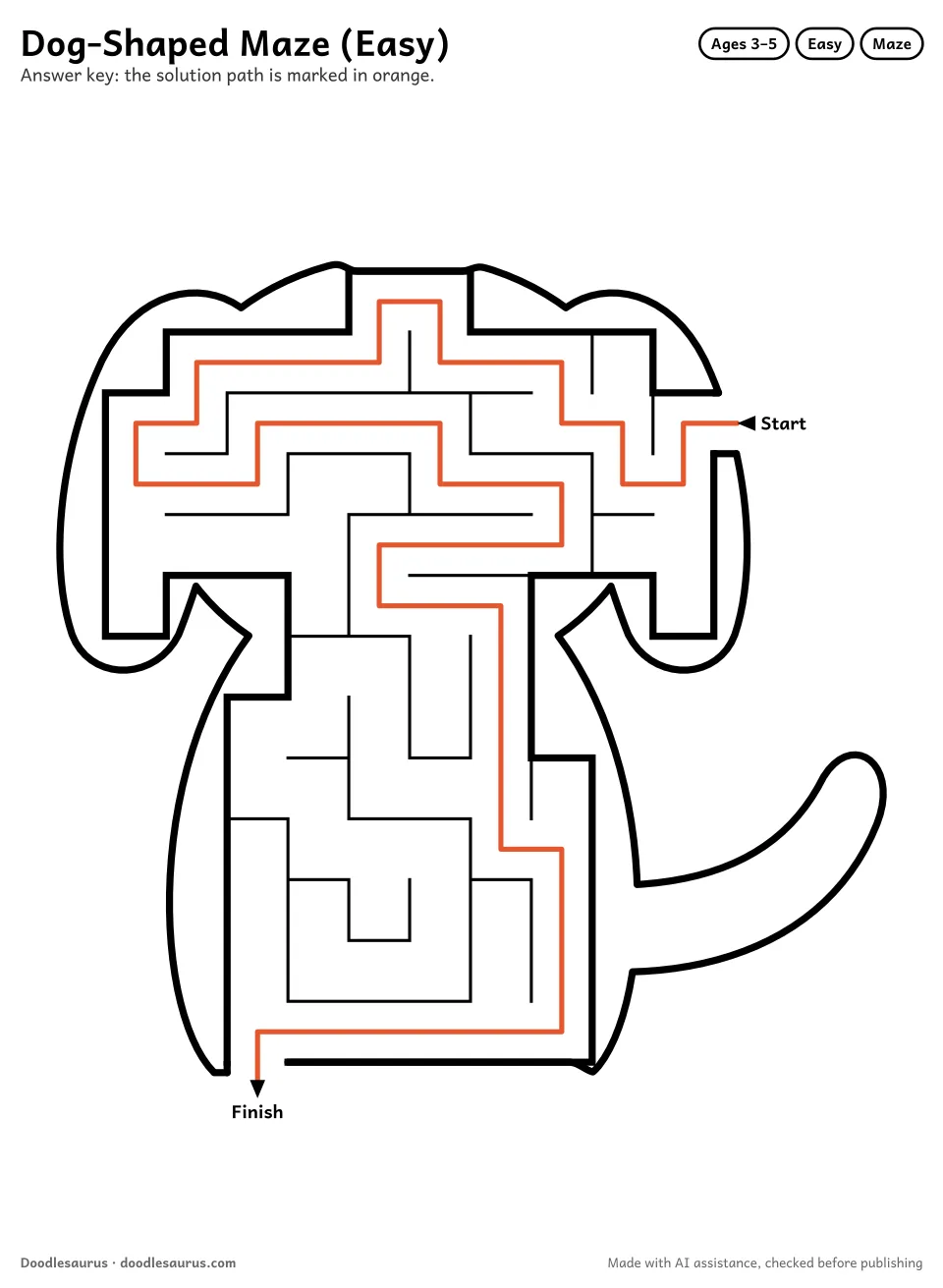
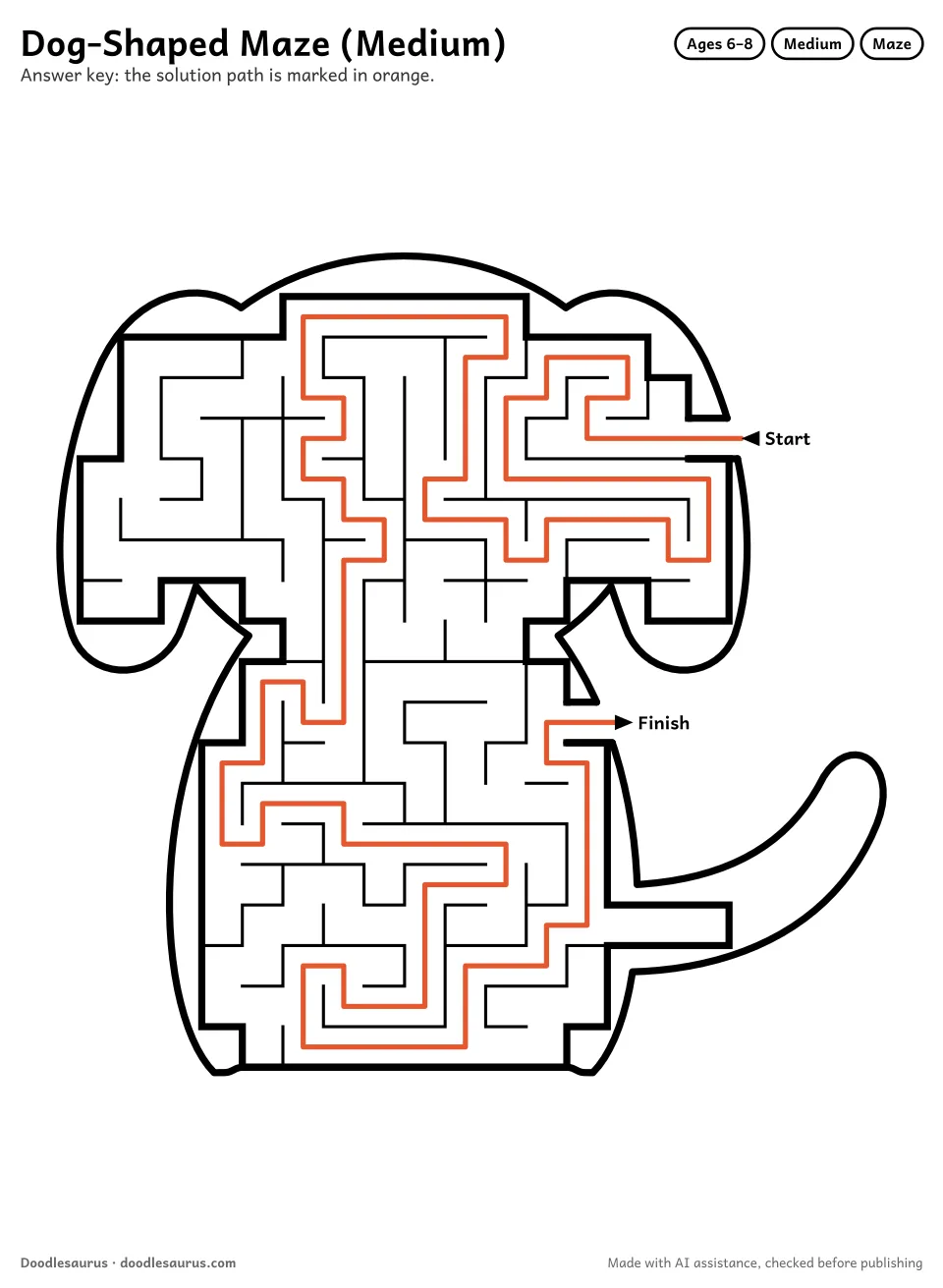
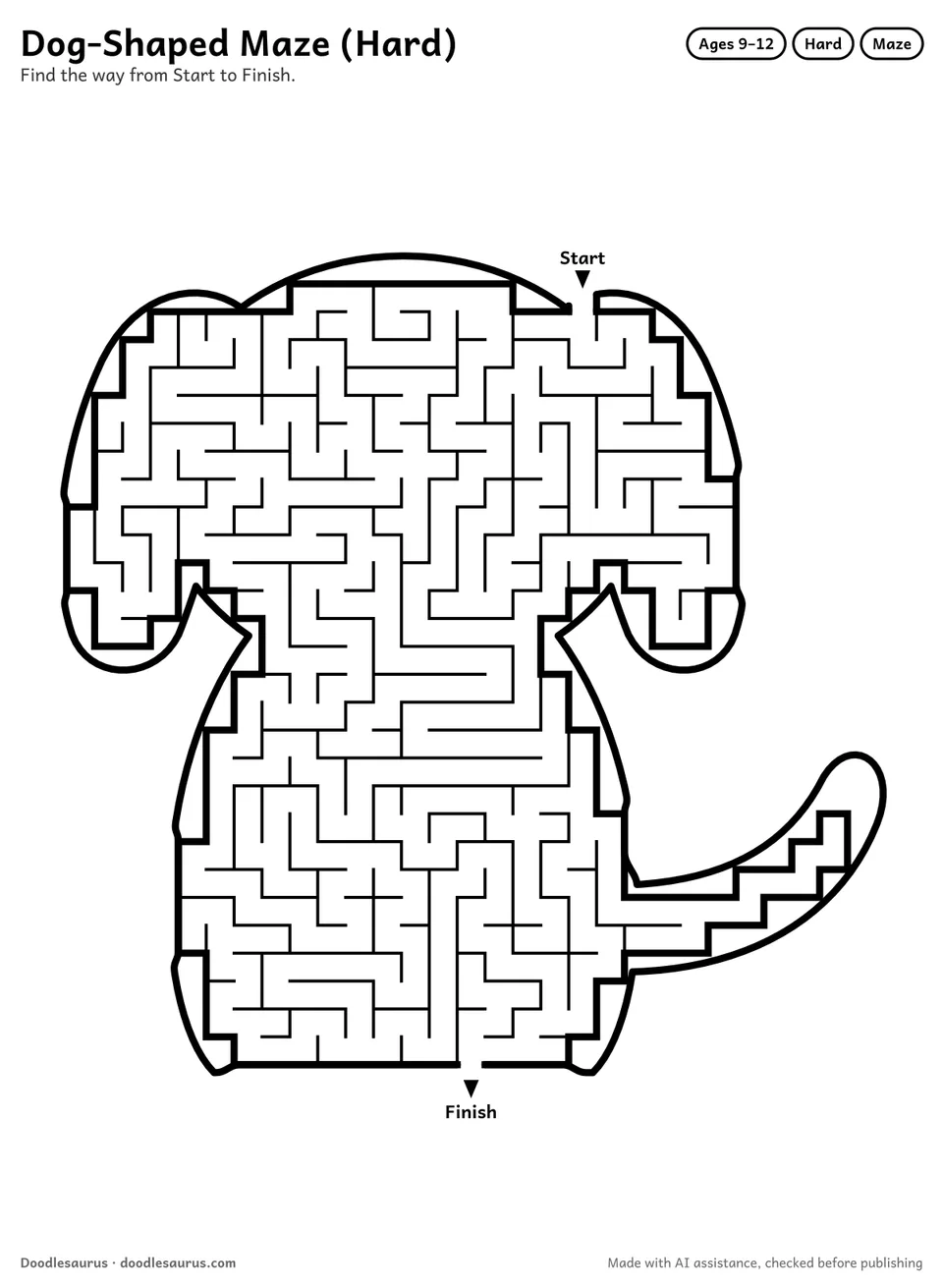
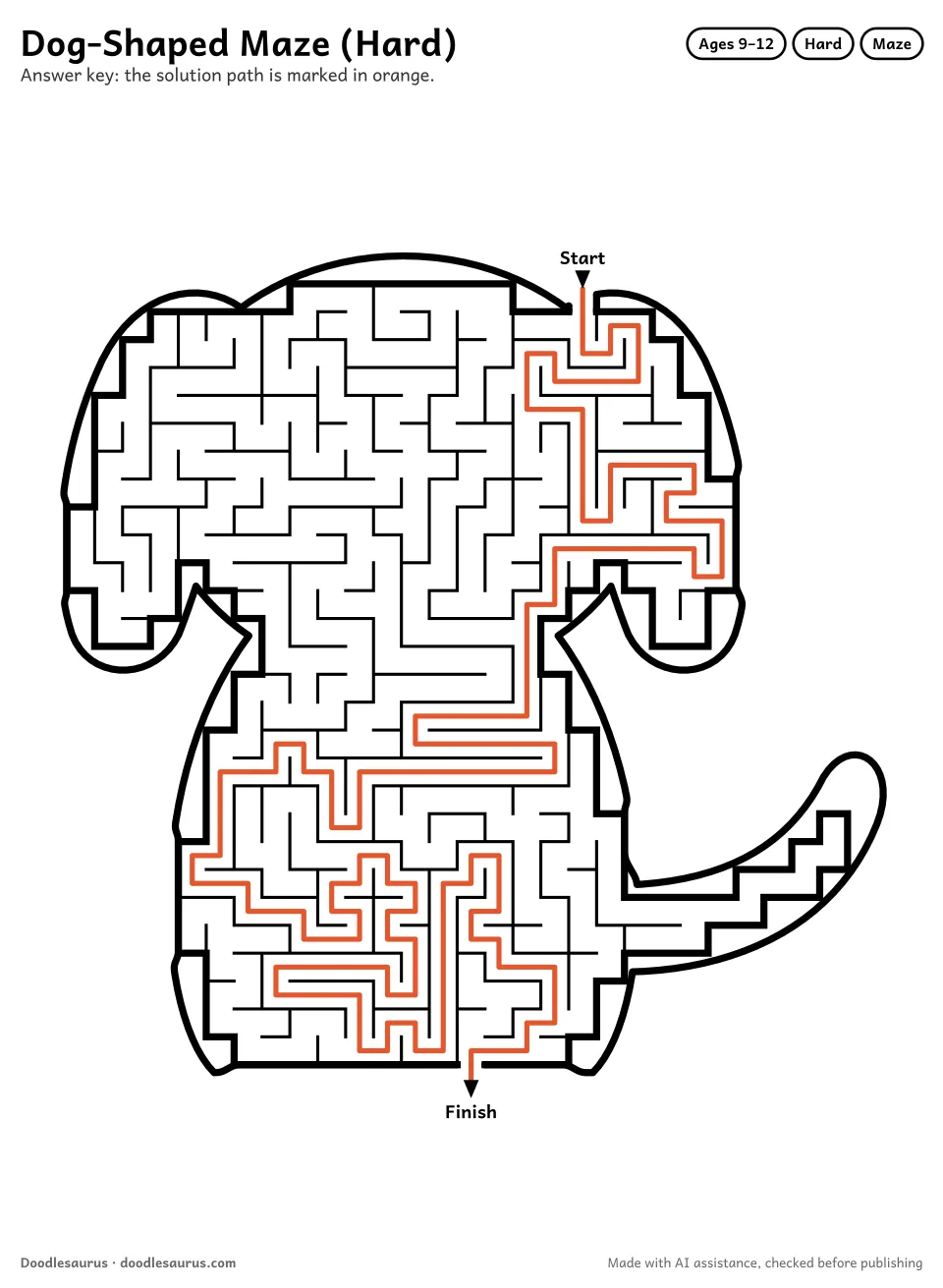
The sitting puppy on this dog maze has a round head with a floppy ear hanging down on each side, a tall body and a short tail curling up on the right. Walls follow that outline in small square steps and stay inside it. The child draws one unbroken line between the two arrows outside the shape, each at the end of a short channel through a gap, and page two of every PDF shows the answer.
Three levels of corridor
Each of the easy dog’s 85 cells is 12 mm wide, enough room for a preschooler’s crayon, and the route passes through 46 of them. It enters beside the right ear, crosses the head, winds down through the body and leaves below the base on the left. On this level the tail is outline only.
Ages 6 to 8 have 210 cells of 8 mm on the medium dog, with a 101-cell route between the right ear and the right side of the body, just under that ear.
The hard dog is a long job for ages 9 to 12: 480 cells only 5.5 mm wide and a route that winds through 143 of them, with passages that run down into both ears and up into the tail. Start sits above the head, right of the middle, and Finish below the base. A sharp pencil keeps the line inside those corridors, as long as fit to page has not shrunk them, so print the A4 or US Letter file at 100 percent. No two levels use the same pair of arrow spots, so the easy page gives no clue about the hard one.
Car rides and quiet mornings
It suits a car ride, a waiting room or a quiet start to the school day. Afterward many children color the dog and keep it.
Skills practiced & tips
- Look for both arrows before starting; no two levels use the same pair of spots.
- Let your child run a finger along the path first, then use a pencil.
- If the pencil hits a dead end, back up to the last place with a choice and try another turn.
- On the hard page, use a sharp pencil so the line stays inside the 5.5 mm corridors.
- When the route is done, color the dog around it as a brown, black or spotted pup.
Dog fun facts
- Greyhounds are among the fastest dogs and can run at about 45 miles per hour.
- All pet dogs, from tiny to giant breeds, descend from wolves.
- The Basenji, a hunting dog from Central Africa, rarely barks and makes a yodel-like sound instead.
Classroom ideas
- Pre-K (ages 3 to 5): solve the easy dog with a finger first, then with a thick crayon, as a pencil-control warm-up.
- Grade 1: work in pairs on the medium dog, one partner drawing while the other reads out each turn.
- Grades 4 to 6: compare the three route lengths, 46, 101 and 143 cells, and show them on a bar graph.
- Year 3 (UK): ask pupils to write directions for the easy route using left, right, up and down.
More dog activities
More mazes
Frequently asked questions
Which dog level needs a sharp pencil?
The hard one, whose 480 cells are only 5.5 mm wide and whose route runs through 143 of them. The medium dog has 210 cells of 8 mm and a 101-cell route, and the easy dog has 85 cells of 12 mm and a 46-cell route, wide enough for a chunky crayon.
Do the easy and hard dogs use the same pair of arrow spots?
No. The easy dog starts outside the right ear and finishes below the base on the left, while the hard dog starts above the head, right of the middle, and finishes below the base, a little right of the middle.
Do the ears and the tail hold paths?
On the easy dog the tail is outline only. The hard dog has passages that run down into both floppy ears and up into the tail.
Are Start and Finish close together on the medium dog?
Yes. Start is outside the right ear and Finish is beside the right side of the body, just under that ear, so the two arrows sit close together even though the route between them is 101 cells long.
About this printable
- Made with AI assistance (vector drawing authored by a language model) and checked by automated tests and an AI reviewer.
- Checked by automated tests and an AI reviewer on 22 Oct 2026.
- Free for personal and single-classroom use. See the license. Read the license · How these are made · Report a problem.
- Vector PDF, 2 pages, 186×254 mm art box — prints edge-safe on A4 and US Letter.
New printables, twice a month
Our newsletter starts soon, with new sheets twice a month and a free 10-page starter pack for every new reader.