
Bird Tracing Worksheets with a Songbird on a Twig
A songbird on a twig in dashed gray: bird tracing worksheets with one large bird for ages 3 to 5 and three small copies for 6 to 8. A4 and US Letter.
Choose a level
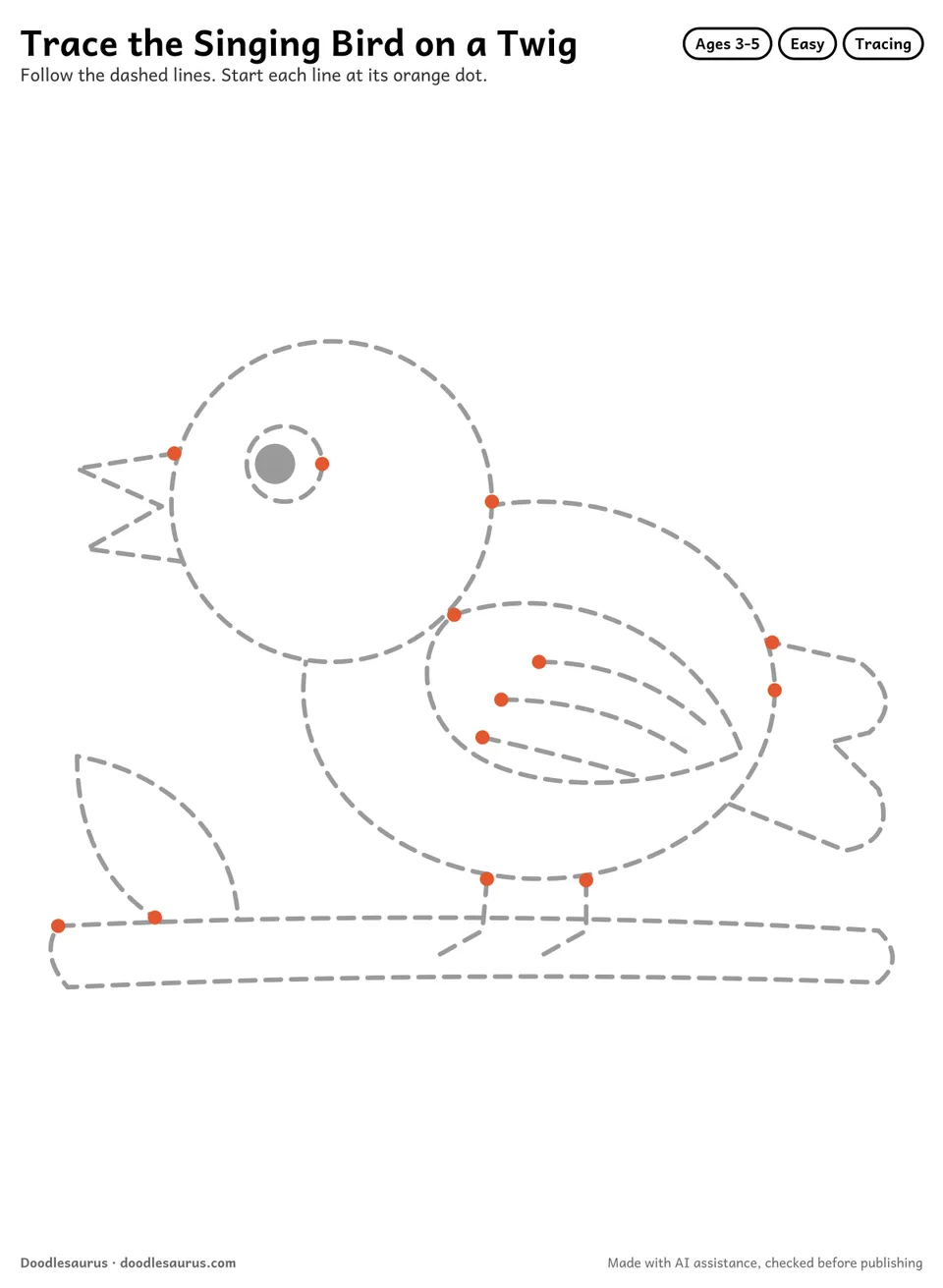
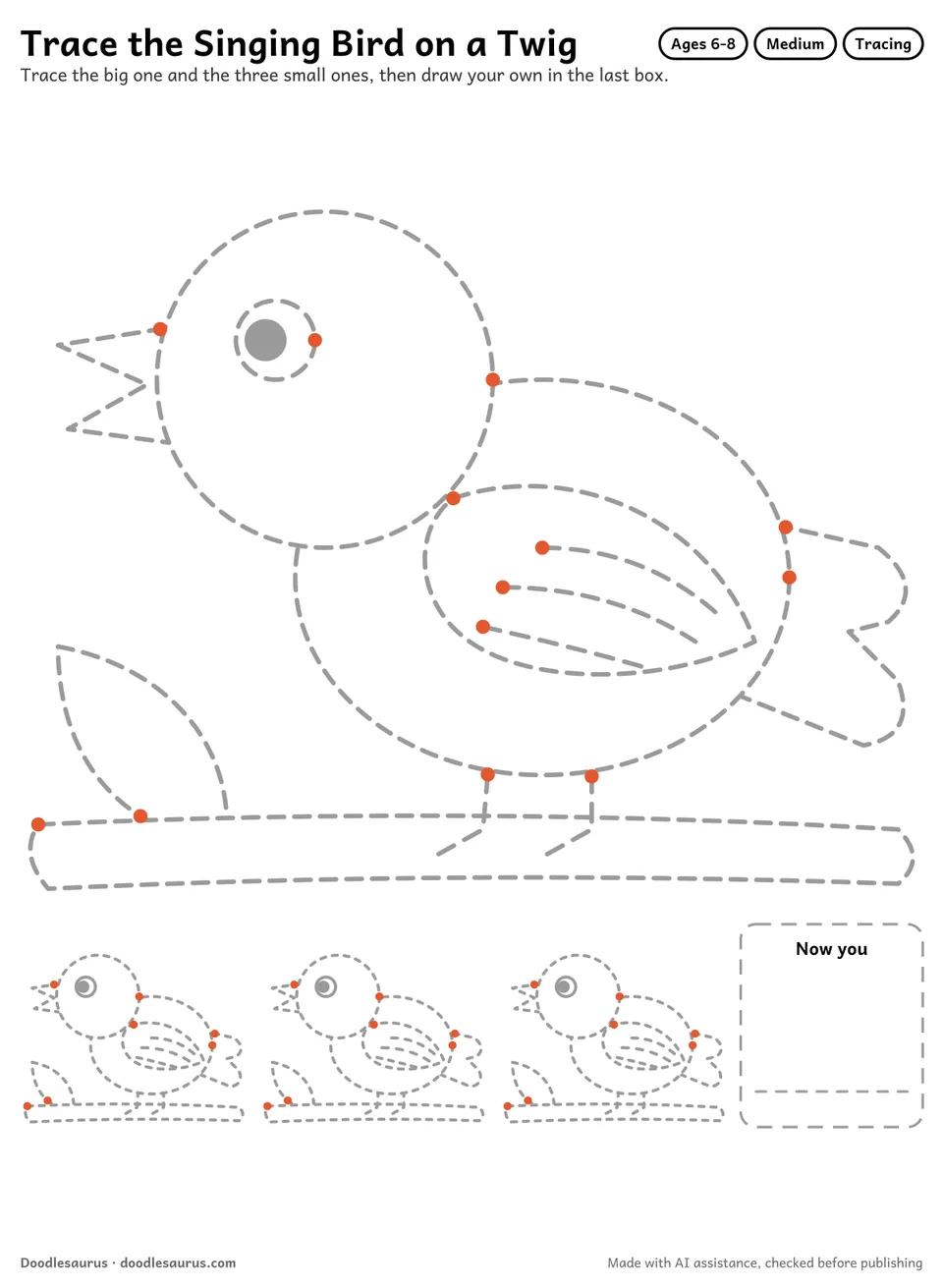
Singing Bird on a Twig Tracing Worksheet
A little songbird with an open beak perches on a twig here, every part of it drawn in dashed gray. Each stroke has an orange dot at its start, so a child can see where to begin and which way to go. Its pupil is already filled in gray.
Easy: one large bird
Two long, smooth curves carry most of the easy sheet for ages 3 to 5: a big circle for the head and a wide oval for the body. The beak takes two straight lines. The rest is shorter pieces: three gentle feather strokes on the wing, a zigzag tail edge, two legs with toes and a leaf at the end of the twig.
Medium: three more birds to trace
Under the same large bird, the medium sheet for ages 6 to 8 squeezes all 14 parts into three small birds, where curves turn faster and every stroke has to stop on time. Shrink the page and the dashes crowd too close to follow, so print the A4 or Letter PDF at 100 percent. A tall box marked Now you is left empty for a freehand try.
Skills practiced & tips
- Put a finger on an orange dot and slide it along the dashes before using the pencil.
- Begin with the large head circle and body oval, which are the easiest lines.
- Save the three short wing lines and the toes for when the hand is warmed up.
- Use a thick crayon on the easy sheet and a sharp pencil on the three small birds.
- Stop after the large bird if your child is tired and finish the rest another day.
Bird fun facts
- Birds have no teeth, so many swallow small stones that help grind food in a part of the stomach called the gizzard.
- Hummingbirds are the only birds that can fly backward.
- Many birds can see ultraviolet light, which people cannot see.
Classroom ideas
- Preschool (ages 3 to 5): put the easy page in a clear sleeve and trace it with dry-erase markers at a fine motor table.
- Kindergarten: trace the large bird on Monday and the three small birds on Tuesday, then draw one in the Now you box.
- Grade 1: after tracing, children color their bird and write what it is singing on the dashed line at the bottom of the Now you box.
More bird activities
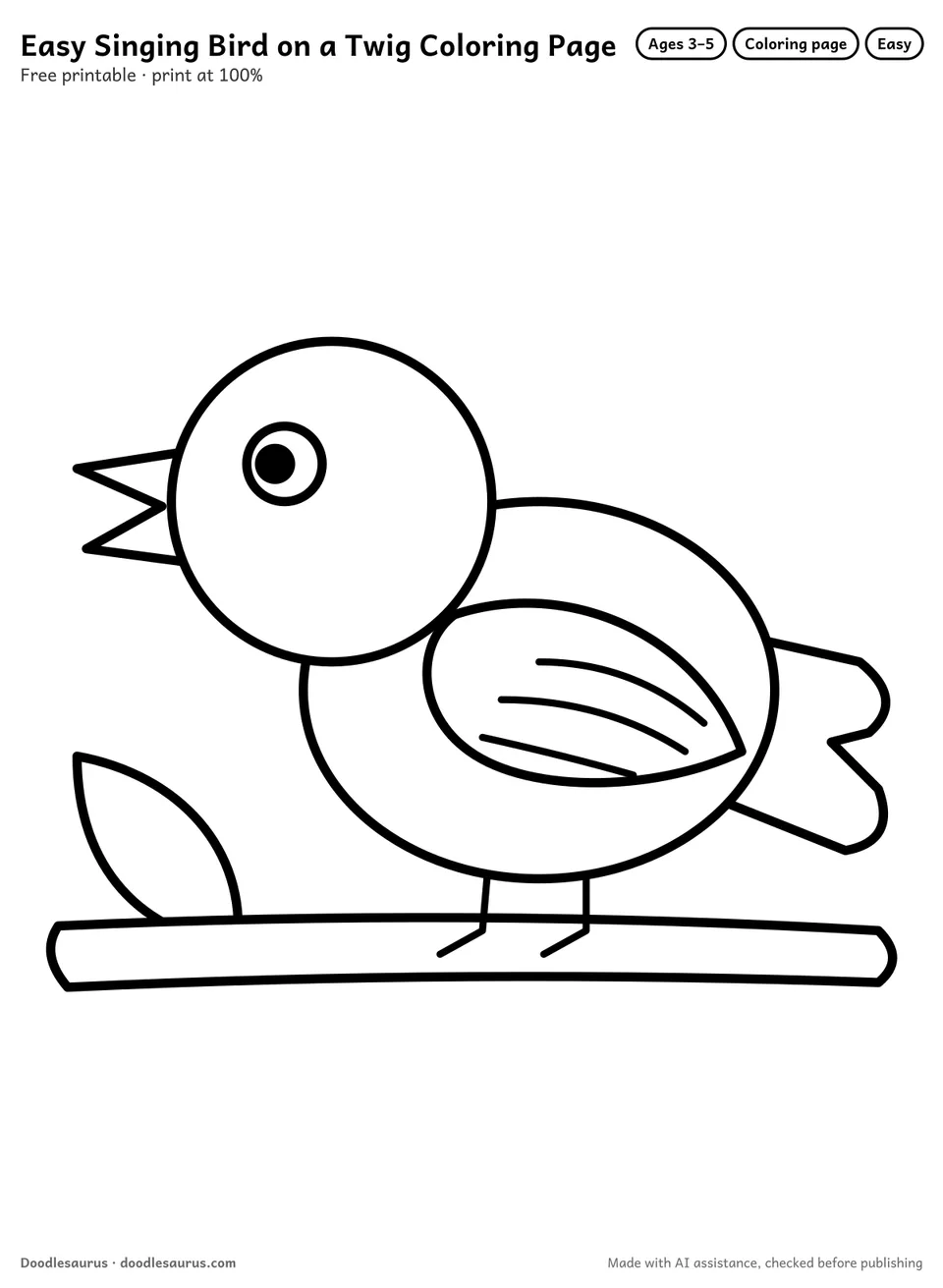
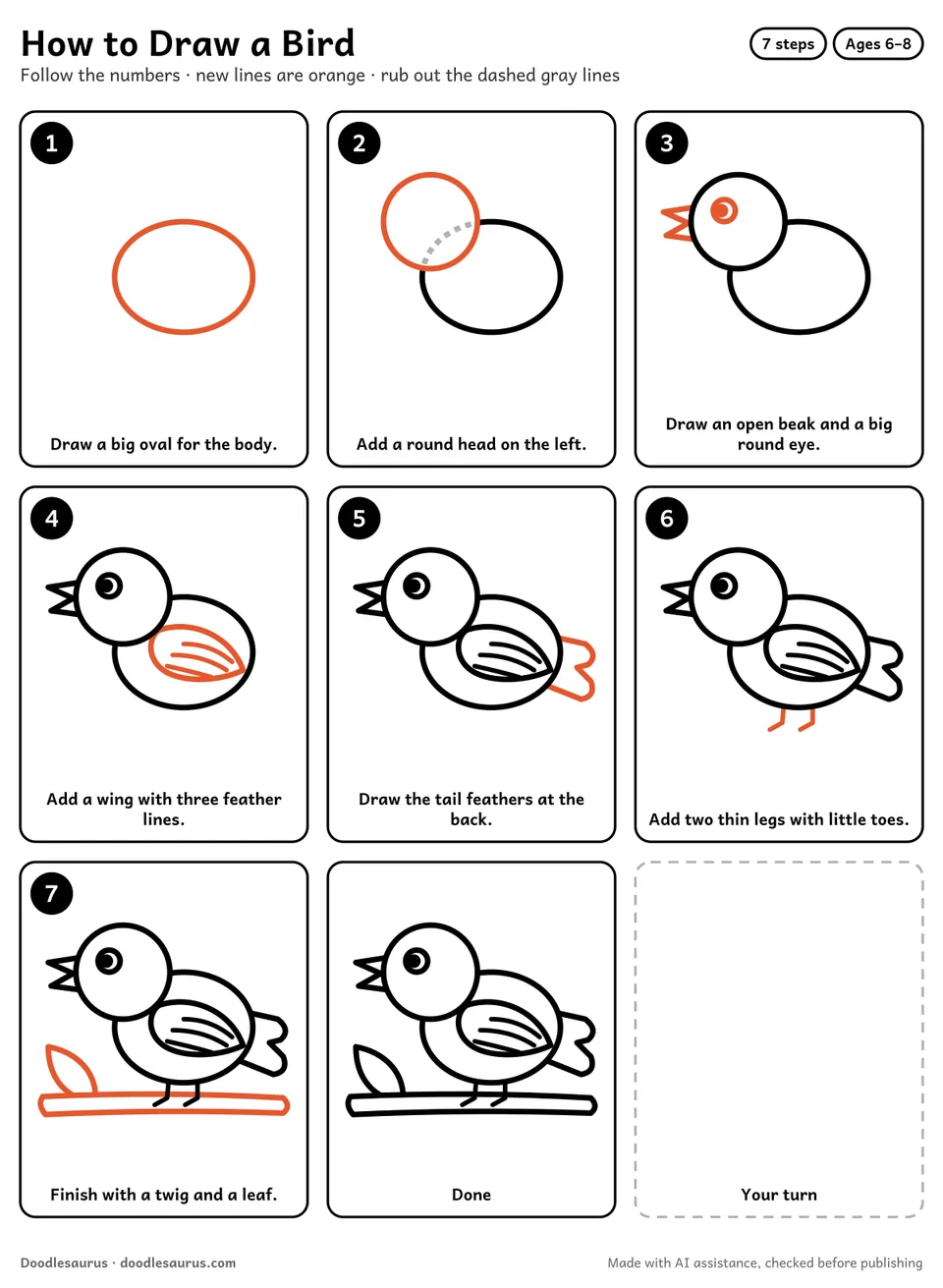
More tracing
Frequently asked questions
What happens to the bird's 14 parts on the three small copies?
The medium sheet for ages 6 to 8 squeezes all 14 parts into three small birds under the large one, so the curves turn faster and each stroke has to stop on time. The easy sheet for ages 3 to 5 keeps to one large dashed bird in the middle of the page.
Why does every line start with an orange dot?
The dot shows where to put the pencil down. Starting there means your child traces each part in a set direction instead of jumping around the drawing.
Which lines are easiest to begin with?
The large head circle and the body oval, two long and smooth curves. The three short wing lines and the toes are better left until the hand is warmed up.
About this printable
- Made with AI assistance (vector drawing authored by a language model) and checked by automated tests and an AI reviewer.
- Checked by automated tests and an AI reviewer on 22 Oct 2026.
- Free for personal and single-classroom use. See the license. Read the license · How these are made · Report a problem.
- Vector PDF, 1 page, 186×254 mm art box — prints edge-safe on A4 and US Letter.
New printables, twice a month
Our newsletter starts soon, with new sheets twice a month and a free 10-page starter pack for every new reader.