Bunny Tracing Worksheets for Little Hands
Trace a sitting bunny with tall ears and a fluffy tail: bunny tracing worksheets with one big bunny for ages 3 to 5 and four on medium. A4 or US Letter.
Choose a level
Sitting Bunny Tracing Worksheet
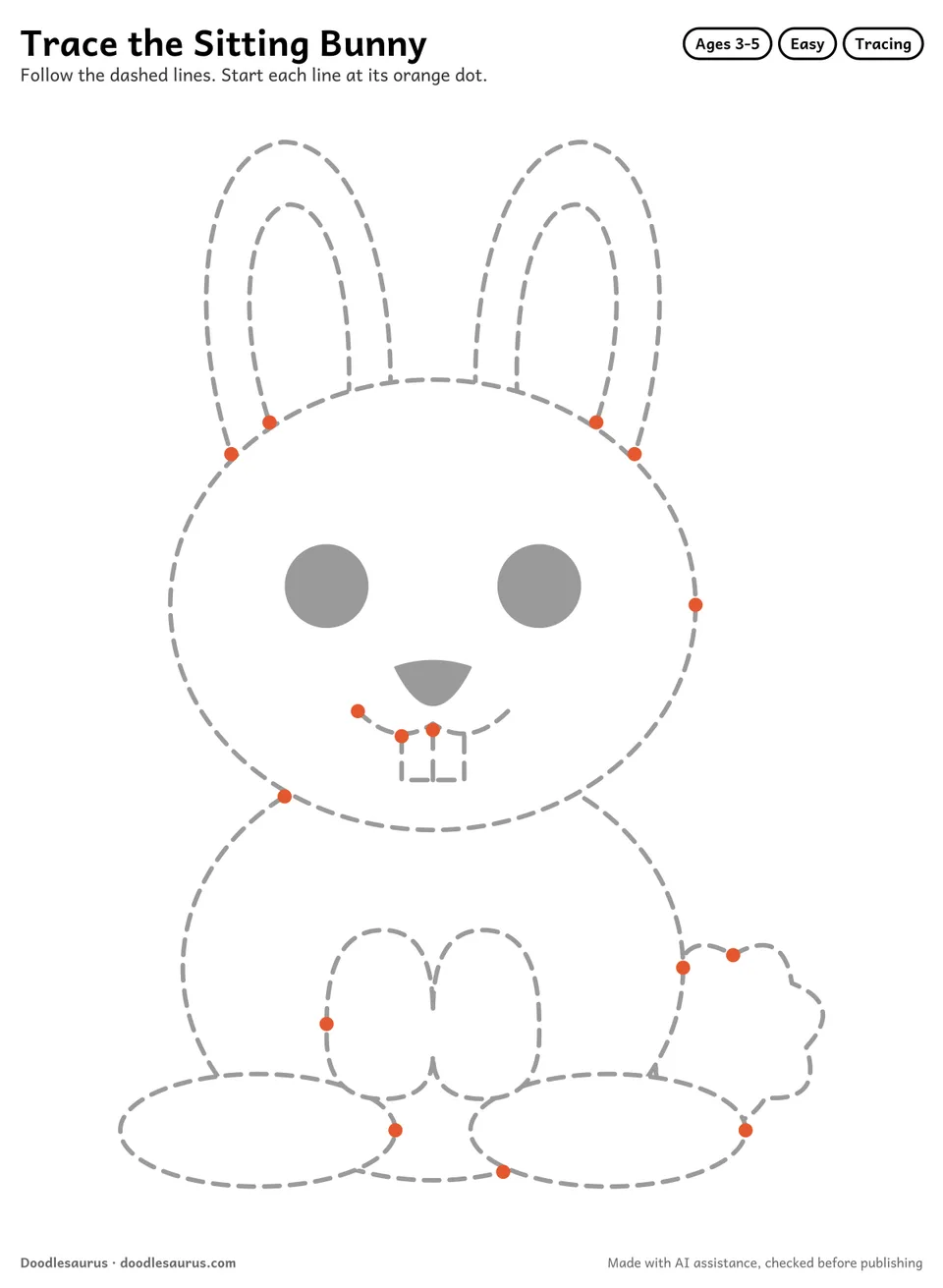
Long, smooth strokes make up most of this sitting bunny, from the two tall ears down to the oval feet. Each dashed gray line has an orange dot where the pencil should land, and the eyes and nose are printed as solid gray shapes, so the face looks friendly from the start.
Easy: one large bunny
A single big bunny takes the whole easy page for ages 3 to 5: tall ears, a wide oval head, a round body, two front paws, two broad feet and a fluffy tail on the right. Only the smile and the teeth are small. A preschooler can take the long curves slowly with a crayon.
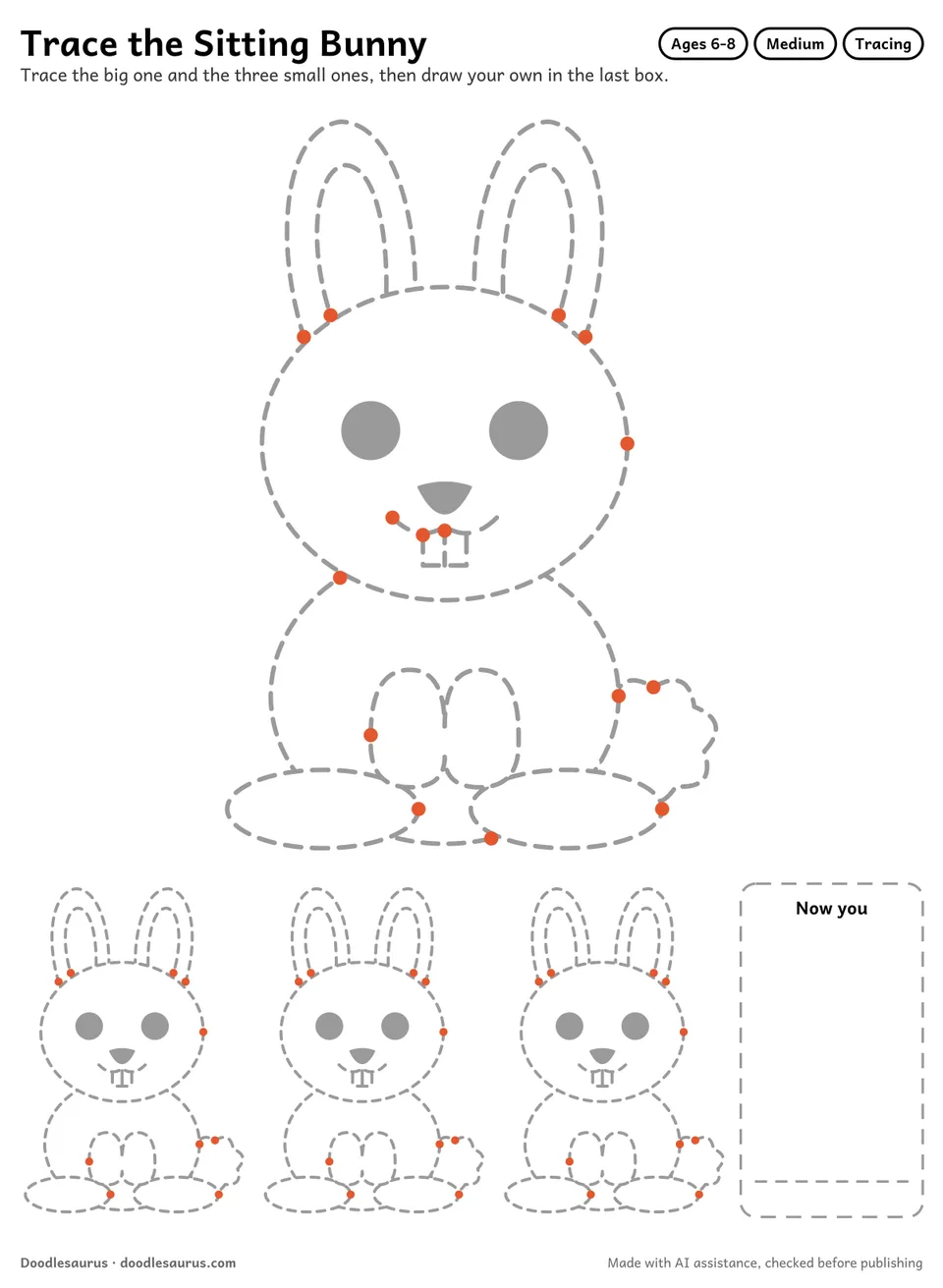
Medium: four bunnies and a blank box
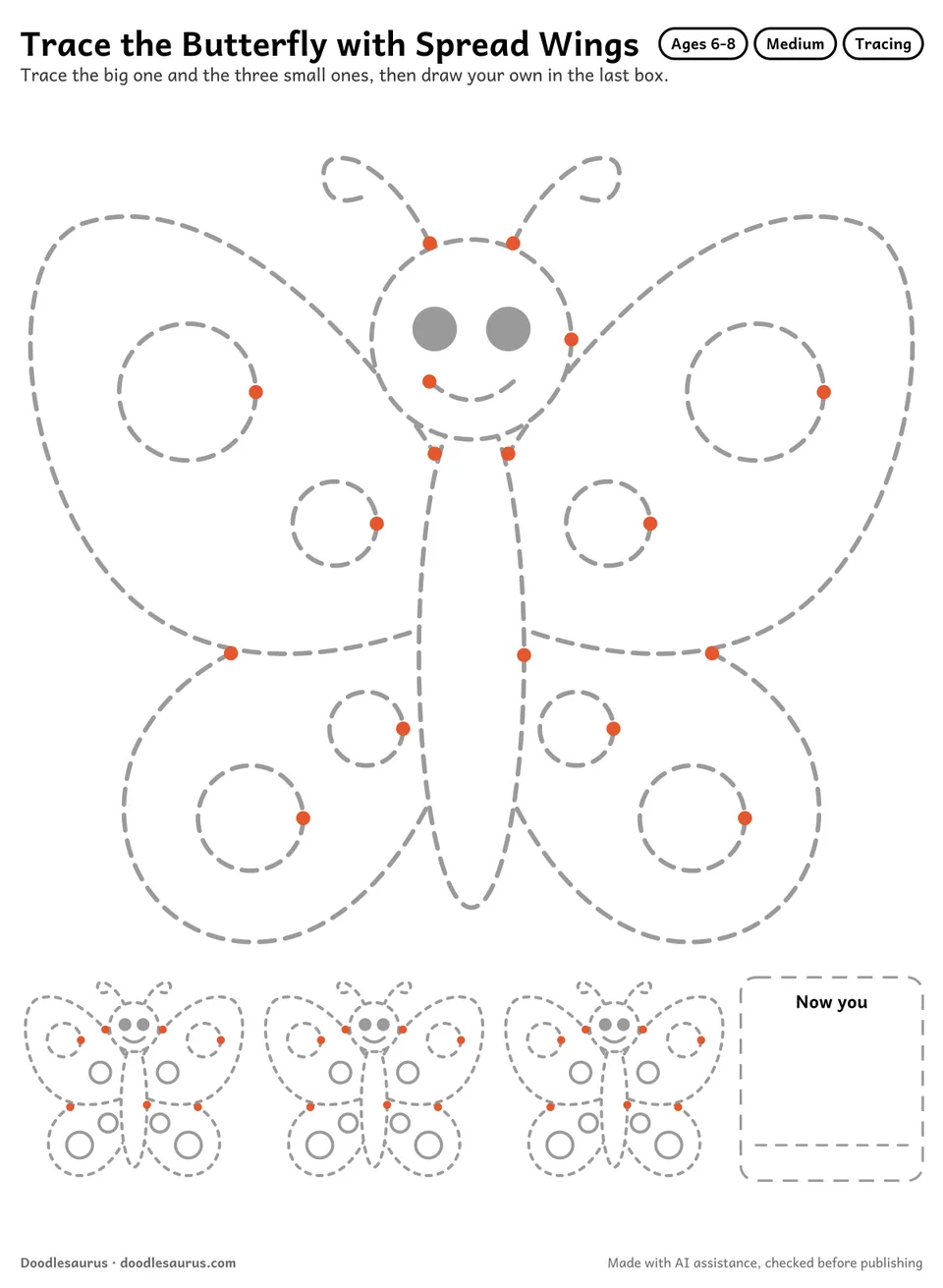
The medium page, for ages 6 to 8, puts a large dashed bunny at the top and three small ones along the bottom. A box marked Now you ends the row, left empty for a first try without lines. The ears turn narrow on the small bunnies. The feet sit close together, so the pencil has to turn and stop more often. Check that the print dialog says 100 percent before the A4 or Letter PDF goes out, since the small bunnies get hard to follow when the page shrinks.
Skills practiced & tips
- Point to an orange dot and trace the first stroke together with your finger.
- Start with the long, easy lines of the ears and head before the small teeth.
- Give a thick crayon for the big bunny and a sharp pencil for the three small ones.
- Turn the paper if a curve feels awkward, such as the underside of the feet.
- Let your child color the bunny once every dashed line is covered.
Bunny fun facts
- A rabbit's nose twitches many times a minute, which helps it pick up scents.
- Strong back legs let a rabbit cover a long distance in a single hop.
- Wild rabbits live in groups and dig networks of underground tunnels called warrens.
Classroom ideas
- Preschool (ages 3 to 5): slip the easy page into a plastic sleeve and trace it with dry-erase markers during center time.
- Kindergarten: trace the big bunny one day and the three small bunnies the next, then try the Now you box.
- Grade 1: after tracing, children write a name for their bunny in the Now you box and a sentence about it underneath.
More bunny activities
More tracing
Frequently asked questions
Will the little teeth give a young child trouble on the easy bunny?
On the easy page for ages 3 to 5 the smile and the two front teeth are the only small shapes. Everything else is a long curve, from the two tall ears to the oval head and the round body, so a preschooler can go slowly with a crayon.
Why are the eyes and nose already filled in?
The gray eyes and nose are printed solid so the bunny has a face before tracing begins. That helps a young child see what they are drawing and keeps the small shapes from becoming fiddly.
Which lines are trickiest on the small bunnies?
The ears, which turn narrow, and the feet, which sit close together, so the pencil has to turn and stop often. Turning the paper helps with the curve under the feet.
About this printable
- Made with AI assistance (vector drawing authored by a language model) and checked by automated tests and an AI reviewer.
- Checked by automated tests and an AI reviewer on 22 Oct 2026.
- Free for personal and single-classroom use. See the license. Read the license · How these are made · Report a problem.
- Vector PDF, 1 page, 186×254 mm art box — prints edge-safe on A4 and US Letter.
New printables, twice a month
Our newsletter starts soon, with new sheets twice a month and a free 10-page starter pack for every new reader.