
Cat Tracing Worksheets with Whiskers and a Curled Tail
One sitting cat, two levels: cat tracing worksheets with a big dashed cat for ages 3 to 5 and three small ones for 6 to 8. A4 or US Letter.
Choose a level
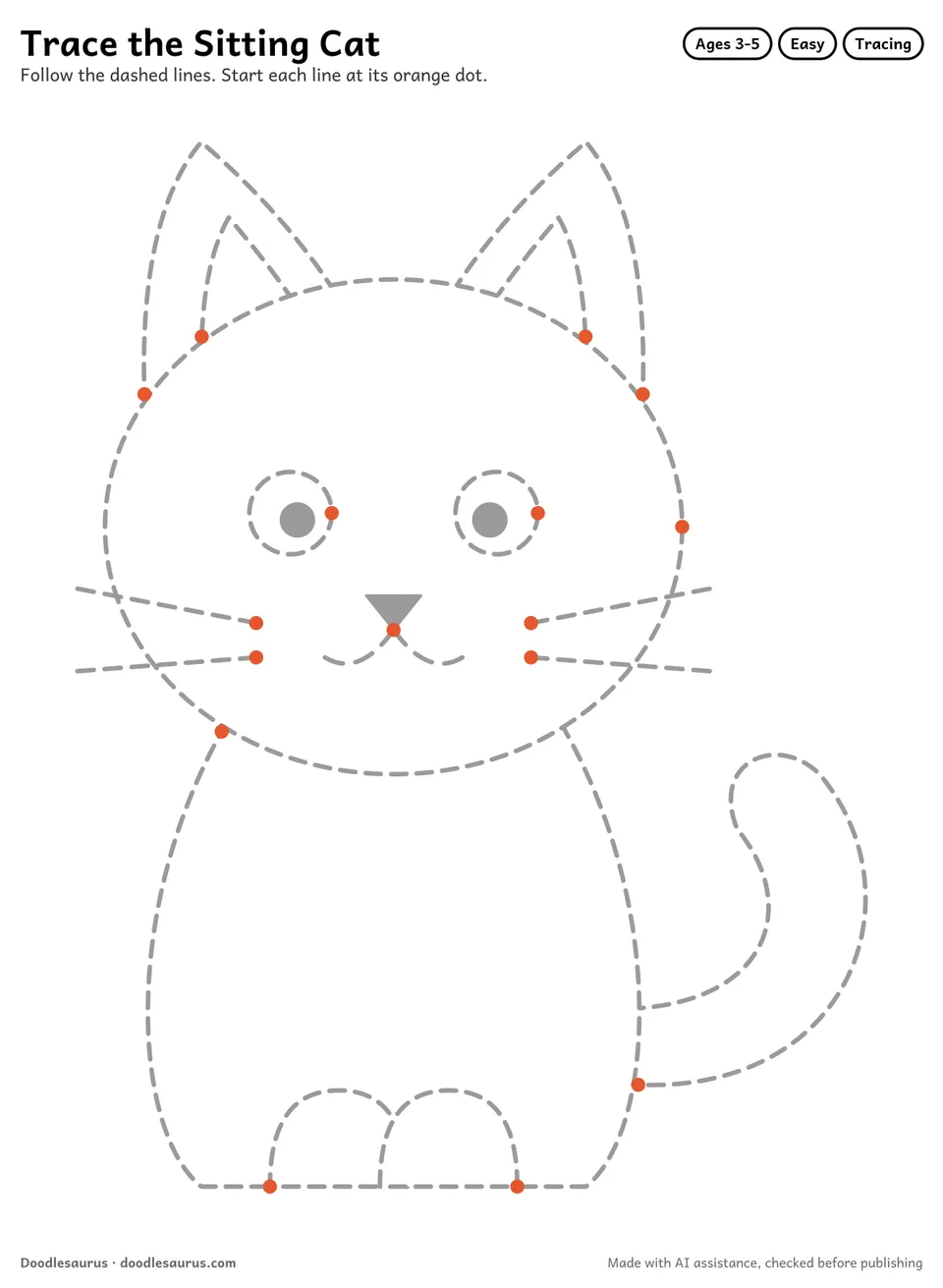
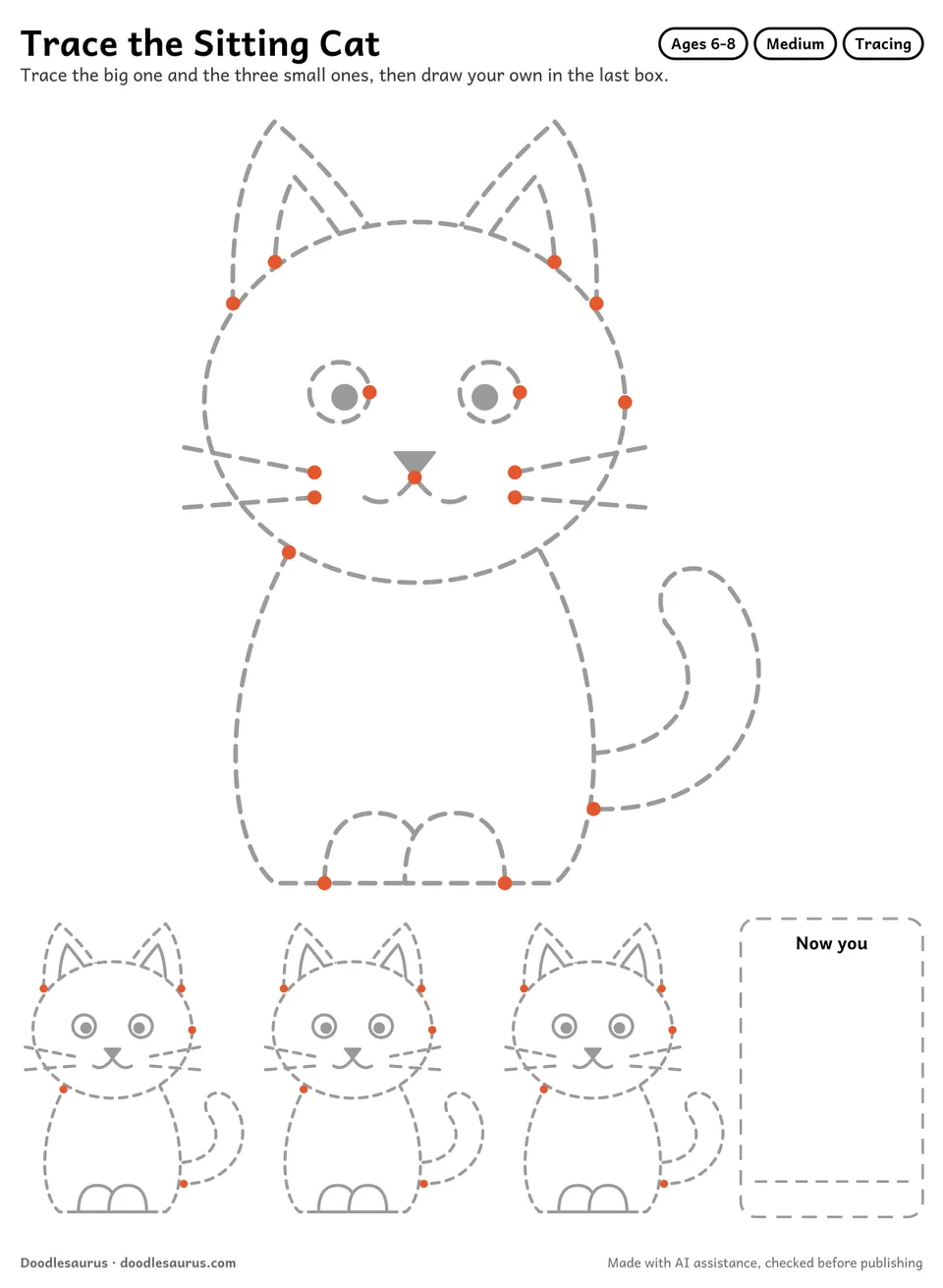
Sitting Cat Tracing Worksheet
A sitting cat with its tail curling up beside it fills the picture, drawn in dashed gray lines for a pencil or crayon to go over. Each stroke begins at an orange dot, so it is always clear where to put the pencil down and which way to travel. The pupils and the triangle nose come filled in gray, and the face is recognizable before any tracing starts.
Easy: one big cat
Long, gently curved lines make up the large cat on the easy sheet for ages 3 to 5: a round head, two tall ears with smaller lines inside, a rounded body and two front paws. Short whiskers break up the curves. On shapes this big, a child can practice keeping the pencil on a line and steering slowly around a bend.
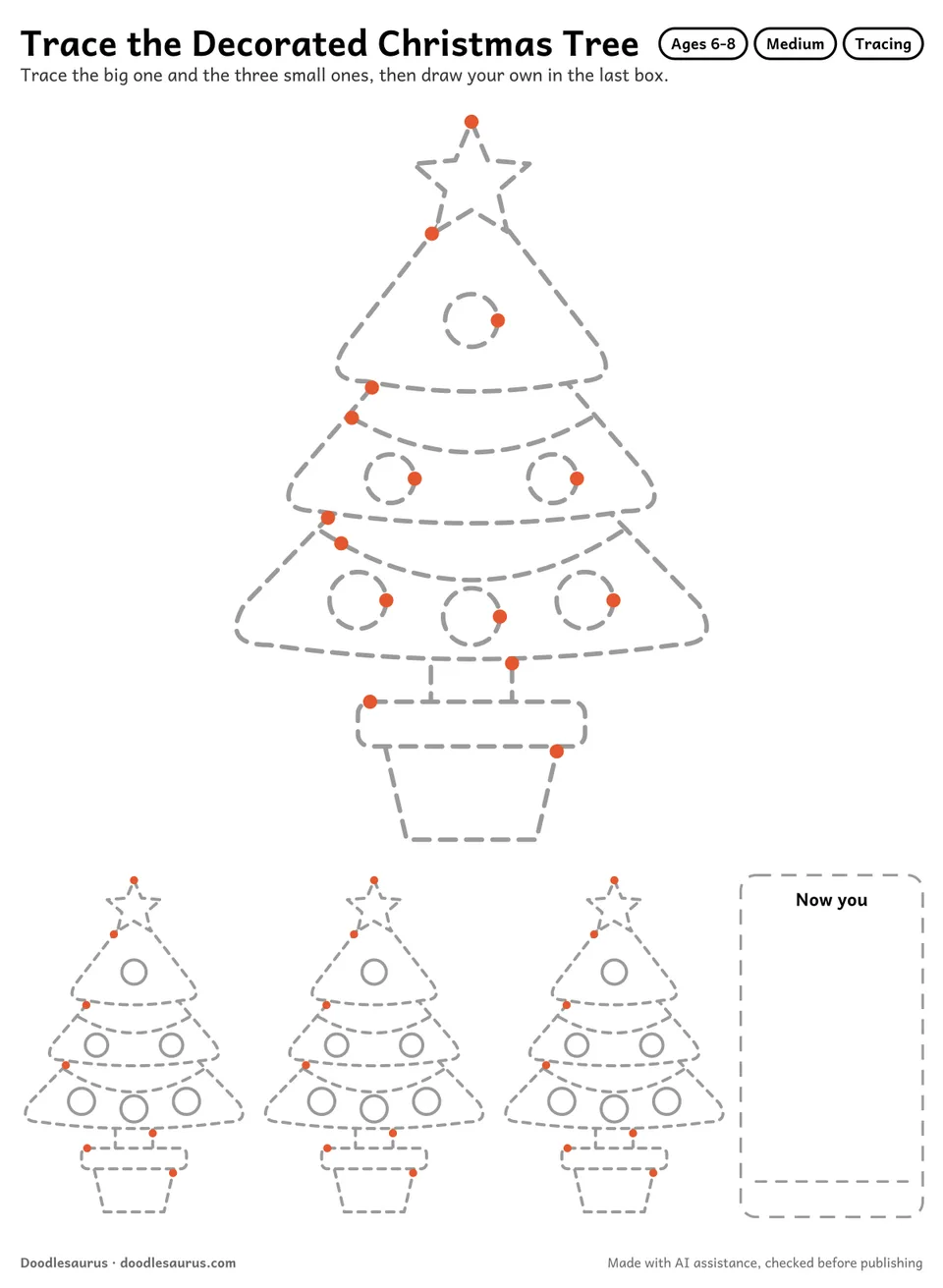
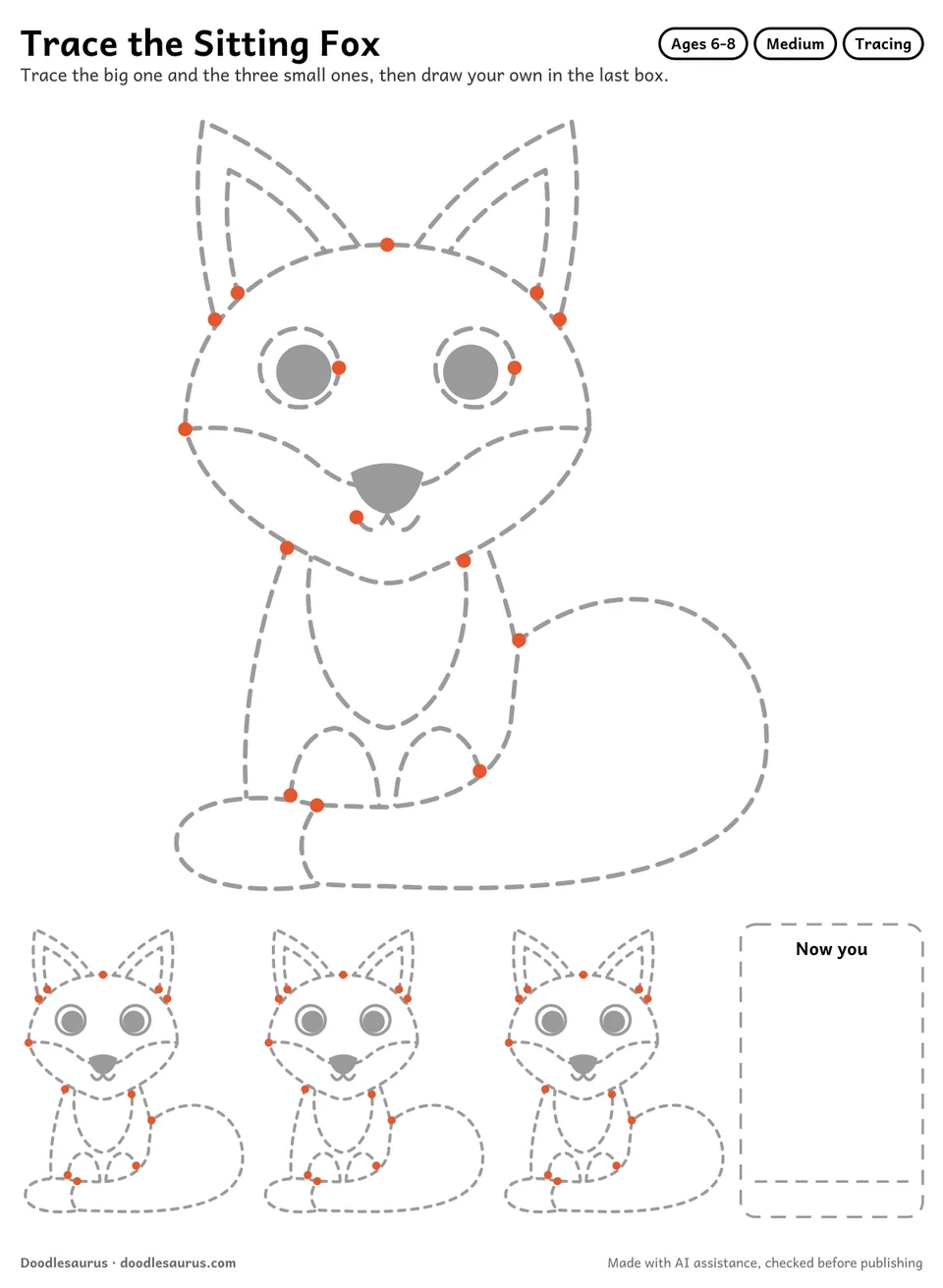
Medium: three small cats and a free box
Under the large cat on the medium sheet for ages 6 to 8 sit three smaller copies of the same drawing. The curves get tighter. Those dashes are spaced for a full page and get hard to follow when it is scaled down, so print the A4 or Letter PDF at 100 percent. At the end is an empty dashed box labeled Now you, for a cat drawn without guides.
Skills practiced & tips
- Show your child the orange dot and the direction of the dashes before each new line.
- Use a chunky pencil or wax crayon on the easy page and a sharpened pencil for the small cats.
- Trace the head and body first, then the ears, and leave whiskers and tail for last.
- Take a short break between the big cat and the three small ones.
- Praise a line that stays close to the dashes rather than one that is fast.
Cat fun facts
- A cat's nose has a pattern of ridges that is unique to that cat.
- Most cats have about 12 whiskers on each side of the muzzle, set in four rows.
- A cat can turn each ear on its own, pointing it toward a sound without moving the head.
Classroom ideas
- Preschool (ages 3 to 5): laminate the easy page and let children trace it with a dry-erase marker at a table center.
- Kindergarten: complete the medium page over two days, the big cat first and the small cats with the Now you box second.
- Grade 1: after tracing, students write one sentence about the cat inside or under the Now you box.
More cat activities
More tracing
Frequently asked questions
Why are the whiskers straight when the rest of the cat curves?
They are short straight strokes that break up the long curves of the head, ears and body. There are four of them, and they are best left for last along with the curled tail.
Do the three small cats copy the big one line for line?
They are the same drawing at a smaller size, so the lines are shorter and the curves tighter. The pencil turns more often and has to stop more precisely, and that is the step from the easy sheet for ages 3 to 5 to the medium sheet for ages 6 to 8.
Which parts of the cat should be traced first?
The head and the body, then the ears. The whiskers and the curled tail are best left for last, once the hand is steady.
About this printable
- Made with AI assistance (vector drawing authored by a language model) and checked by automated tests and an AI reviewer.
- Checked by automated tests and an AI reviewer on 22 Oct 2026.
- Free for personal and single-classroom use. See the license. Read the license · How these are made · Report a problem.
- Vector PDF, 1 page, 186×254 mm art box — prints edge-safe on A4 and US Letter.
New printables, twice a month
Our newsletter starts soon, with new sheets twice a month and a free 10-page starter pack for every new reader.