
Whale Tracing Worksheets with a Spout and a Tail Fluke
Whale tracing pages with a spouting whale, three looped spout drops and a two-pointed tail fluke. Easy and medium levels, in A4 or Letter size.
Choose a level
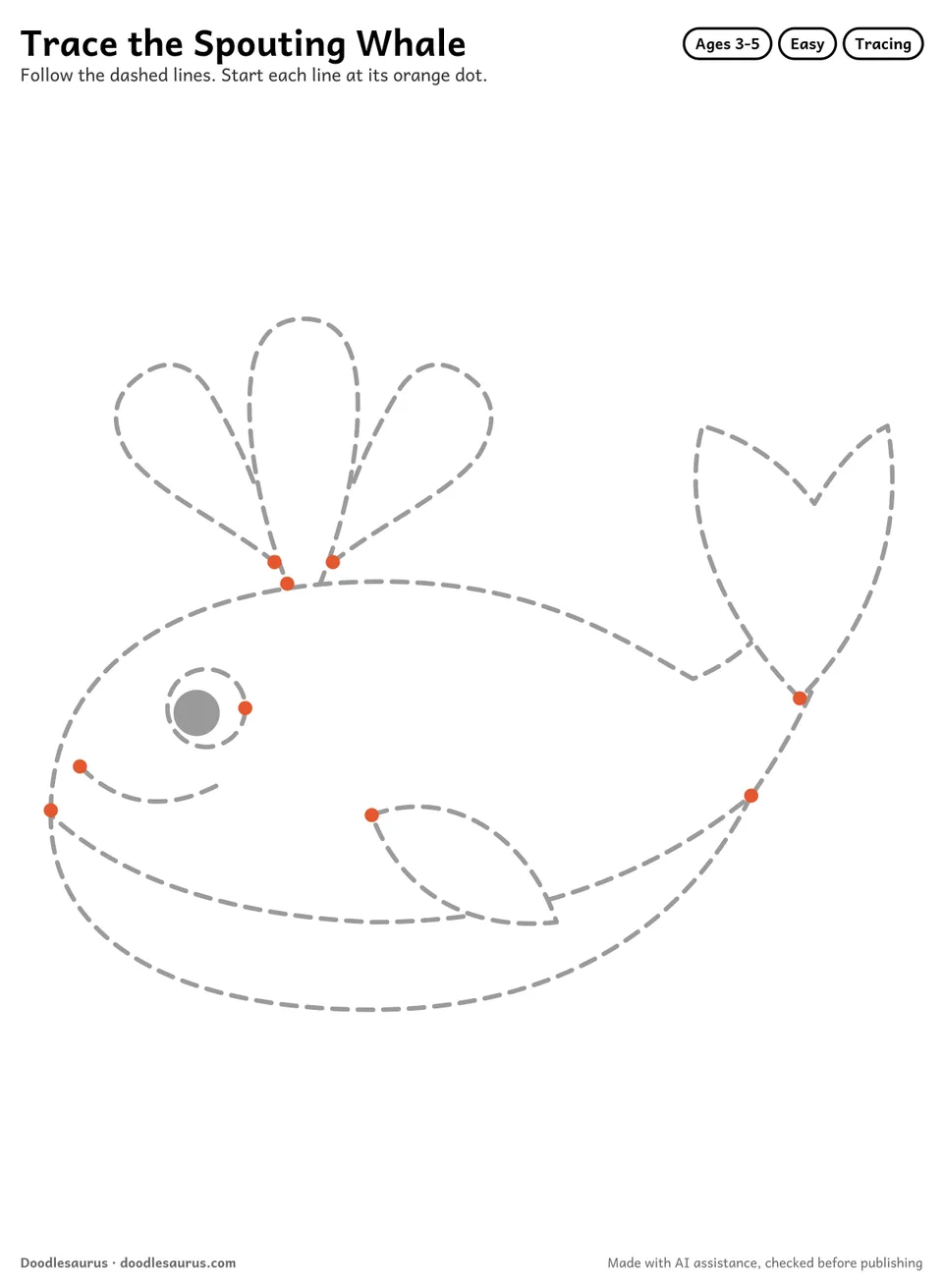
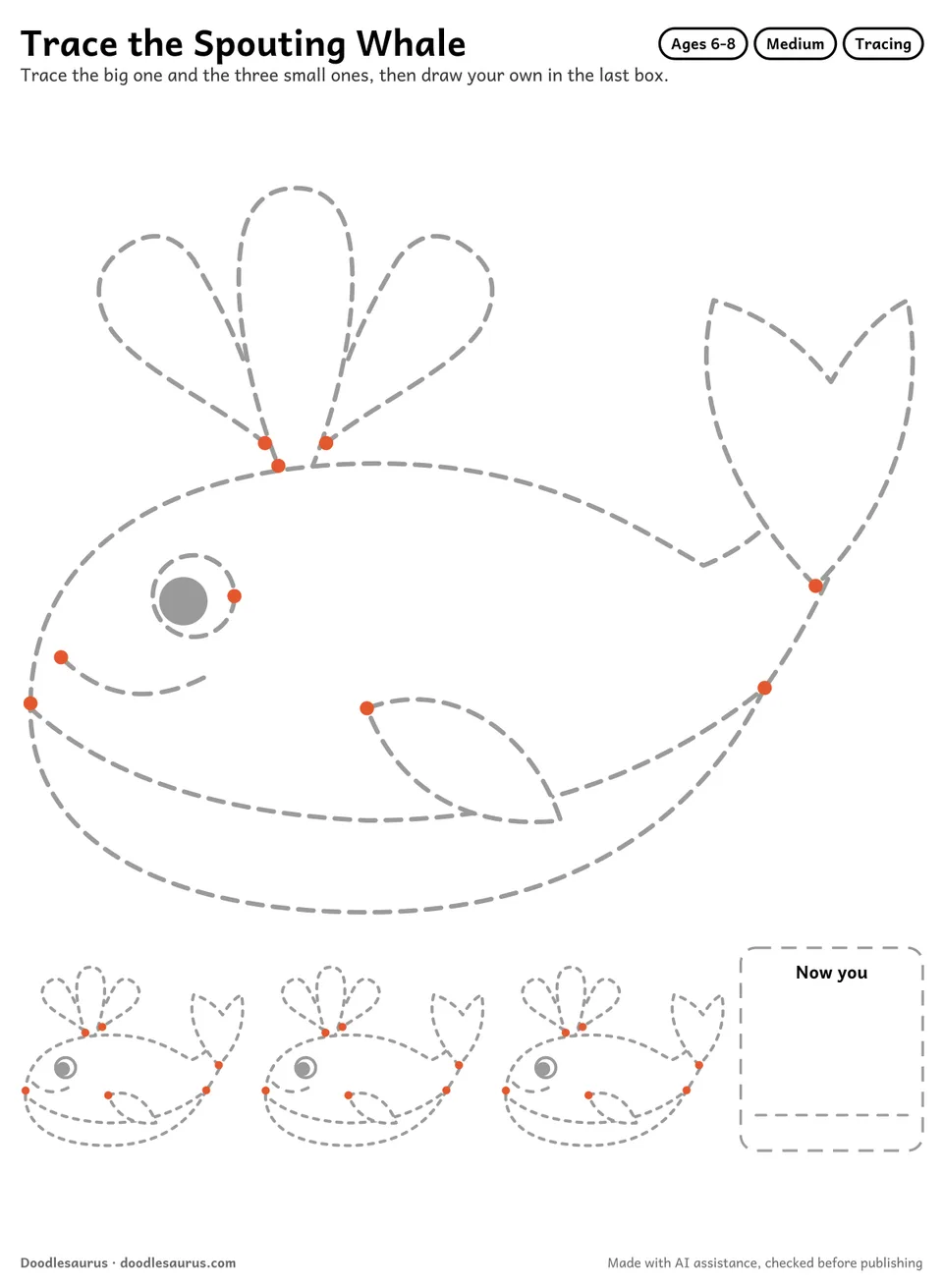
Spouting Whale Tracing Worksheet
Three looped drops of spout rise above this whale’s head, and each loop starts and ends at the head, which is good practice at closing a shape. Below them nearly every stroke is a long sweeping curve: the outline of the body, the band across the belly and the edge of the leaf-shaped flipper. The tail fluke has two sharp points and a dip.
The big whale has nine orange dots, three of them at the base of the spout drops. Its pupil is filled in gray.
Easy: one large whale
Ages 3 to 5 can work through the big whale on the easy sheet one part at a time, with thick crayons: the body outline first, then the belly band and the flipper. The line turns sharply at the tail tips.
Medium: three small whales and a drawing box
The spout drops and the tail shrink to a few dashes once the whale gets small. Lined up under the large whale on the medium sheet for ages 6 to 8, the three small whales also have an eye that is a thin solid circle with no dot. If the A4 or US Letter page is shrunk to fit, those few dashes get hard to trace, so set the scale to 100 percent instead. Beside them is an empty dashed box labeled Now you, for a whale drawn with no guide lines at all.
Skills practiced & tips
- Point to the orange dot before each stroke so your child knows where to begin.
- Trace the big body outline first, then the belly band and the flipper.
- Go around each spout drop in one smooth loop without lifting the pencil.
- Slow down at the two tips of the tail, where the line turns sharply.
- Slide the sheet into a plastic sleeve and use a dry-erase marker for repeat practice.
Whale fun facts
- Baleen whales have two blowholes side by side, while toothed whales such as dolphins have only one.
- Whale calves drink milk from their mothers, just like other mammals.
- Humpback whales sing long, repeating songs that can carry for many kilometers underwater.
Classroom ideas
- Preschool (ages 3 to 5): use the easy whale at a fine motor table with thick crayons, tracing one part at a time.
- Kindergarten: trace the large whale on day one, then the small whales and the Now you box on day two.
- Grade 1: after drawing in the Now you box, students label the tail, flipper and spout with short words.
More whale activities
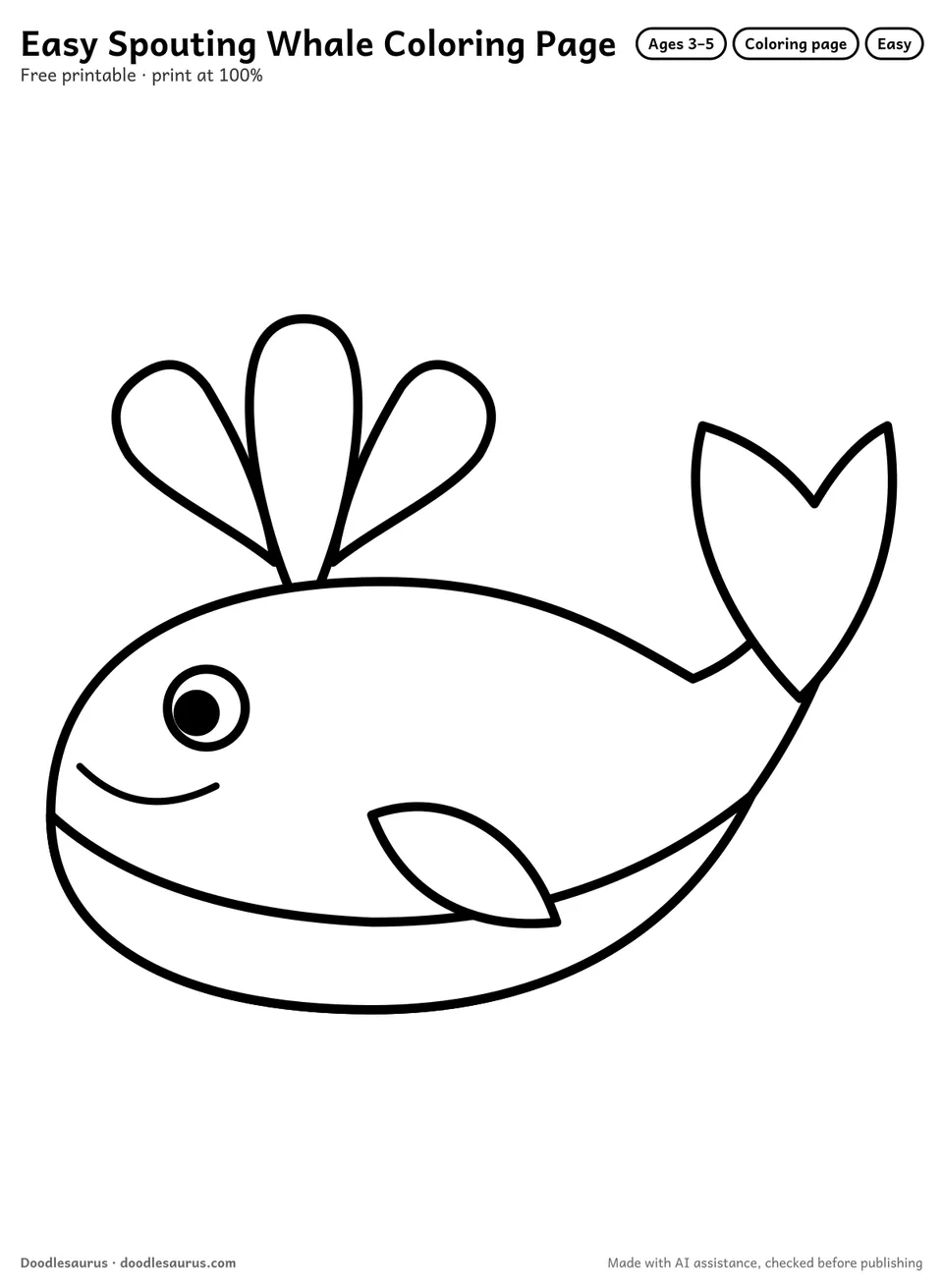
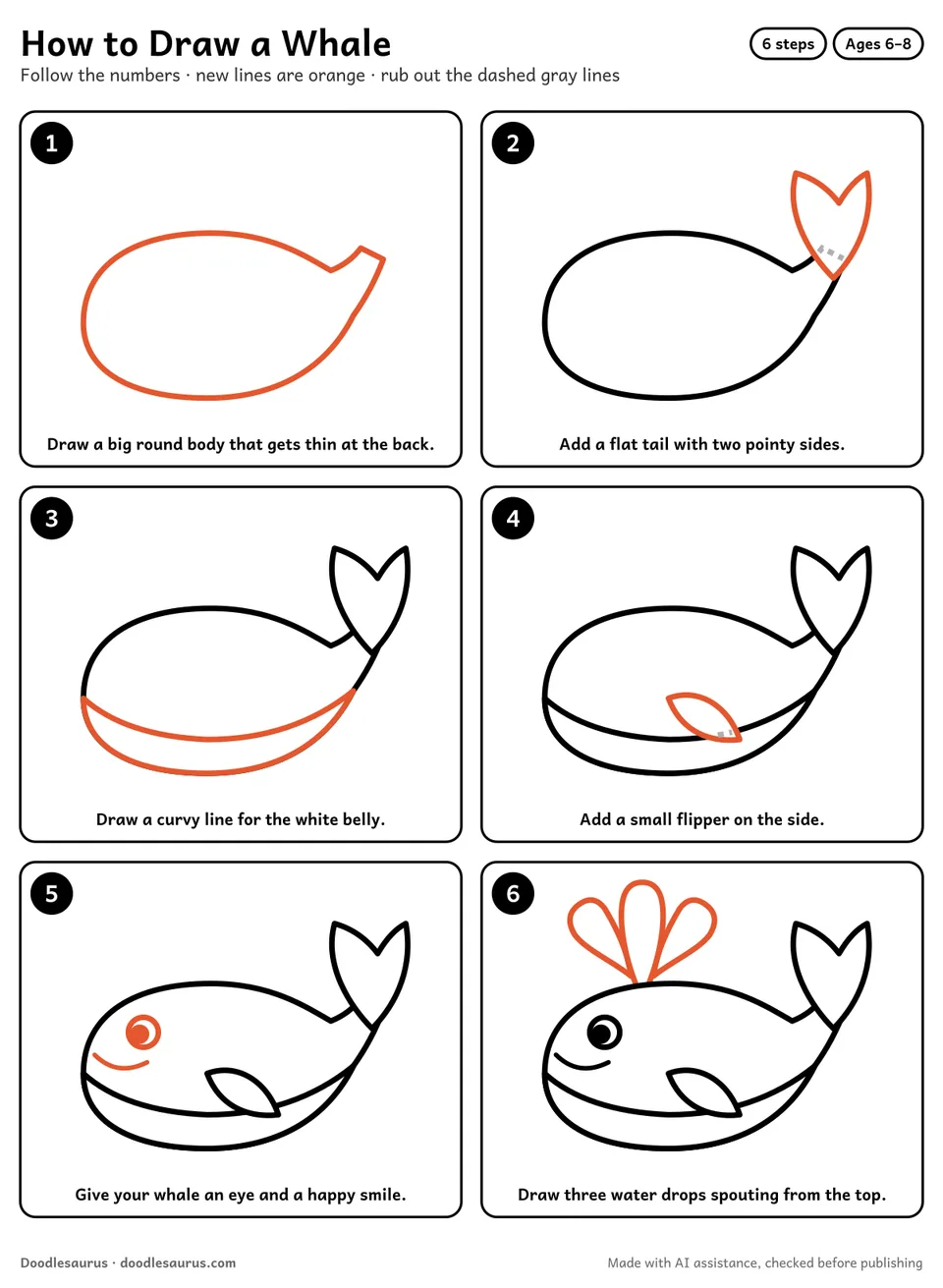
More tracing
Frequently asked questions
Do the spout drops each need their own orange dot?
Yes. Three of the big whale's nine dots sit at the base of the spout drops, and the other six are on the eye, the smile, the front of the body, the flipper, the belly band and the tail.
What should the pencil do at the two tips of the tail?
Slow down. The tail fluke adds two sharp points and a dip, so the line turns sharply at each tip.
Can the whale be used for repeat practice?
Yes. Slide the sheet into a plastic sleeve and trace it again and again with a dry-erase marker.
About this printable
- Made with AI assistance (vector drawing authored by a language model) and checked by automated tests and an AI reviewer.
- Checked by automated tests and an AI reviewer on 22 Oct 2026.
- Free for personal and single-classroom use. See the license. Read the license · How these are made · Report a problem.
- Vector PDF, 1 page, 186×254 mm art box — prints edge-safe on A4 and US Letter.
New printables, twice a month
Our newsletter starts soon, with new sheets twice a month and a free 10-page starter pack for every new reader.