Bunny Maze with Tall Ears and a Puffy Tail
Bunny maze printables in three levels: 88 wide cells for ages 3 to 5, 215 for ages 6 to 8 and 490 narrow cells for ages 9 to 12, each with an answer key.
Choose a level
Two ears and a tail to explore
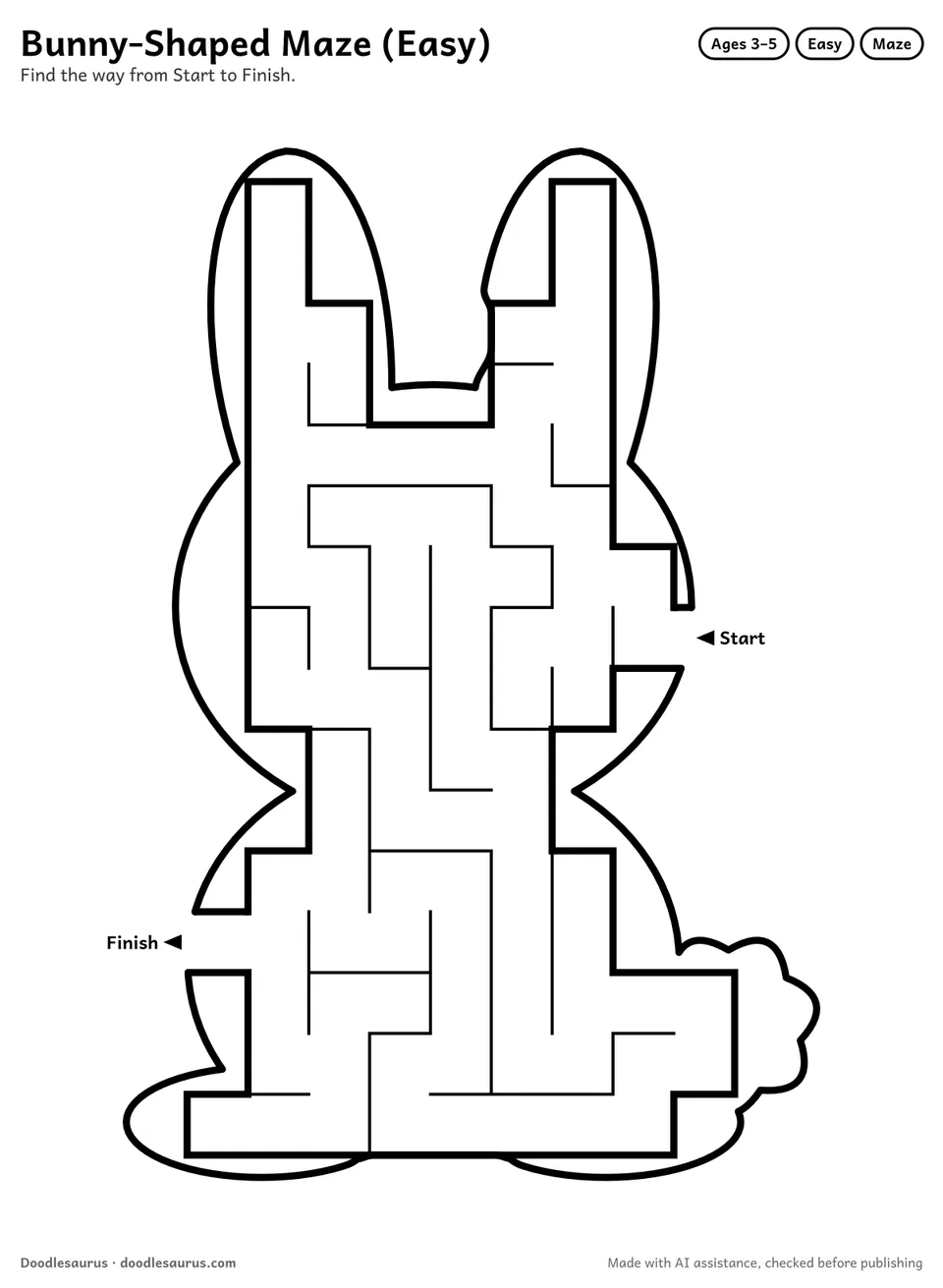
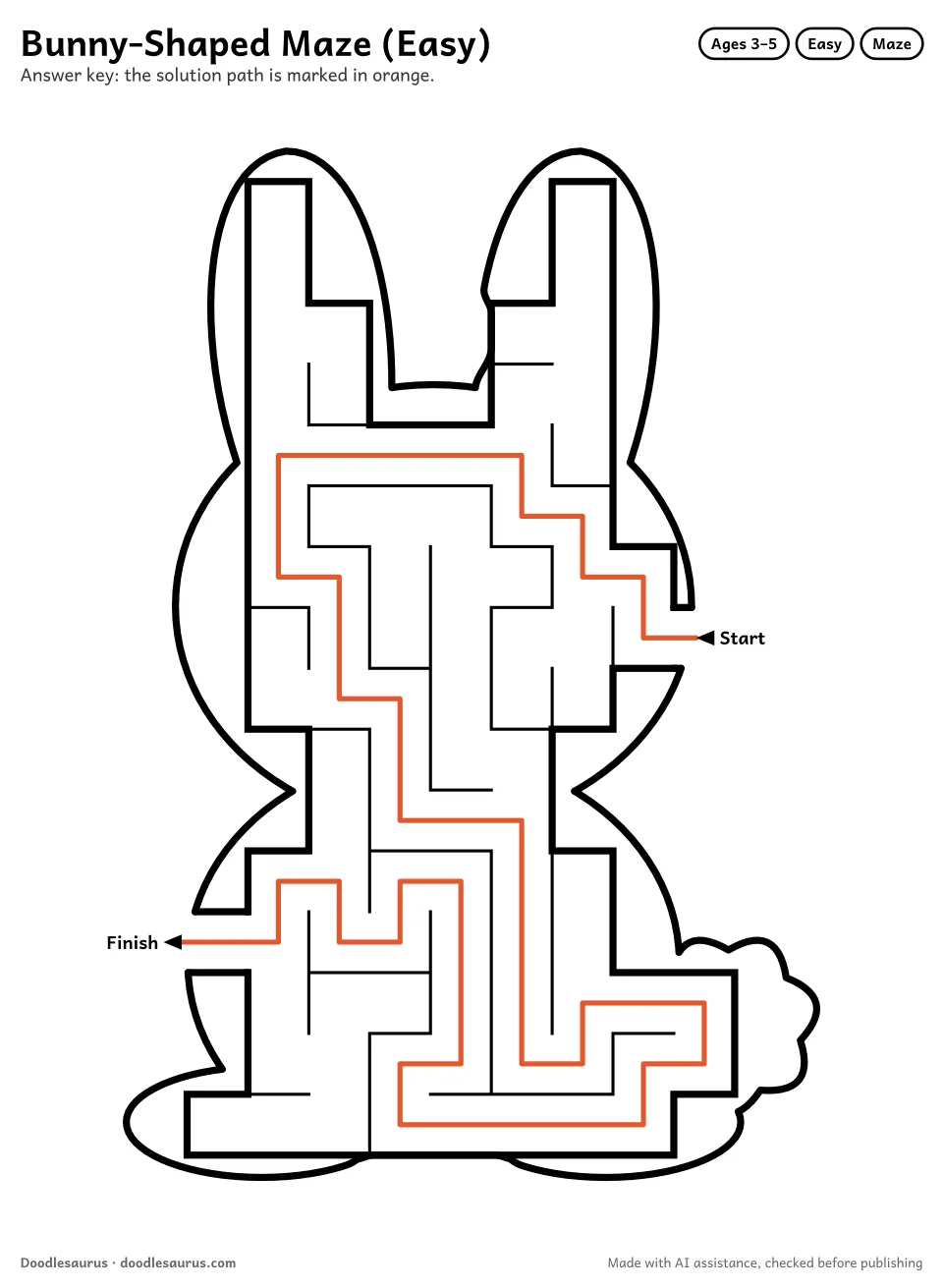
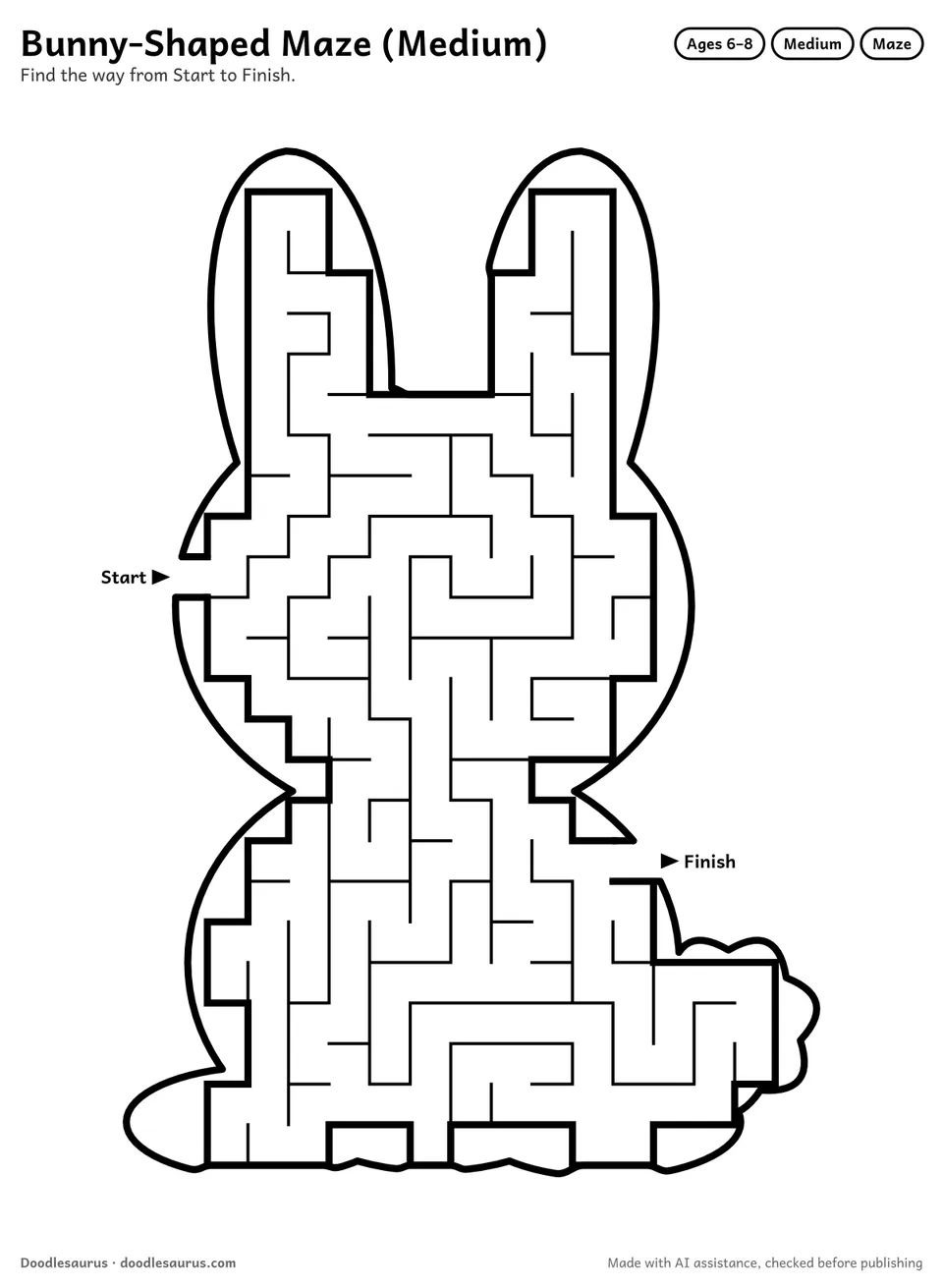
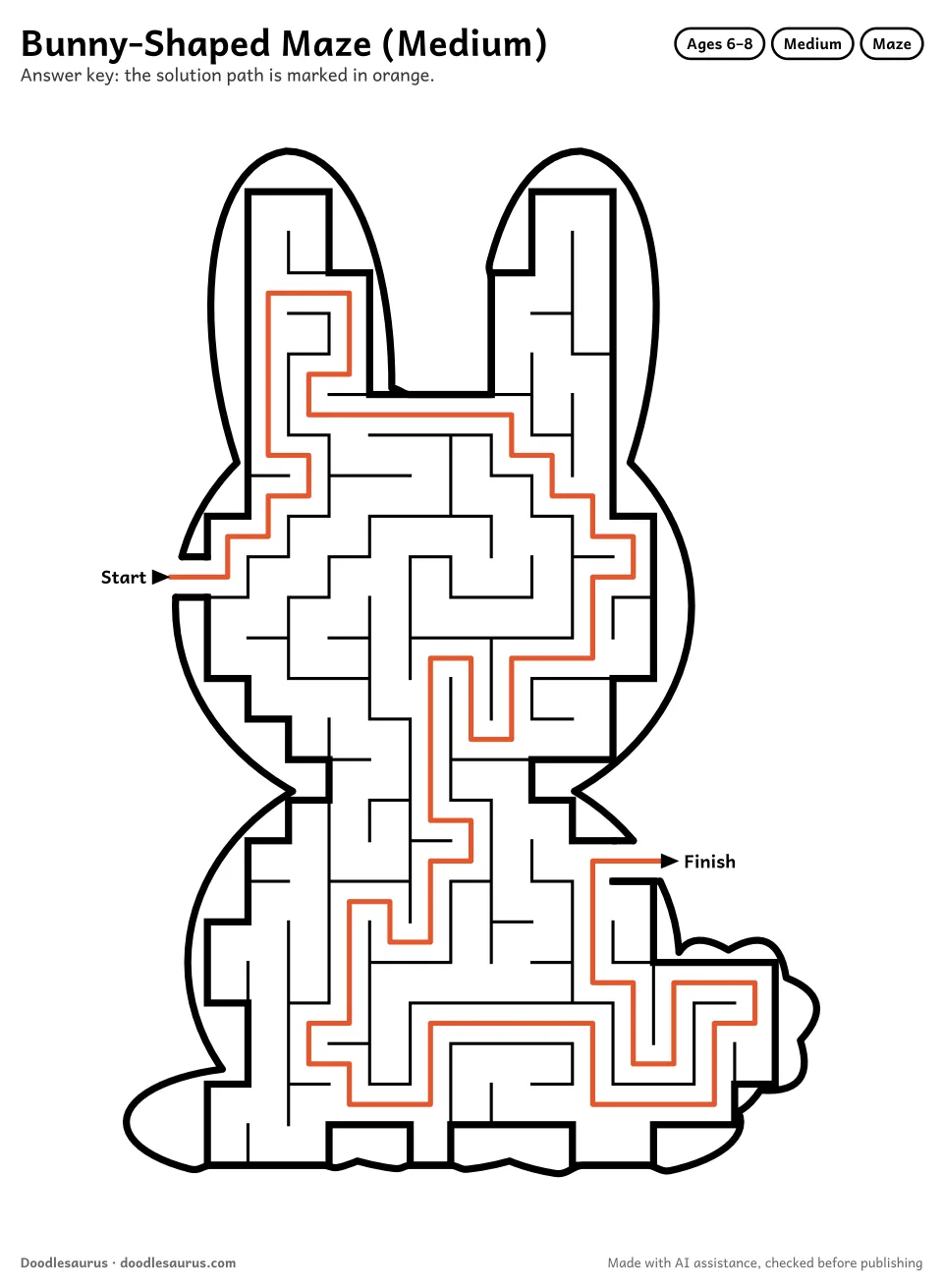
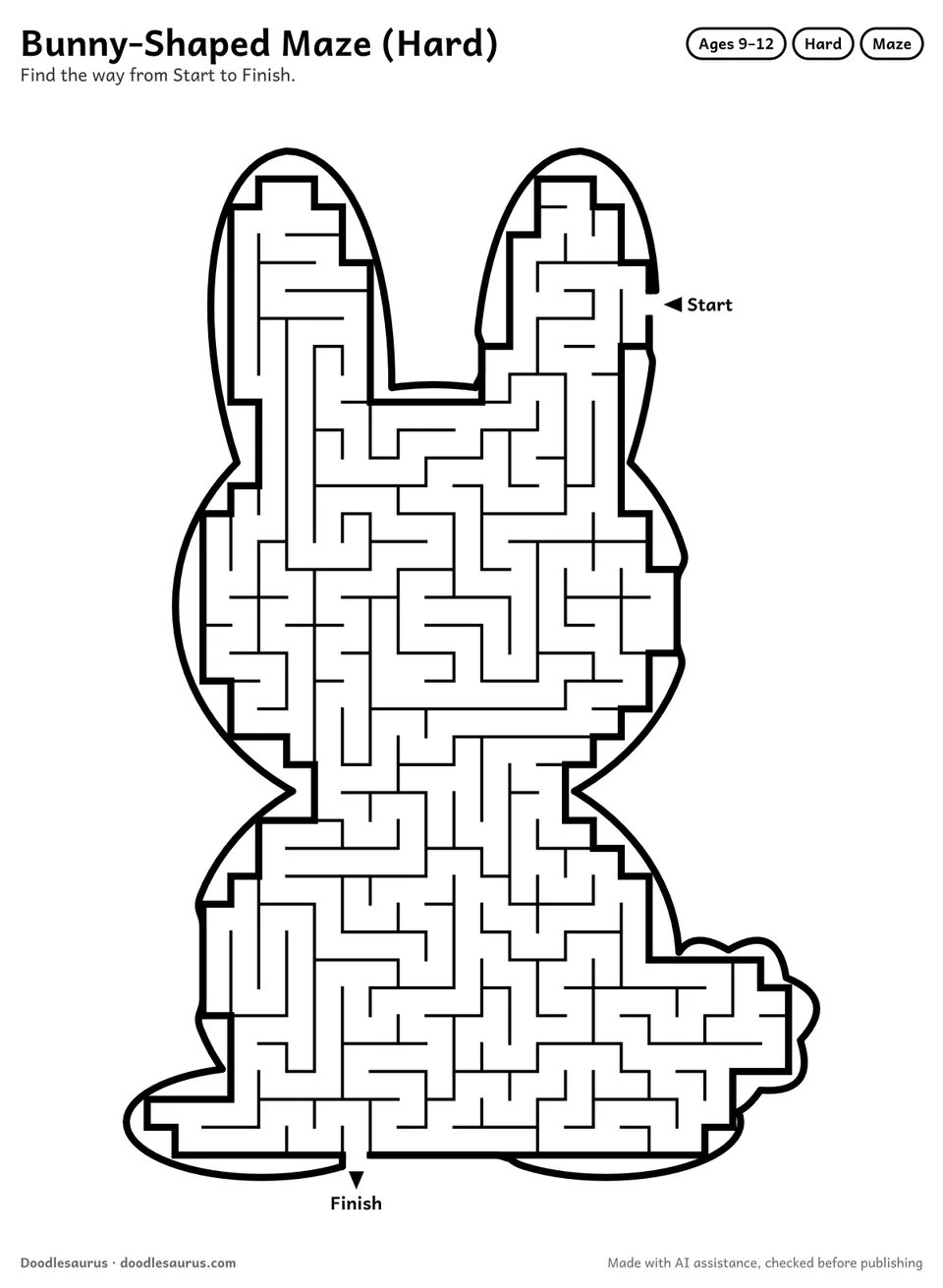
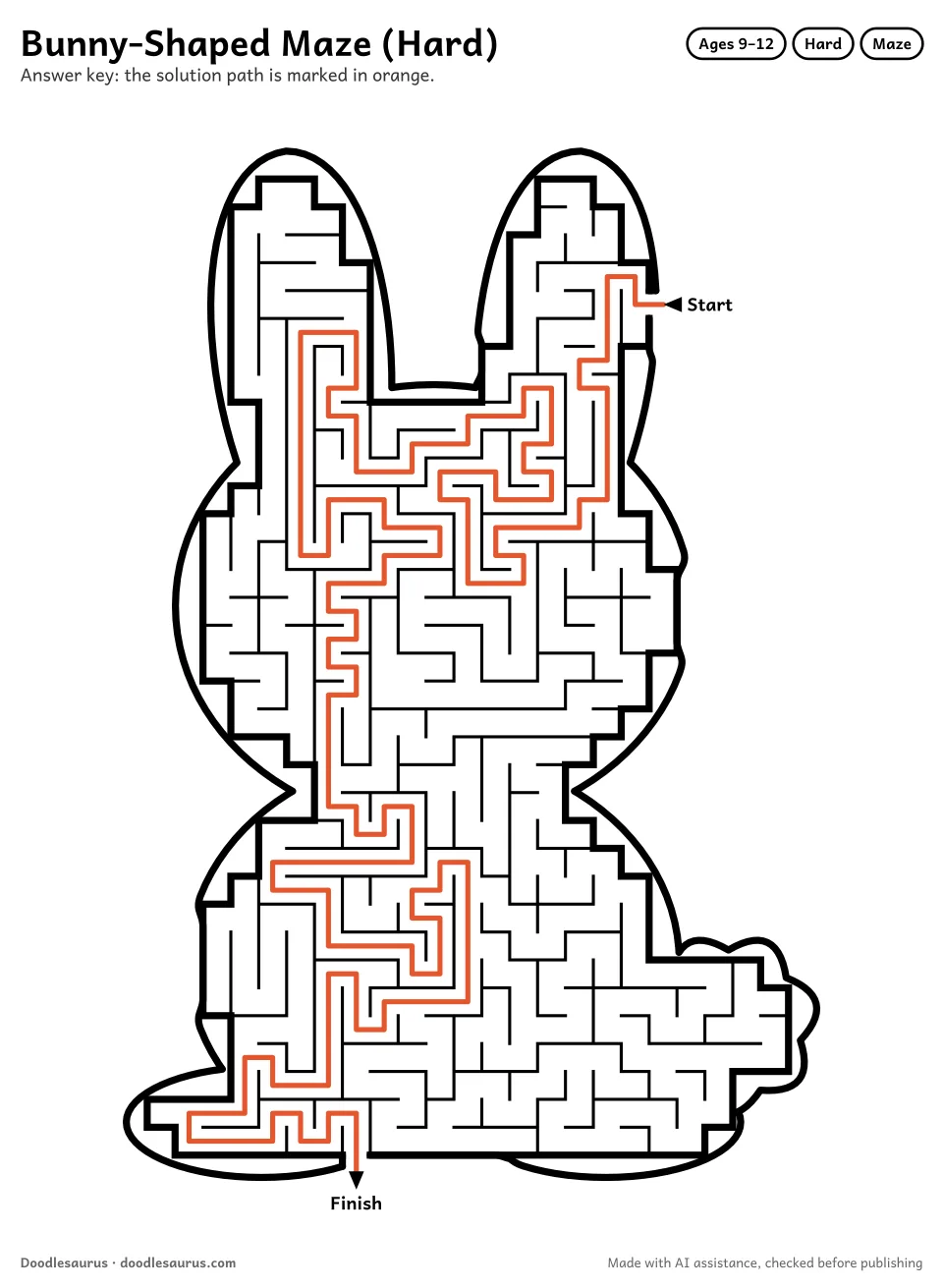
A sitting bunny gives the paths two long ears and a puffy tail to reach into, besides the oval head, the round body and the broad feet. On this bunny maze the outer walls follow those curves in small square steps. Two arrows outside the outline mark where to go in and where to come out, and the second page of every PDF shows the answer in orange.
Easy, medium and hard
The easy bunny is small, with only 88 cells, each 12 mm across, for ages 3 to 5. Its 46-cell route enters at the right side of the head, crosses the head, runs down through the body and finishes on the lower left side, just above the feet.
Ages 6 to 8 move up to 215 cells of 8 mm on the medium bunny. It begins beside the left side of the head, and the 87-cell route climbs into the left ear, crosses the head to its right side, drops through the middle of the body and swings along the bottom into the tail before it ends on the right side of the body, just above the tail.
On the hard bunny, 490 narrow cells of 5.5 mm fill the same outline, for ages 9 to 12. Its 157-cell route starts at the outer edge of the right ear, winds across the head and down through the belly, and finishes at the bottom edge, at the inner end of the left foot. Corridors that thin lose too much if the printer shrinks the page, so switch fit to page off and send the A4 or US Letter file at 100 percent.
Spring units and waiting rooms
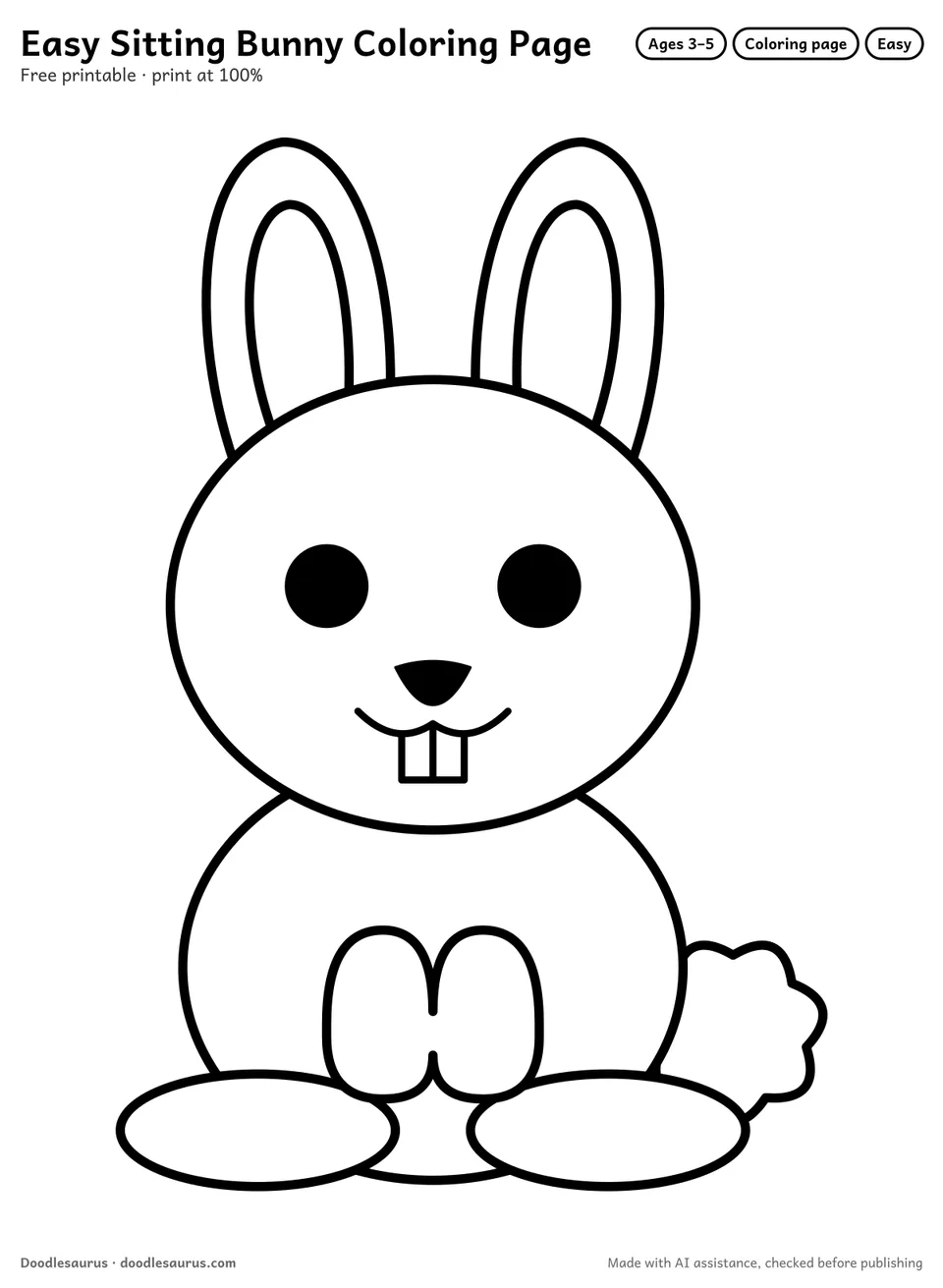
It fits into a spring unit, a waiting room or a quiet start in class. Many children color the bunny afterward, brown, gray or white.
Skills practiced & tips
- Look for the Start and Finish arrows first, because they move from level to level.
- Run a finger along the route before using a pencil.
- If the line gets stuck, go back to the last fork instead of starting over.
- Switch crayon colors for a second try so the two routes are easy to compare.
- When the path is done, color the bunny brown, gray or white around it.
Bunny fun facts
- Wild rabbits dig tunnel systems called warrens, with several entrances and connected chambers.
- Rabbits zigzag when they run from a predator, which makes them harder to catch.
- A rabbit's eyes sit high on the sides of its head, giving it a very wide field of view.
Classroom ideas
- Pre-K (ages 3 to 5): use the easy bunny for pencil control, first with a finger and then with a chunky crayon.
- Grade 1: compare the bunny maze to a rabbit warren and talk about why animals build tunnels with more than one exit.
- Grades 4 to 6: chart the three route lengths, 46, 87 and 157 cells, and work out how much longer each level is than the last.
- Year 3 (UK): pupils write turn-by-turn directions for the easy route and swap them with a partner to test.
More bunny activities
More mazes
Frequently asked questions
How large are the corridors on each bunny maze?
The easy bunny has 88 cells that are 12 mm wide, with a route through 46 of them. The medium bunny has 215 cells of 8 mm and an 87-cell route, and the hard bunny has 490 cells of 5.5 mm with a route of 157 cells.
Which level finishes at the bunny's feet?
Only the hard one. Its 157-cell route ends at the bottom edge, at the inner end of the left foot. The easy route stops on the lower left side of the body, just above the feet, and the medium route ends on the right side of the body, just above the tail.
Does the maze reach into the ears and the tail?
The puffy tail is part of the maze, and the medium route swings along the bottom into it after climbing into the left ear. The hard route starts at the outer edge of the right ear.
Does each maze come with an answer?
Yes. Page two of every PDF is an answer key with the correct route drawn in orange.
About this printable
- Made with AI assistance (vector drawing authored by a language model) and checked by automated tests and an AI reviewer.
- Checked by automated tests and an AI reviewer on 22 Oct 2026.
- Free for personal and single-classroom use. See the license. Read the license · How these are made · Report a problem.
- Vector PDF, 2 pages, 186×254 mm art box — prints edge-safe on A4 and US Letter.
New printables, twice a month
Our newsletter starts soon, with new sheets twice a month and a free 10-page starter pack for every new reader.